Reported by Boyi Ma (Duke University, Class of 2026)
On September 12–13, 2025 — Duke Kunshan University’s Humanities Research Center hosted Flora and Feminists: The Subversive Science of Botany, a symposium, exhibition, and workshop that brought together international scholars, students, and artists to explore the intersections of plants, gender, and knowledge. Over two days, the program blended lectures, hands-on sessions, and an exhibition that highlighted how plants shape histories of medicine, resistance, and ecological practice.
Friday Symposium

The symposium opened with Dr. Paul Alan Cox, whose lecture Polynesians Rely on Women’s Knowledge for Healing emphasized how women in Polynesian societies serve as knowledge keepers of medicinal plants. Cox illustrated the ways this expertise is passed down through families and remains essential to community health.
Next, Dr. Aunchalee Palmquist presented Of Birth and Bloom: Biocultural Perspectives on the Ethnobotany of Perinatal Transitions. Palmquist examined how plants support reproductive health through menstruation, pregnancy, and postpartum care. She also highlighted the subversive use of cotton root by enslaved African women in the antebellum U.S. to resist forced pregnancies, underscoring the political significance of plant knowledge.

In the afternoon, Dr. Robin Rodd delivered a critique of psychedelic medicine in Decolonial, Feminist and Anti-Capitalist Perspectives on the Rise of Psychedelic Medicine. He argued that psychedelic research often appropriates indigenous plants while embedding them in capitalist and military frameworks, and he raised concerns about gendered violence in unregulated psychedelic therapy spaces.
Dr. Renee Richer followed with Hand of Mary: Cultural and Corporal Use of Plants During Childbirth, exploring both symbolic and practical plant uses to ease labor and link birth to spiritual meaning.

The day continued with a bilingual presentation, Sowing Resilience: Indigenous Plant Knowledge and Ecological Feminist Practice in Rural China, by Dr. Liangliang Zhang, Yun Jiang, and Chengcheng Liu. Drawing on fieldwork, they described how practices such as permaculture and regenerative education in rural communities sustain ecological and feminist traditions.

Closing the symposium, Dr. Erin Wilkerson presented Feral Practices, an autoethnographic exploration that connected witch trials, women’s bodies, and more-than-human landscapes as sites of both oppression and resistance.
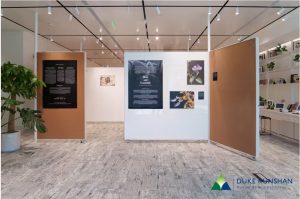
That evening, the exhibition opened in the DKU Library and Humanities Research Center, featuring botanical art, herbarium sheets, and archival materials that brought the themes of the symposium into visual and sensory form.
Saturday Workshops
Saturday shifted from theory to practice with three interactive workshops.
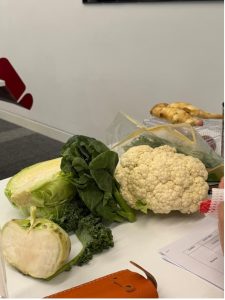
In Develop Your Plant Relationships, Dr. Richer introduced participants to plant structures using fresh vegetables and fruits. Attendees observed, smelled, and tasted samples to better understand how everyday food plants reveal their anatomy and functions.
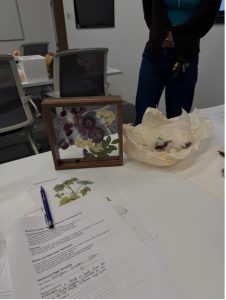
Dr. Palmquist led Herbaria for Herstories, where participants created personalized herbarium sheets. The session combined scientific documentation with storytelling, inviting participants to reflect on how plants intersect with their own experiences and cultural histories.
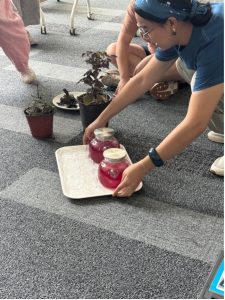
The final session, Sensing the Local, was led by Dr. Zhang, Jiang, and Liu as a bilingual exploration of plants native to the Shanghai region. Participants focused on Perilla, discussing its characteristics and cultural associations, drinking Perilla tea, and tasting Perilla-based sauces. The workshop concluded with a circle-based mindfulness practice, encouraging participants to reflect on their sensory experiences and their deeper connections with plants.