“Cultural Obstacles to Economic Development: Often Overstated, Usually Transitory,” in Culture and Public Action, ed. Vijayendra Rao and Michael Walton (Stanford: Stanford University Press, 2004), pp. 115-37.
All posts by Timur Kuran
Article: “Islamic Statecraft and the Middle East’s Delayed Modernization”
“Islamic Statecraft and the Middle East’s Delayed Modernization,” in Political Competition, Innovation and Growth in the History of Asian Civilizations, ed. Peter Bernholz and Roland Vaubel (Cheltenham, U.K.: Edward Elgar, 2004), pp. 150-83.
Book: Islam and Mammon: The Economic Predicaments of Islamism
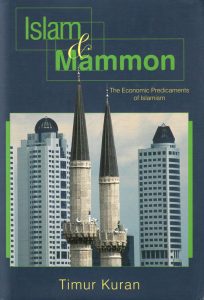 Islam and Mammon: The Economic Predicaments of Islamism (Princeton: Princeton University Press, 2004), xviii + 194 pp.
- Arabic translation: Al-Islam wal-Thara’al-Fahish: Ma’zaq al-Iqtisad al-Islami (Amman: al-Ahliyya, 2012).
- South Asian edition (New Delhi: Tulika Press, 2006).
- Turkish translation: İslâm’ın Ekonomik Yüzleri, by Yasemin Tezgiden, with an original introduction (Istanbul: İletişim, 2002), 303 pp.
Article: “Islamic Redistribution Through Zakat: Historical Record and Modern Realities”
“Islamic Redistribution Through Zakat: Historical Record and Modern Realities,” in Poverty and Charity in Middle Eastern Contexts, ed. Michael Bonner, Mine Ener, and Amy Singer (Albany: State University of New York Press, 2003), pp. 275-93.
Article: “The Islamic Commercial Crisis: Institutional Roots of Economic Underdevelopment in the Middle East”
“The Islamic Commercial Crisis: Institutional Roots of Economic Underdevelopment in the Middle East.” Journal of Economic History, 63 (June 2003): 414-46. Abstract
- Reprint in Historical methods in the Social Sciences, ed. John Hall and Joseph Bryant (New York: Sage, 2005), pp. 45-82.
Encyclopedia article: “Levant: Islamic Rule”
“Levant: Islamic Rule,” Oxford Encyclopedia of Economic History, vol. 3 (New York: Oxford University Press, 2003): 309-14.
Working paper: “Opportunistic Taxation in Middle Eastern History: Islamic Influences on the Evolution of Private Property Rights”
“Opportunistic Taxation in Middle Eastern History: Islamic Influences on the Evolution of Private Property Rights” (August 2002).
Review: Pamuk, A Monetary History of the Ottoman Empire
Review of Şevket Pamuk, A Monetary History of the Ottoman Empire (New York: Cambridge University Press, 2000), in International Journal of Turkish Studies, 8 (Spring 2002): 144-46.
Article: “The Religious Undertow of Muslim Economic Grievances”
“The Religious Undertow of Muslim Economic Grievances,” in Understanding September 11: Perspectives from the Social Sciences, ed. Craig Calhoun, Paul Price, and Ashley Timmer (New York: New Press, 2002), pp. 67-74. [Shorter version: http://www.ssrc.org/sept11/]
- Spanish translation: Siglo XXI (2003).
Article: “The Provision of Public Goods under Islamic Law: Origins, Impact, and Limitations of the Waqf System”
“The Provision of Public Goods under Islamic Law: Origins, Impact, and Limitations of the Waqf System ,” Law and Society Review, 35: 4 (December 2001), 841-97. Abstract
Comment: Bill Maurer’s “Speculations on Islamic Financial Alternatives”
Comment on Bill Maurer’s “Speculations on Islamic Financial Alternatives,” Anthropology Today, 17:3 (June 2001): 28-29.
Edited book: Julian Simon, “The Great Breakthrough and Its Cause”
Julian Simon, The Great Breakthrough and Its Cause, ed. Timur Kuran with editorial preface (Ann Arbor: University of Michigan Press, 2001).
Encyclopedia article: “Public Opinion, Microsociological Aspects”
“Public Opinion, Microsociological Aspects,” International Encyclopedia of the Social and Behavioral Sciences (Amsterdam: Pergamon, 2001): 12556-60.
Article: “Controlling Availability Cascades”
(with Cass R. Sunstein), “Controlling availability cascades,” in Cass R. Sunstein (ed.), Behavioral Law and Economics (New York: Cambridge University Press, 2000), 374-97.
Video: “Institutions and Economic Performance: A Conversation between Douglass North and Timur Kuran”
“Institutions and Economic Performance: A Conversation between Douglass North and Timur Kuran” (41 minute educational video for the Idea Channel (now the Free to Choose Network, May 2000).
