

-

Previous Posts
Archives
- December 2025 (2)
- November 2025 (1)
- October 2025 (1)
- August 2025 (3)
- July 2025 (2)
- June 2025 (2)
- May 2025 (3)
- April 2025 (2)
- March 2025 (1)
- February 2025 (1)
- October 2024 (1)
- September 2024 (1)
- August 2024 (1)
- July 2024 (1)
- May 2024 (1)
- April 2024 (1)
- February 2024 (2)
- January 2024 (1)
- December 2023 (1)
- October 2023 (1)
- September 2023 (1)
- July 2023 (1)
- June 2023 (1)
- May 2023 (2)
- April 2023 (2)
- March 2023 (2)
- November 2022 (1)
- October 2022 (2)
- July 2022 (2)
- June 2022 (2)
- May 2022 (1)
- April 2022 (1)
- March 2022 (1)
- January 2022 (1)
- November 2021 (1)
- October 2021 (1)
- August 2021 (1)
- July 2021 (1)
- June 2021 (1)
- May 2021 (1)
- February 2021 (1)
- November 2020 (1)
- October 2020 (1)
- August 2020 (5)
Author Archives: Cristian Badea
Predictive Alzheimer’s Risk
Congratulations to QIAL’s Dr. Alexandra Badea and Dr. Trong-Kha Truong on receiving the 2025 Medical Physics Fall Seed Grant Award for their project, “Predictive Modeling of Alzheimer’s Disease Risk Using Explainable AI and High-Resolution MRI.”
Posted in Uncategorized
Leave a comment
Exercise Protects the Aging Heart in High-Fat Diet APOE Mice
Using photon-counting CT and deep learning, we show that voluntary exercise significantly mitigates high-fat diet–induced cardiac dysfunction in adult APOE-targeted mice, with the strongest benefits observed in APOE4 and humanized innate immune (HN) backgrounds. Exercise mitigates high-fat diet–induced cardiac dysfunction … Continue reading
Posted in spectral CT
Leave a comment
Imaging Bone Aging with Photon-Counting CT
How do genetics, sex, and immune signaling shape bone health as mice age?Our study shows that photon-counting CT in APOE mouse models reveals strong sex- and immune-dependent bone loss, with female HN mice showing the most pronounced decline. Nadkarni, R.; … Continue reading
Posted in spectral CT
Leave a comment
Visiting Fulbright Scholar: Dr Kristina Bliznakova
Delighted to host Dr. Kristina Bliznakova, Fulbright Scholar, at Duke’s Quantitative Imaging & Analysis Lab. Looking forward to teaming up on photon-counting CT and virtual imaging.
Posted in Uncategorized
Leave a comment
Identifying Alzheimer’s network biomarkers
New article and three institutions collaborating! We identify network biomarkers of Alzheimer’s risk by combining high-res MRI with multifactorial analysis in ApoE mouse models. Joint volume + texture patterns reveal how genotype, sex, diet, & immunity interact to shape brain … Continue reading
Virtual Wistar Rats Enable Realistic PCCT Simulations
Our team developed anatomically variable digital Wistar rat phantoms for realistic preclinical imaging simulations, enabling PCCT studies & reducing animal use. Segars, H. E., Nadkarni, R., Badea, C. T., Badea, A., Chin, B., Johnson, G. A., Payne, J., Samei, E., … Continue reading
Posted in Uncategorized
Leave a comment
Olfactory-Guided Behavior Uncovers Signatures of AD risk
Could your sense of smell reveal Alzheimer’s risk years before memory loss? Our new study connects olfactory behavior, brain networks, & blood gene signatures to early AD vulnerability. Moon, H.S.; Han, Z.Y.; Anderson, R.J.; Mahzarnia, A.; Stout, J.A.; Niculescu, A.R.; Tremblay, J.T.; … Continue reading
Adaptive AI Denoising for Pediatric Cardiac PCCT
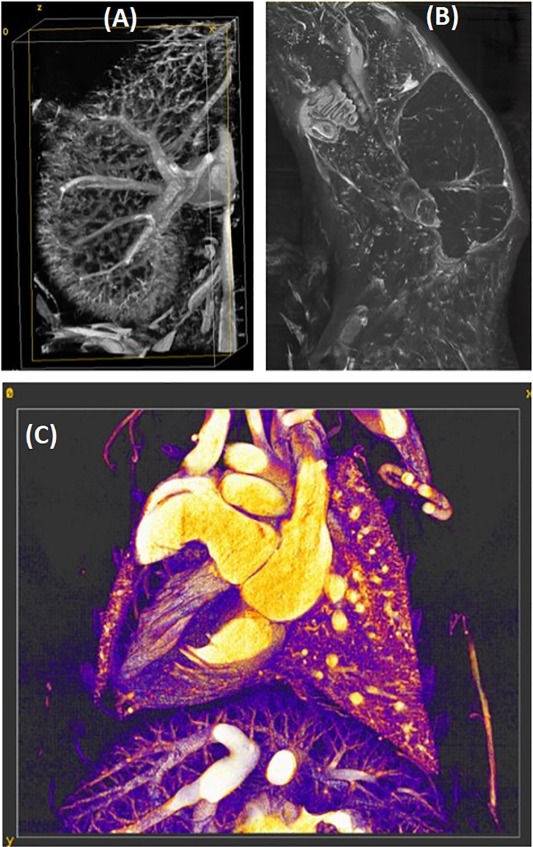
We developed a data-adaptive, self-supervised deep learning method combining sparse coding (SC) + visual transformer (ViT) for denoising pediatric cardiac photon-counting CT. Preserves anatomy, adapts to noise, generalizes well—even to preclinical data. Clark, D. P., Cao, J. Y., & Badea, … Continue reading
Posted in spectral CT
Leave a comment
PCCT-Visible Bioprinted Patch
Our team developed a CT-visible bioprinted vascular patch using dual-contrast bioinks. Photon-counting CT enabled precise tracking of structure and perfusion, highlighting the role of imaging in cardiac repair. Gil, C. J., Allphin, A. J., Jin, L., Salar Amoli, M., Rezapourdamanab, … Continue reading
Posted in spectral CT
Leave a comment
Rapping Research
Our QIAL lab member Rohan Nadkarni brought the heat at the BME retreat—taking 2nd place in the rapid-fire challenge with original rap lyrics
Posted in Uncategorized
Leave a comment
