Brad’s GG-motif paper was selected for a virtual issue

Brad’s JACS 2015 paper about the peptide rescue of GG-motif mutations was selected for the JACS young investigator virtual issue.  In this paper, we reported that some of the mutations in MoaA that cause human Moco deficiency disease could be rescued by a synthetic peptide, suggesting potentials for the future development of a novel therapeutics.  Interestingly, this study also revealed that the C-terminal tail of MoaA is involved in the radical initiation during the MoaA catalysis.

Welcome Haoran and Matthew!!

Two new graduate students, Haoran and Matthew, joined the lab.  Haoran is a first year student in the Biochemistry Ph.D. program, and will be working on the Moco project and the mechanism of radical SAM enzymes in general.  Matthew is a third year student in the MSTP (M.D. Ph.D.) program and the first year in the Ph.D. phase.  Matthew will work on the biosynthesis of antifungal natural products and its application to development of novel antifungal agents.  Welcome on board and let’s enjoy the sicence together!!

Congratulations to Edward for winning the poster award!!

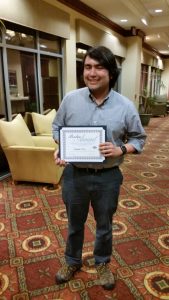
Edward won the poster award in the Biochemistry Department retreat.  He presented his work on the mechanistic study of MoaC using the uncleavable substrate analog (published in 2015 Biochemistry).  In this work, Edward found a MS evidence for the covalent linkage of the dead-end inhibitor with MoaC.  Congratulations!!  This is Edward’s second time for the same award; his first award was in 2014 for his work on NikJ/PolH characterization.  This is the lab’s fifth straight year poster award since the lab’s establishment in 2011.  Last year, Abhi won the award.


Welcome Hai!

Dr. Hai P. Nguyen joined us to study fungal cell wall biosynthesis.  He received a Ph.D. degree from University of Toledo.  One of his key achievements was a successful development of a synthetic method to construct beta-mannosides, one of the most challenging glycosidic linkages to create using synthetic approaches.  In our lab, Hai will work on development of chemical biology approaches to study fungal cell wall biosynthesis and the mechanism of action of antifungals.  He will also work partially on the molybdenum cofactor biosynthesis.

Our work on nikkomycin and polyoxin biosynthesis was published in Nature Chemical Biology

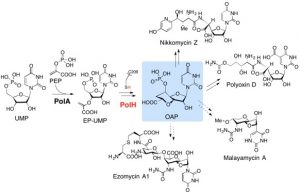
Our recent discovery of novel radical SAM enzyme that catalyzes free-radical mediated C-C bond formation during nikkomycin and polyoxin biosynthesis was published online in Nature Chemical Biology.  The work is highlighted on the journal’s top page.  Our studies showed that biosynthetic routes to nikkomycins and polyoxins proceeds via a bicyclic intermediate, octosyl acid phosphate (OAP), formed by a free radical mediated ring closure catalyzed by the radical SAM enzyme, PolH. We also propose OAP to be a common biosynthetic intermediate for various antifungal nucleosides, and PolH as the genetic marker for genome mining discovery of these natural products. Edward A. Lilla, a graduate student, performed all the characterizations described in the paper.

divergent-biosynthesis


Sojourn in Biochemistry Conference: Stubbe Symposium

A conference to celebrate JoAnne Stubbe’s 70th birthday will be held in Boston MA on June 11-12. Most of the Stubbe lab alumni and many collaborators (~130 attendees) will gather and discuss their latest progress.  Ken will give a talk and Edward will present a poster.  Thank you Marty (Bollinger) and Dan (Nocera) for organizing such an exciting event.  Looking forward to see friends and new people.

Our new web site is now launched!!

3',8-cH2GTP_side3We are interested in the functions and mechanisms of enzymes involved in the biosynthesis of natural products and cofactors as well as those in fungal cell wall biosynthesis. The target enzymes play essential roles in inheritable human disease, or bacterial or fungal infectious disease. We aim to understand the mechanisms of these enzymes and use the knowledge to discover novel therapeutics. Specifically, we are interested in:

(1) Cofactor biosynthesis in humans and pathogenic bacteria.

(2) Antifungal biosynthesis and genome mining.

(3) Fungal cell wall biosynthesis and antifungal mode of action.

We use a combination of approaches from organic chemistry, biochemistry, molecular biology and spectroscopy with particular focus on in vitro functional and mechanistic characterization of enzymes, small molecule characterization, bacterial and fungal/yeast genetics, synthetic organic chemistry, NMR, EPR and fluorescence microscopy.