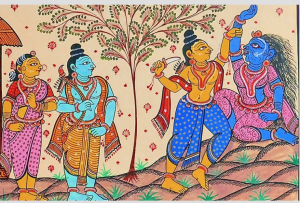
चित्र गूगल से साभार (photo credit google)
Samhitha Sunkara
Sita Symbolizes Unfair Expectations for Women:
Sita is depicted as the perfect wife because she is chaste and passes the fire test. However, the expectation to be chaste is not placed on men, as well. Furthermore, when Ravan plans to kidnap Sita, it creates the expectation that men can use women as objects of their revenge. Sita is also not given many emotions or agency; the only emotion she has is fear. This creates the expectation that women need men to save them.
Challenging Sita’s Position as an “Ideal” Indian Wife & Woman
Anya Gupta
Sita is often seen as the ideal wife, mother, and woman in Eastern culture, with her devotion to her husband and family being glorified. “Yes to Sita, No to Ram: The continuing popularity of Sita in India” by Madhu Kishwar explores the viewpoints of unmarried and married Indian girls, finding that those who were not married tended to look up to figures like Mother Teresa and Indira Gandhi. Meanwhile, married women tended to glorify Sita as a female they want to emulate and were inspired by. My podcast explores Sita’s shortcomings as a result of her confinement to the domestic sphere, and offers a comparison between her agni pariksha with the more modern “sati” that is practiced in India. I encourage listeners to reevaluate the idea that Sita really may not be the ideal woman to be inspired by.
Sita’s Trial By Fire and Modern Indian Misogyny
Naman Agarwal
Sita is portrayed in most versions of the Ramayan as a divine avatar herself – the absolute symbol of purity. This purity allows her to prove herself as loyal to Ram after Ravan’s defeat, but the fact that Ram even casts doubt on her to begin with sets a model for Indian society. If Ram, who is a god himself, doesn’t believe the most chaste woman in the world, what does it say about how women should be treated in society in general? It’s possible that this holy text has allowed for the extreme levels of misogyny that India still experiences to this day.
Shining a Light on the Other Side of Sita, the so-called “Ideal Woman”
Shreyas Gupta
Sita is commonly viewed as the ideal daughter, the ideal wife, and the ideal mother. She is praised for her purity, her chastity, and her obedience but there is so much more to the lead female character of this story. She is strong, she is intelligent, and she is passionate. Sita, one of the most well-regarded and important figureheads in modern-day Hinduism, is an incredibly progressive and powerful figure if you start taking a deeper look at the text. Although Sita may not necessarily be the “ideal woman” as she is often referred to as, she does spark numerous thoughts and conversations around the power of women and gender equality in an otherwise not-so-equal society.
Sita’s Courage in a Patriarchal Society
Prathmesh Patel
Sita is the ideal woman in Indian culture according to the Ramayana. Known for her beauty, loyalty, and sacrificial nature, Sita is the wife of Ram. Ram had “won” Sita in a swayamvar, and Sita courageously followed Ram and Lakshman into exile in a forest filled with demons to keep her husband company. Even after staying loyal to Ram as Raavan’s captive, Ram must test her loyalty through an agni-pareeksha.
