In late 2023, Dr. Van Cappellen was awarded grant funding from the John Templeton Foundation to investigate lived experiences of hope! Dr. Van Cappellen serves as Principal Investigator on this grant ($259,979) titled “What is Hope? Bridging the Gap Between Lived Experience, Practice, and Research”, a three-year project beginning in September 2024 to March 2027.
Hope is an important human experience and a valuable resource for practitioners working with people facing adversity. Pioneering work by Snyder (1994, 2002) focuses on goal pursuit motives of hope, but this project aims to further expand the psychological study of hope by engaging with lived experiences of practitioners and community members, including people of faith. To do so, “stories of hope” from people of varied religious and cultural backgrounds have been collected, transcribed, and qualitatively coded (see more under Bass Connections Project Team 2024-2025 below!).
In addition, an interdisciplinary scientific meeting (psychology, theology, nursing and medicine, other practitioners) will be held at the end of this year to co-construct an expanded definition of hope that is both phenomenologically-grounded and scientifically precise. This project will build foundational basis and provide the impetus for a renewed study of hope in psychology, one that sits more closely at the interface of healthcare, spiritual care, and lived experiences. To learn more, visit our project website!
Bass Connections Project Team 2024-2025
An interdisciplinary Bass Connections Project Team focusing on collecting “stories of hope” was assembled for the 2024-2025 academic year! Dr. Patty Van Cappellen served as Team Leader alongside Dr. Erin Johnston for this project, entitled: “What is Hope? Bridging the Gap between Experience and Research.”
In year-long Bass Connections project teams, faculty, graduate, and undergraduate students engage in collaborative research that explores complex societal issues.
What does hope look like in everyday life?
Hope is central to promoting resilience and flourishing, which are both strongly associated with psychological well-being. Hope is also an important religious competency for leaders and followers alike to possess. Its scientific study is, however, surprisingly limited — existing conceptions range from too narrow (Snyder, 1994) to too broad (Scioli et al., 2011). We aim to renew our understanding of hope through a deeper engagement with its lived experiences, existential roots, and religious understandings.
“I want you to think about different times in your life when you’ve experienced hope. Pick one that feels important or meaningful to you…. It might be a recent experience or one that occurred a long time ago. I’d like you to tell me about this experience, describing it in as much detail as you can.”
This team engaged with the lived experience of hope as reported by practitioners and community members, including people of faith. Team members conducted semi-structured interviews to gather 76 personal stories of hope. This data repository contains rich qualitative data on experiences of hope from a diverse set of people representing different religious, cultural, and socioeconomic backgrounds. By identifying common themes and elements of these hope stories, the Bass Connections project team was able to provide a broadened understanding of what the lived experience of hope looks like for everyday people.
The team wrapped up the year by presenting research highlights at the 2025 Fortin Foundation Bass Connections Showcase!
Interested in what we found from these stories of hope? See a preliminary data visualization HERE for themes from the narratives! In each section, click for supporting example quotes.
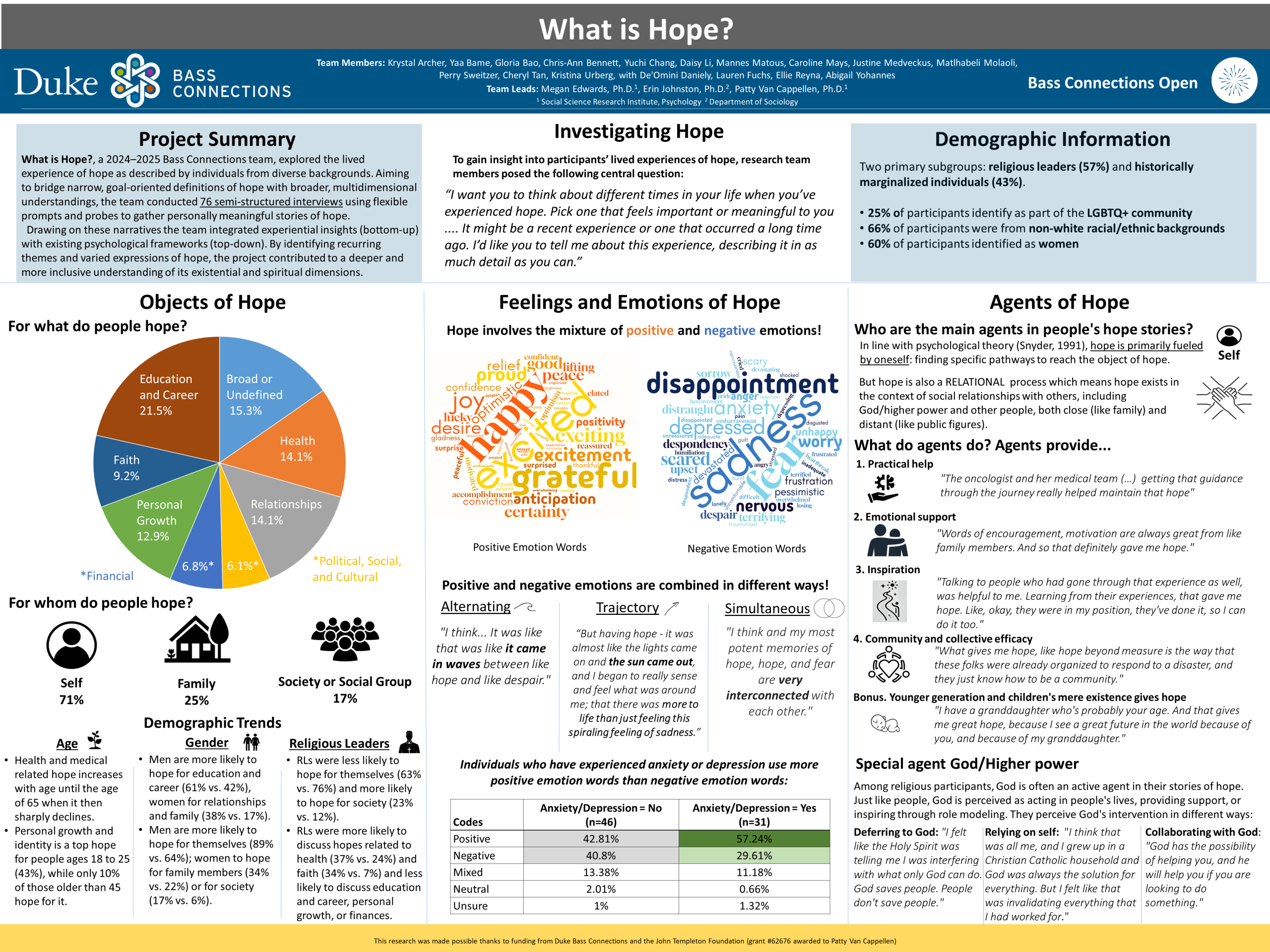
- Objects: For what do people hope? For whom do people hope?
- Feelings & Emotions: How, and what feelings and emotions are involved in hope?
- Agents: Who are the main agents in people’s stories of hope?
Also see the poster below for a full overview of the team’s findings!