Cereal in the Anthropocene

Cereal in the Anthropocene

Charlie reached into the cabinet,

He grabbed a bowl, a spoon, and the box.

“Chocolate Flavored Puffs: With Lots of Artificial Flavors and No Preservatives!”

Nothing to preserve if the chocolate wasn’t real to start with.

Charlie doesn’t know the difference.

He doesn’t have to decide whether to pour the milk first or the cereal (age old debate)

He doesn’t have to eat soggy cereal,

since there isn’t any milk to pour.

Charlie doesn’t know the difference.


Victoria Grant, Brandon Foreman, John Desan, Barbara Lynn Weaver

BREAKING NEWS: Government announces that energy budget for each citizen will be cut indefinitely, effective immediately. Wristbands will reflect the changes as of 8:00 am this morning. Make adjustments in your lives accordingly. No exceptions will be made.
A government controlled energy ration system. Each citizen is allocated a fixed amount of energy that is controlled by a wristband. They have to budget the energy for everything they want or do: electricity, transportation, food preparation, hospital visits, physical activity. The wristband has a modest, sleek design with a clasp that is nearly impossible to undo. The wristbands design does not inhibit anyone’s sense of style and makes it impossible for anyone to lose. Energy was once freely exchanged in the world but, now it must be conserved, even to the point on monitoring, and limiting physical actions.

Butterflies in the Anthropocene

Thud – thud – thud. Our wings beat in vain, propelling us forward in what feels to be an endless cycle, an eternity in which we are fated to forever remain here – moving yet immobile. It’s warm, crowded. The lights – too bright – glint from above, reflecting in the clear box that both is our world and separates us from it. But one day, we may be free. One day, if the rain comes back, and the sun gently warms the earth instead of scalding it. One day, if the hard gleaming metal fades back into a gentle green, and the earth giggles, we will once again flutter the clear skies and dance with dandelions. Perhaps, one day we will be more than a mass of fragile wings yearning for release.

Glasses of the Anthropocene

They don’t see. 

I guess I’m not sure if they ever truly saw. 

Was anything ever distinct 

To them? Was everything always blurry? Was the distance too great?

If they couldn’t see, then how shocked would I have made them be?

The lift of a veil into a world unseen.

A world that was right in front of them

All along. 

What is the Anthropocene? Should it be considered a geologic era?


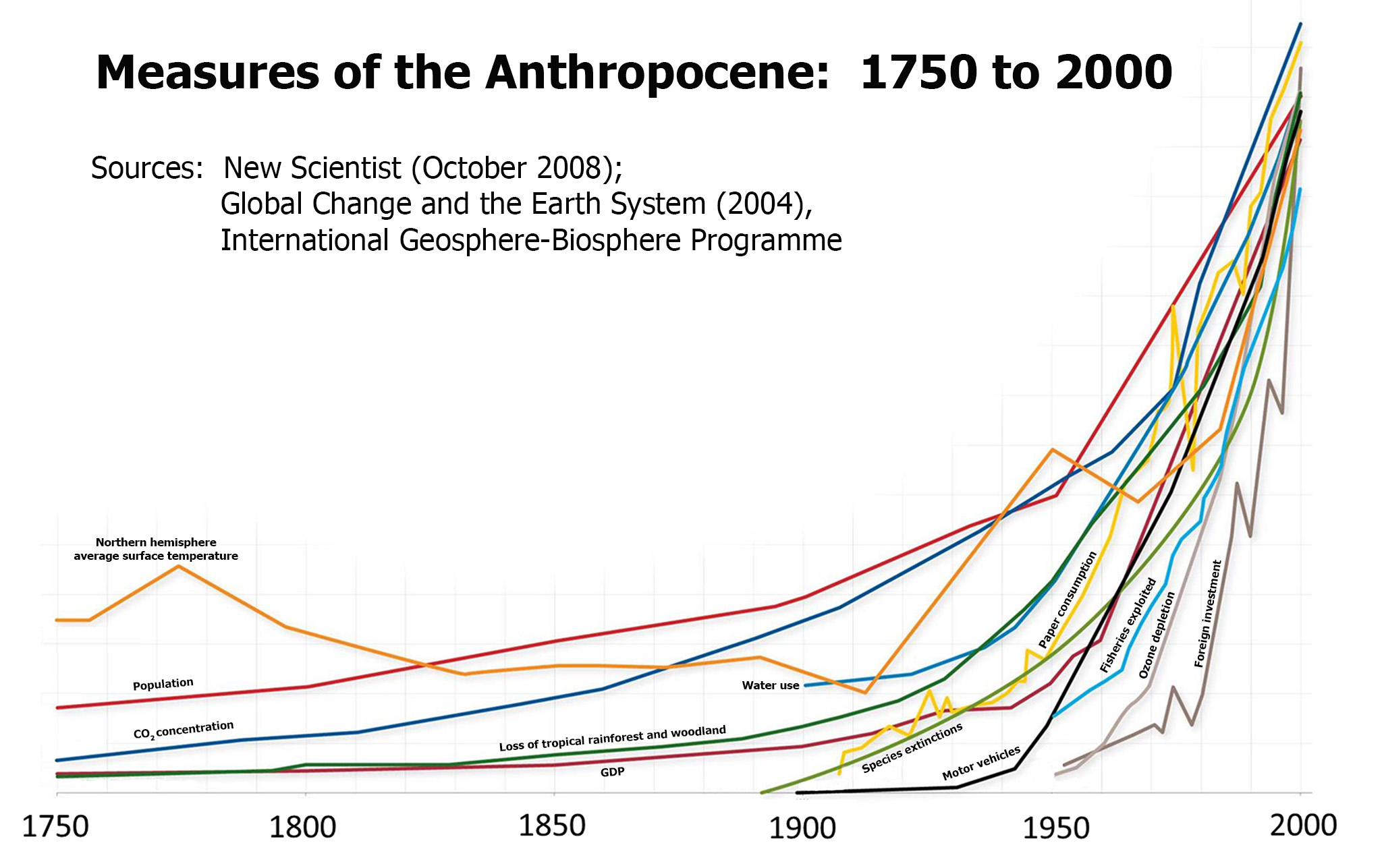
There is no doubt based on the evidence that humans are having a negative impact on our environment. I like the way Yeo refers to this in that “humans have mined, cultivated, trawled, bleached and emitted their way forward with new technologies and higher populations” (2016). This statement is raw and true about the past and potential future of our species. Haraway stated that “There is no question that anthropogenic processes have had planetary effects, in inter/intraaction with other processes and species” (2015). Based on human impacts on an international basis over the last few hundred years, this point in time is starting to be referred to as the “Athropocene”. This is the period of geologic time where humans have resulted in exponential increases in anything from population, carbon dioxide, surface temperature, tropical forest loss, ocean acidification, methane, energy use, water use, and international tourism (Yeo 2016). No matter which way you mold the topic there is no denial in the power that humans have in determining the degradation or restoration of the earth itself.

Although I do think that this anthropogenic time period is vital for bringing to light the degradation as a result of humans, I do not know if this can be considered a geologic time period. Most geologic time periods contain hundreds of thousands to millions of years. This could be considered a geologic time period if we consider the long-term impact on the earth and its processes for potentially hundreds of thousands to millions of years into the future. The impact of the Anthropocene can be used as a vision or foreshadowing the future of the earth.

The question we then can ask is what do we do about it? Everyone is waiting for an answer from someone else on what to do, how to act, and decisions to make. This in itself is a whole other human problem in which we are constantly looking for someone else to do the dirty work rather than trying to figure things out on our own. As someone who considers myself a teacher it seems silly for me to wait for other scientists or people to provide answers. Yet knowing what I know, I can use my science classroom to teach what I know to be helpful as ways to influence my students and provide them with some of those solutions. This to me is the way in which I can and they can contribute in a positive way rather than negative in this “Anthropocene”.

http://humanorigins.si.edu/sites/default/files/measures%20of%20the%20anthropocene.jpg


Works cited:

Haraway, Donna. “Anthropocene, Capitalocene, Plantationocene, Chthulucene: Making Kin.” Environmental Humanities 6.1 (2015): 159-65. Web.

Yeo, Sophie. “Anthropocene: The Journey to a New Geological Epoch.” Climate Brief Ltd. N.p., 06 Oct. 2016. Web. 16 Feb. 2017. <https://www.carbonbrief.org/anthropocene-journey-to-new-geological-epoch>.

Meat in the Anthropocene


John slices a potato into thin pieces while prepping dinner for his two kids, Juliette and Adam. After slicing the potato, he sets it to the side and pulls from the cabinet a bag of genetically engineered cow meat. On the bag of so called meat the label advertises that the product “Tastes like REAL meat” and “You can’t believe it’s not meat”. Without thinking, John slices open the package and the red brick-like structure falls into the pan.

In an attempt to break up the minute little squares, John takes his spatula and pokes the meat. He watches as the little bits of blood red dyed protein fall into the pan and start to brown and sizzle. The aroma of the meat cooking in the pan releases a smell unlike any type of meat he remembers as a child.

http://www.knowingforsure.com/wp-content/uploads/2014/01/beef.jpg

Cloud in the Anthropocene

In the beginning, there is nothing; nothing until a mighty roar begins. I feel myself separate piece by piece while I rise. I walk through the multiple hallways of my steel home and go out of my grated front door. Now, there is light and I can see the world below me. I cruise slowly along the glass ceiling: attempting to preserve the moment but, the end always comes too soon. A person on the ground admires my design from below and I try to wave before I am gone. The track ends and I go back into nothingness. I combine as one and sleep until I can go out to play again.

Roads in the Anthropocene

I’m poured out, and over. Over and over.

Humans claiming as theirs, what never really was.

Each layer of my unnatural being, slowly enshrouding what was once green, and alive.

But, man’s always been this way. He walks over everything, just like he walks over me.

Hard rubber soles, hollow souls. Building all these roads.

Roads that run in every direction, but roads that lead to nowhere.

Roads that they envisage pave the way to a better tomorrow

Purposefully oblivious that today might be their last.

Bridging the gap with fiction

Often, people do not see the impact of their actions on the environment. There is no immediate visual indication of how their full gas tanks, ubiquitous air conditioning, or even long showers damage our ecosystem, and consequently, many of these people continue with their harmful quotidian routines, ignorant of their impact. Unbeknownst to them, more often than not, their lifestyles’ negative byproduct contributes to the pollution of environments hundreds of miles away from them. This geographical disconnect between these peoples’ actions and their actions’ effects may never be closed; therefore, it is imperative to educate people of their impact because quantifying the effect of their lifestyles will help them understand the reason they need to change.

In Oil on Water, the reader is introduced to a country plagued by oil. Foreign greed for oil had reduced the country’s land and people to just tools for harvesting more oil. By viewing these people as inanimate objects, the foreign oil tycoons never developed any empathy for these people’s hardships. They never knew the smell of oil on water. In order to have the reader develop empathy for the country’s suffering, Helon Habila fills his narrative with vivid descriptions of the country’s environment: everything from the sweet taste of corn porridge to the putrid smell of dead life in the oil-infested waters. By familiarizing the reader to the realities of the country’s environment, Habila attempts to bridge the geographic disconnect between the readers’ lifestyles and their foreign footprint on a land’s environment.

A Nigerian village's oil-infested shoreline

A Nigerian village’s oil-infested shoreline

Although fiction may not be the most succinct way of communicating facts, it is indeed a valuable medium for immersing a reader in experiences starkly different from their own. Without personal experience, it’s sometimes difficult to understand the gravity of a problem; however, fiction attempts to fill that void by recounting the experience of someone else and ultimately making you feel as if it were your own.


Works Cited

Calvino, Italo. Numbers in the Dark: And Other Stories. New York: Vintage International, 1996. Print.

Dodocutepoison. “Pumzi.” YouTube. YouTube, 07 Dec. 2012. Web. 16 Feb. 2017.

Habila, Helon. Oil on Water. Lagos; Nigeria; Parrésia Publishers Ltd.: n.p., 2016. Print.


A Toilet in the Anthropocene

I sit in the 4 by 4 stall and wait for the next person who has become so filled with pain to come relieve themselves. This exchange has moved away from a simple release, wipe, and go. Now, with every flush they can see the pain and destruction that I am causing. They used to not understand that with every turn of the handle I used several gallons of their most prized resource. Both of us used to be free to use this resource as we pleased…or were we? But in any case, now they understand, and our exchange has become rather toxic. They are so filled with the pain of the barren world that they are living in that they come to relieve themselves, and are met by one of the very objects causing this pain. If they had took the time to understand before now, we both could be living free of the pain that we have both caused.

The “Spot” Bot (Nanki Singh, Brielle Tobin, Mary Osborn, Joe Jacob)

  • A dog robot
  • replaces real dogs – plays fetch, cuddles, and wags its tail – a little too perfect
  • wealthy people who feel the need to have a pet
  • it looks just like a real dog except no genitalia
  • people still crave the companionship of a dog, except they are unable to live in the new atmosphere

People view these dogs are the best thing ever because they are ignorant of what dogs used to be! these dogs don’t even have warmth! 🙁

Reduce Your Trace: Lowering Your Digital Carbon Footprint

Eco-Tips for reducing your digital trace

Device Maintenance

  • Buy Conscientiously & Consume Selectively
    • buy energy-saver devices
    • buy repairable devices
    • buy used and refurbished devices
    • buy only what you need
    • buy only when you must
  • Optimize Charging
  • Optimize Device Life
    • treat your devices with care
  • Repair, Reuse, Re-make, and only then Recycle
    • check out iFixit, Instructables, and YouTube for DIY repair instructions
    • be sure you recycle responsibly using a reputable electronics recycling center

Online Activity

  • Reduce Streaming
  • Save Selectively: by reducing the amount of data you save, you reduce your carbon footprint
    • delete unnecessary data
    • save only what is needed
    • reduce over-redundant saving
  • Use Green Web Hosts
  • Design Low-Carbon Websites
    • reduce the load on your website (with carefully-chosen colors, lower-resolution images, deliberately-designed typefaces, and reduced interactivity) and you reduce the energy it consumes
  • Use Carbon-Neutral Search Engines like Ecosia (Ecosia also donates trees each time you search)
  • Try Tab for a Cause to make your tab-opening activities work toward making positive change
  • Try GoodBlock ad blocker, “the ad blocker with a purpose”