
 DUNE is a full-time, 8-week summer research internship exclusively for high school students from Durham public and charter schools. DUNE students are paired with a graduate student or postdoctoral mentor to conduct hands-on research in an on-campus laboratory at Duke University. Funded through the philanthropic efforts and sponsorship from the Duke Institute for Brain Sciences (DIBS), the DUNE program aims to welcome and expose high school students to the scientific environment and make the research community more accessible to all students in the sciences. Through independent research projects, DUNE students hone their ability to develop hypotheses, gather data, and analyze and present their findings.
DUNE works hard to cultivate cohesive cohorts. Students have lunch together to bond with their peers and attend socials with groups like the Duke Research in Engineering Program and the Cell Biology Academy to expand their networks. To help alumni with college applications, gaining research experience as undergrads, and more, DUNE holds two college check-ins during the school year, where mentors reconnect with alumni and provide support.
Students who participate in DUNE often express enthusiasm about joining the Duke community and are eager to continue their research. A recent participant described the supportive network, saying, “I did research I was actually interested in, had an amazing and supportive mentor, and had the best friends alongside me. I’m so grateful for this opportunity and experience, and it’ll truly be one I’ll never forget.”
The Team that Makes it Happen
 DUNE runs smoothly thanks to the administrative efforts of DIBS leaders, program coordinator Tiffany Scotton, and graduate student co-leads Alev Brigande and Owen Traubert. Alev and Owen work with a team of volunteers to organize the program during the academic year and coordinate it over the summer. The team supports coordination with Duke laboratories, student programming, and admissions. Most recently, the team has been advertising the upcoming DUNE application opening to local Durham high schools and community partners such as the Emily K Center and Student U. The DUNE program also puts great effort into engaging prospective participants directly. Team members recently visited the City of Medicine Academy and will have a table at Durham Ignite! Online Academy Career Fair.
Furthermore, DUNE simply would not function without the generous graduate students, postdoctoral mentors, research technicians, and professors who host DUNE students in their laboratories. Mentors report finding the experience deeply rewarding. One mentor spoke to the impact of this role, stating, “It was incredibly fulfilling to watch my mentee grow in confidence and curiosity, and it reminded me of the importance of mentorship in nurturing the next generation of scientists.” Beyond providing a pathway for high school students, the DUNE program advances real-world neuroscience research. DUNE mentors sometimes enlist DUNE students to pilot a new research project, like testing a hypothesis in a new model organism.
Improving the Program
The DUNE program successfully overcame administrative hurdles to expand its cohort from 6 to 8 students. First, the administrative team pooled their experiences to identify factors that might limit growth. They found that the process of preparing a mentor research abstract for DUNE students to use in selecting their research projects was inefficient and causing bottlenecks. Program administrators addressed this challenge by stepping in to help mentors refine their abstracts to fit the appropriate scope. Another issue was the effort required to complete regulatory documentation for high school students to join laboratories. They found that the documentation process was simpler when two students were paired with mentors in the same laboratory, partly because having two high school students in one lab makes it easier to meet regulatory requirements. An additional benefit emerged in that having two high school students in one research laboratory allows them to serve as peer mentors, helping each other navigate the daily learning process.
DUNE actively seeks participant feedback on all its activities each week, allowing administrators to adjust programs in science education, college preparation, and career exploration to better meet the needs of students. Alumni of DUNE also provide valuable insights about the program as a whole. Students particularly enjoy hands-on learning experiences, such as a recent activity on optogenetics, a neuroscience technique that uses light to control genetically modified neurons, allowing for precise activation or inhibition of specific cells. Incorporating this feedback has led to several significant improvements in the DUNE program.
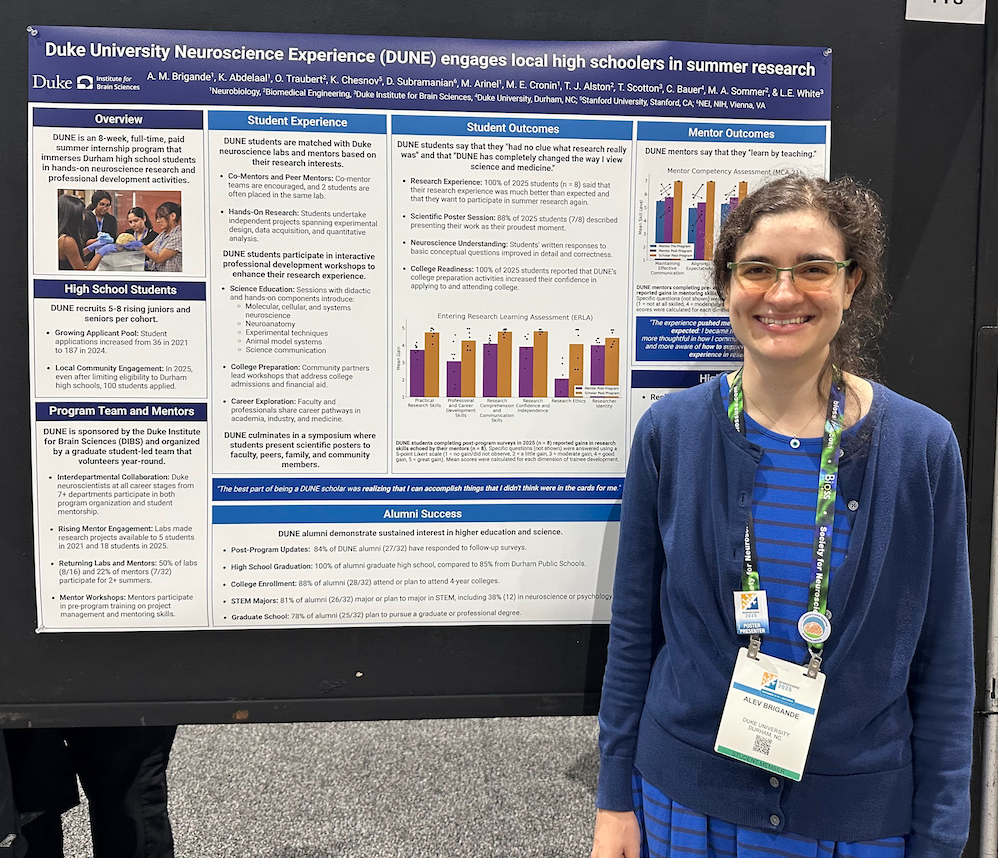
The program also works to share its findings with the broader neuroscience community. Alev Brigande, graduate student co-lead, recently attended the Society for Neuroscience conference in San Diego to present a poster on DUNE’s impact on high schoolers. A recent evaluation of the DUNE program indicated that the program is indeed transformative for students. After completing the program, participants report a higher understanding of neuroscience principles and techniques, confidence in their ability to attend college, interest in pursuing research, and desire to become an undergraduate at Duke University after completing the program. DUNE mentors affirm this, reporting that students who complete the program improve as neuroscience researchers.

One of the clearest indicators of the transformative effect of the DUNE program is the confidence with which the students present their research projects at the end of the program. The high school students effectively communicate their project goals, data acquisition, analysis methods, and conclusions in the presence of their families and the Duke neuroscience community. “Our students come in with maybe no knowledge of neuroscience,” says Owen Traubert, graduate student co-lead, “but at the end of the summer, they’re explaining neural circuits, how their experiment was able to test their hypothesis, and so many aspects that are impressive, even if they were an undergraduate.”
Getting Involved
The DUNE program engages the local Durham community to identify exemplary high school students to learn about neuroscience through hands-on research and activities. The students, in turn, learn more about college, the Duke community, and whether they want to pursue research in the future. Students also receive a stipend to support their participation.
The DUNE application will open on December 15th, 2025, and is open to all 10th and 11th-graders who attend Durham public and charter schools, including those without prior research experience. To learn more about the DUNE program at Duke, visit dibs.duke.edu/dune. To explore opportunities to engage DUNE students, explore how to become a DUNE mentor.
