
Staff from Duke Clinical and Translational Science Institute’s (CTSI) Workforce Development (WFD) pillar and Duke School of Nursing partnered with the North Carolina Community Schools Coalition to engage local students in basic principles of clinical research. On November 7th, the WFD team traveled to Central Elementary in Hillsborough to provide interactive learning for students at their November Science, Technology, Engineering, Art, and Mathematics (STEAM) night.
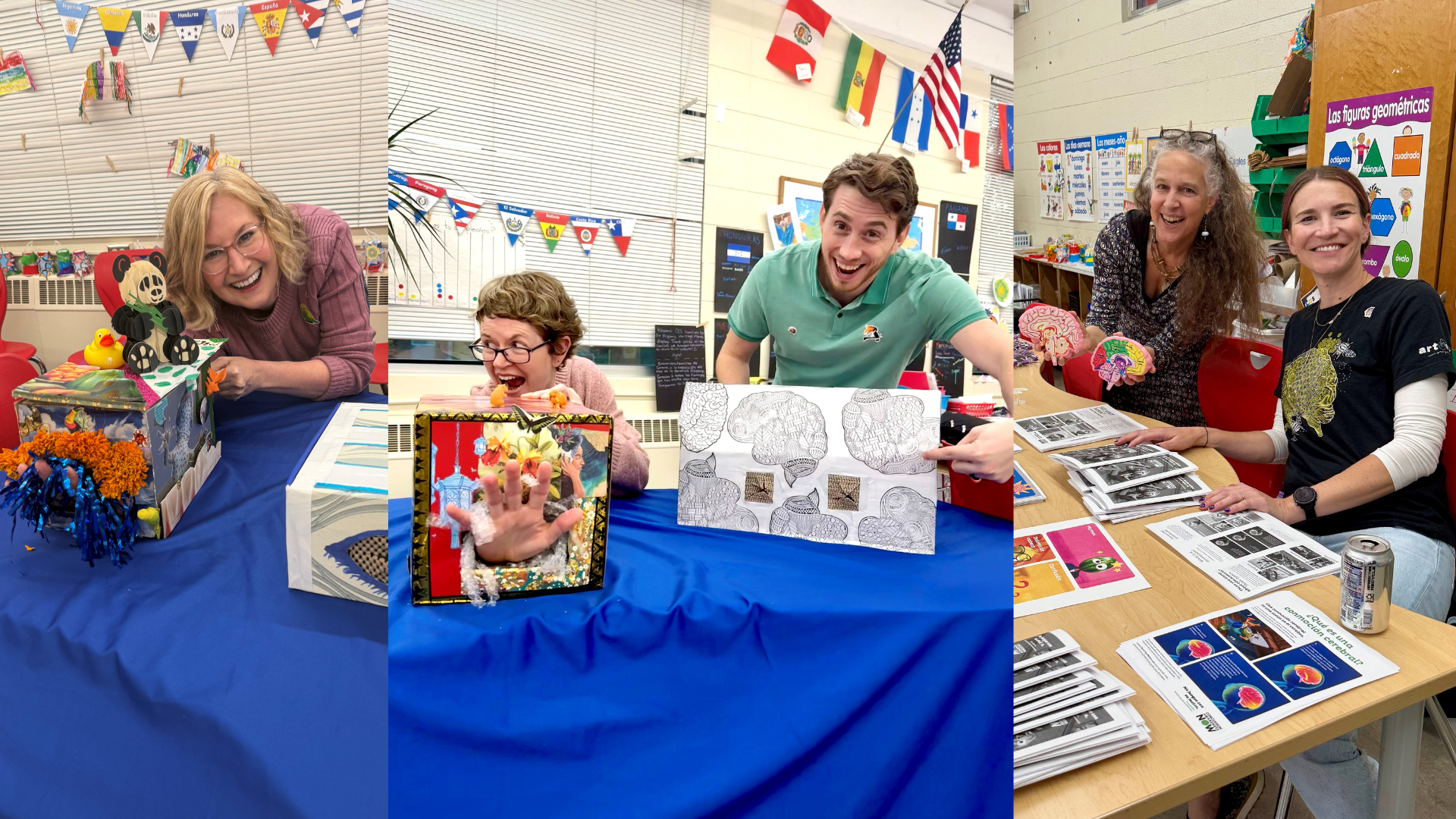
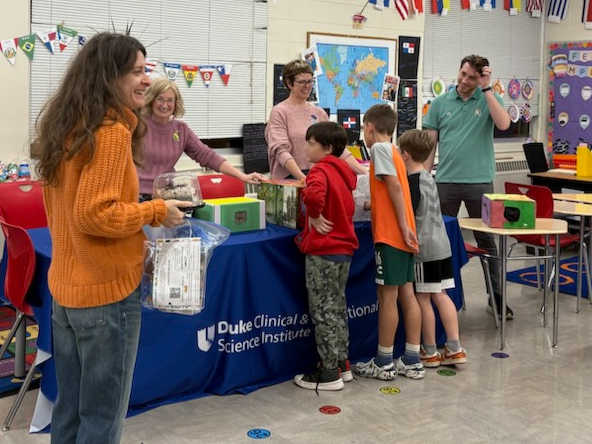 These activities lay the foundation for a future STEAM night, where Duke students in the Pratt School of Engineering will teach students about health and engineering principles through interactive exercises. At that event, K-2nd graders will build a model of a bird’s nest and test whether the nest can protect bird eggs from the wind, simulated by a fan. To foreshadow this activity, the CTSI team created artistically decorated boxes in which mystery health and safety items were hidden for students to guess their identities solely by touch (no peeking!). Then, they explored with students how these items—including a seatbelt, water bottle, toothbrush, doorknob covers, and helmet—keep children safe, just as a nest protects a baby bird. The students enjoyed the guessing game. One student who clearly has an aptitude for theater boldly requested, “Change them all!”, and the team was happily obliged for another round of guesses.
The future activity for third- to fifth-graders will challenge students to build a helmet prototype to protect an egg in an egg drop, symbolizing the human brain in a concussion. To prime students for this, Jessica Almy-Pagan from WFD and Amanda Fitterer, a Clinical Research Coordinator in Duke School of Nursing who is actively working on a concussion clinical trial with local adolescents, spoke with students and families about the importance of the human brain, how to prevent concussions, symptoms of a concussion, and how to receive treatment for a concussion. Students played a guessing game to address common misconceptions about concussions and received handouts and brain stickers to help them remember what they learned.

Both students and staff greatly enjoyed the activities. Molly Matlock described this enriching experience by saying, “I’m scared to tell those with jobs less fun than mine how fantastic it is to participate in events like the Central Elementary STEAM nights. Students visited our brain health and safety activities multiple times, challenged us to teach them more while they shared their own exciting health and safety facts for our edification, too.”
To get involved in CTSI WFD outreach activities, please email Amanda McMillan or Jessica Almy-Pagan.
