Author Archives: Jules Odendahl-James

UPDATED Pronunciation files

Two files from our work with John today. (THANK YOU JOHN!!) The first has the list from Baker’s script with a few additions (dacha, kopeck, Rozhdestveno).

The second has Astrovs’ song, the dentalized “T” you for Sonyas & Yelenas, and a few more additions (place & people) that we found going through the play with John.

Astrovs — Here’s the transliterated song from pg. 55

khodI khAta
khodI pech
khoz’Ainu nEgde lech


Change that moves too fast for us to adapt.

In Monday’s Duke Chronicle I caught a story/study that make me think both of Astrov and of last fall’s residency by PearlDamour and their How To Build a Forest installation/performance. The quote below has my emphasis added:

A recent study from the Nicholas School of the Environment found that forests in the eastern United States are exhibiting faster turnover in response to rising global temperatures.

The study was published earlier this month in the journal Global Change Biology. It is one of the first studies to demonstrate that forest turnover is currently more prevalent than northward migration of trees. The findings are in contrast to the prevailing prediction by environmental scientists that climate change would lead to migration through seed dispersal.

Christopher Woodall, a co-author of the study and research forester for the Forest Inventory & Analysis Unit of the United States Department of Agriculture, said these findings have significant implications for biodiverse forest success as a whole.

“[The findings] suggest that if climate changes rapidly then forests may not simply move with climate,” Woodall said. “If the rate of climate change exceeds the ability of tree populations to shift, that may suggest less forests with less tree species diversity.” […]

Woodall said that cooperation between governmental and academic entities will be important for preventing further forest degradation.

Beyond the obvious connection between Astrov’s thoughts on conservation, I was struck by the idea of temperature change as being too quick in impact for forests to adapt. I might be stretching the metaphor to its breaking point, but there’s a bit of that tension in the Professor’s big news and Vanya’s reaction to it. Up to that point in Act III, Vanya’s been bemoaning how languid life has become on the estate with the Professor in residency. Things are stagnating in ways that are different, uncomfortable from the previous sense of stasis (which at least contained work, to keep the estate running, to keep the revenue flowing back to the Professor, to help the Professor with his own academic production). And when the Professor makes his announcement, there’s shock and anger but I also sense fear about what will happen. It’s the one of three bold events of the entire play — perhaps the boldest since it would have an impact on so many characters. Yet it doesn’t go forward. It’s not just that there seems to be no warning and that Vanya’s reaction against the announcement is so violent (if incompetent), it’s almost as if it would be too much, too transformative. Like the trees in the new study that cannot transform fast enough to migrate away from places with greater temperature changes, the house simply reduces its variety. The visitors go, probably never to return, and the stalwart inhabitants stay. It’s not that the forest disappears but that it shrinks, dwindles, like Vanya and Sonya at play’s end. And, if that’s the case, then the speech she gives about work and rest, seem all the more absurdly inspiring and at the same time utterly tragic.

People will remember

Broadway is welcoming a stunning set of revivals this year (including a production of Machinal at Roundabout in December/January!), none more anticipated than a production of The Glass Menagerie transferring to the Booth Theater from its successful mounting at the American Repertory Theatre under the direction of National Theatre of Scotland maestro John Tiffany. It stars Cherry Jones and Zachary Quinto but in this review of the ART production from The New York Times‘ Ben Brantley, I was more interested in his description of how the mise-en-scene of the play offers a unique insight into the function of memory and environment to tell this well-trodden play. The emphasis below is mine; these were the parts of the article that for me echoed a bit of our approach to Vanya:

The set and costume designer Bob Crowley has envisioned the cramped apartment shared by Amanda and her children, Tom and Laura (Ms. Keenan-Bolger), as polygonal platforms on the edge of eternal night. I don’t mean just the shadows that lap at the set. (Natasha Katz is the magic-making lighting designer.)

A moat of black liquid lies, placid and menacing, in front of the stage, and every so often one of the characters walks to its brink and stares into it. It’s the abyss — of death, yes, but even worse, of being lost in life — that threatens these three family members who cling together so fractiously.

The forms this clinging takes are among the best known in American drama. Amanda is the former Southern belle, whose handsome, restless husband left her 16 years ago with two children, whom she nags and prods relentlessly, in the voice of a dead civilization.

Neither has any chance of fulfilling their mother’s American dream of success. Laura is a lame, pathologically shy stay-at-home; Tom has his father’s wandering ways and allergy to confinement. He’s long gone when the play begins, and what we see is what he can’t help remembering — “truth,” as he puts it, “in the pleasant guise of an illusion.”

As the familiar story proceeds — with Amanda needling Tom into bringing a gentleman caller home for dinner to meet the agoraphobic Laura — the actions and images assume shapes, both heightened and pared-down, that suggest how we edit and exaggerate when we remember. And how memory can sometimes not creep up, but leap up, on us, as when Laura first makes her entrance into Tom’s imagination. (I’ll let you experience that one firsthand.)

Years’ worth of domestic ritual — of meals cooked and tables laid and cleared — is summoned by a wordless ballet of gestures performed by Amanda and Laura. A repeated vision of Laura struggling to move a heavy typewriter is frozen in the amber of a brother’s pained guilt.

Tom himself is forever pacing, practically racing, falling onto furniture as if he meant to shatter it. When the family sits down to dinner, you never see the food. And Laura’s collection of little glass animals has been reduced to a single unicorn, which casts prismatic light from a low stool whenever she looks upon it. Memory has latched on to and enlarged the details that count.

I have a conflicted relationship with Brantley’s criticism in general (much more with Isherwood’s) but that last line really spoke to me: “Memory has latched on to and enlarged the details that count.” I saw that kind of resonance in Act III of Little Green Pig Theatrical Concern‘s recent production of Our Town in the choice to play Emily’s birthday scene like an old family movie with too-soft sound and too-quick motion that forced Emily only a sliver of the experience she wanted from that memory. I see it in the kind of aggregate and sparse approach we’re taking to the set, props and costumes in Vanya: using only those items of key significance, adhering to architectural detail without respecting bounds of walls and halls, and seeing through to the actor beneath the dress. In a very real sense, every production of a play that has been well-established in the repertoire of performance is done “in memory” of the past. Each community of artists latch on to the details “that count” in this time and place and rehearsals are the way in which we connect the now to the history of the work.

Composition under Culture Ministries and Culture Monies

Has anyone been following moves in Russia’s parliament over the summer, passing regressive anti-LGBT legislation? With the Winter Olympics in Sochi approaching in a few months, there’s been greater visibility and push-back regarding these laws from some in the international community and many in the LGBT community. LGBT citizens and activists within Russia have had a difficult if not impossible time recently in a country that has never been welcoming or liberal where LGBT rights were concerned. The reason I mention this is that there’s a new film about one of Russia’s favorite musical sons — Peter Tchaikovsky — being financed, in part, by the government. One of its main goals appears to be to refute or at least deny evidence about Tchaikovsky’s homosexuality. This weekend, The Guardian [London] ran this story about the effort to straight-wash Tchaikovsky’s biography.

Russia’s culture minister has denied that composer Peter Tchaikovsky was gay, discarding what has long been regarded as historical fact. Vladimir Medinsky claimed that there was no evidence to suggest the 19th-century composer was anything other than a lonely man who failed to find a suitable woman to marry.

Medinsky was asked about the composer’s sexuality after news emerged that a film biopic of Tchaikovsky being made with Russian government funding would ignore the composer’s sexuality. The script was apparently revised to remove references that could have made it vulnerable under Russia’s controversial new “gay propaganda” laws.

The film’s screenwriter, Yuri Arabov, denied that Tchaikovsky was gay, and told the newspaper Izvestiya that the composer of Swan Lake and Sleeping Beauty was “a person without a family who was stuck with the opinion that he supposedly loves men”.

“Arabov is actually right – there is no evidence that Tchaikovsky was a homosexual,” said Medinsky, when asked by the Interfax news agency if the climate of homophobia in Russia was forcing film-makers to censor the issue.

Historians, however, say there is a mountain of evidence to the contrary.

“In the case of Tchaikovsky his homosexuality is so well documented by his own writings and the writings of others that it is simply ludicrous to suggest otherwise,” said the author Konstantin Rotikov, who has written a history of gay Saint Petersburg. “It’s a historical fact. History doesn’t change just because we are trying to push a certain agenda today.”

chekhov_anton_to_Tchaikovsky

I bring this story to your attention for a few reasons. One, because of the great affection (though no love affair) that existed between Tchaikovsky and Chekhov. Chekhov engraved this portrait of himself to the composer and dedicated a collection, Gloomy Stories, to a man who he regarded second only to Tolstoy in genius, an admiration he described in a letter to Modest Tchaikovsky (the composer’s brother). Chekhov even invokes Tchaikovsky’s music in Act III of Three Sisters, when Veshinin hums the melody from the opera Yevgeny [Eugene] Onegin. They even discussed collaborating on an opera, Bela, with Chekhov serving as librettist, based on Lermontov’s novel, A Hero of Our Time (1839-41). Unfortunately, Tchaikovsky died from cholera (1893) before that project could begin.

Two, because last night Queer Nation staged a protest inside and outside New York’s Metropolitan Opera where a production of Tchaikovsky’s Eugene Onegin starring two Russian performers opens the season. This choice of action drew this response from the Met’s general manager, from which I thought this quote was particularly telling in any discussion of art and social justice:

But as an arts institution, the Met is not the appropriate vehicle for waging nightly battles against the social injustices of the world.

Three, I turn to Tchaikovsky’s often disputed (and not just in Russia) personal life and the required revisions, absences, refusals in the new film as an example of state censorship that Chekhov dealt with (though under different historical circumstances) when writing plays. Before the [Moscow] Art Theatre was created as a private company, Chekhov had to submit his work to the Imperial Theatre Committee, which functioned as a government censor that would evaluate work, submit recommended and required changes, and assign it a state-subsidized public theater/company for performance. (The Lord Chamberlin’s Office served in this capacity in British theatre until 1968 and you can find out more details about other nineteenth-century theater censorship systems in the The Frightful Stage: Political Censorship of the Theatre in Nineteenth-Century Europe edited by Robert Justin Goldstein, Berghahn Books, 2009.) By the time he had to decide whether or not to “give” Uncle Vanya to MAT or send it through the regular state system, the decision, according to his biographer Donald Rayfield, was made for him by the censor who “took umbrage at the play’s aspersions on a professor and demanded changes.” (Anton Chekhov: A Life 487).

All of this to say that it is easy to see how government imposed control on artists constrains, coerces, and sometimes radically, sometimes incrementally changes the how, what, and why of an artwork (even of an artist’s own history). Commercial interests operate in much the same way though their networks of influence are less visible and, one might argue, more insidious. We usually reserve the cry of “censorship” for government imposition of value(s), for a public entity’s or official’s intrusion on an artist’s process or product; however, the marketplace itself (and all the structural components of that marketplace, which includes people and capital) shapes who makes and the what, how and why that gets made. Certainly we decry the market’s influence when we see sequel and sequel or remake after remake cranked out of Hollywood; however, theater seasons make their programming choices based on similar calculus. Even in the non-profit world, money and patronage drive the production machine. Don’t forget, the MAT was able to offer Chekhov a free(r) space for dramaturgical invention but that freedom was made possible by the wealth of patrons and fellow artists particularly Stanislavski who had significant income from cotton mills, a fact that would later come to constrain his own freedoms after the Russian revolution.


It’s complicated.

Last Tuesday, Jeff and I drew a set of through-lines between Chekhov’s biography, his evolving dramaturgy in major and minor works, and Stanislavski’s emerging actor training system and vocabulary some of you know well or not very well that will be relevant as we go forward, building into/onto the movement language we’re developing with Kali.

In reading David Allen’s  book Performing Chekhov (Routledge, 2000), I found some more connections among the topics of discussion last Tuesday as well as the overall approach we’re taking with this production. Just as with Boyd’s “Chekhov lexicon,” these quotes are mere snippets of a complex and lengthy studies, but it’s my hope that they continue to add to the given circumstances of historiography, biography and dramaturgy we are exploring this semester.

In 1899, [Chekhov] told Ilya Gurlyand: ‘Let everything on stage be just as complicated and just as simple as in life. People eat, just eat, and at the same time their happiness is being decided or their lives ruined.’ This implies a rejection of ‘extraordinary events’ in drama. Rather, the emphasis is on apparently minor or incidental events — ‘people come and go, eat, talk about the weather and play cards’. At the same time the aim is not simply to reproduce the ‘naturalistic’ surface of life. On the surface, little may appear to be happening; but there is a tension and dichotomy between this lack of ‘external’ drama, and the significant changes, the inner drama, that may be occurring just beneath the surface. (4)

‘Chekhov’s art demands a theater of mood’, Meyerhold declared. The premiere of [The Seagull] at the Aleksandrinski [in 1898] failed, he argued, because it did not capture ‘the mood the author demands.’ Now only two years later the play was a triumph; and the difference was attributed, in part, to Stanislavski’s creation of an emotionally absorbing ‘atmosphere’. […] The [Moscow] Art Theatre production, sometimes seen as the acme of stage naturalism, was in fact a highly poetic rendering of the play. The use of lighting, sound, and setting was intended less to reproduce the naturalistic surface of life, than to soak the play in an overwhelming ‘atmosphere’. (13)

Although we are taking a very different approach than Stanislavski — who was more focused on making external details, particularly those of the environment, present via sound effects especially — I would argue that we are in search of that same poetic rendering that evokes a mood or feeling in the audience about the world and mood of the characters. And perhaps, just perhaps, we might find a happier marriage between text and performance than Chekhov himself found with Stanislavski’s early approaches:

On one famous occasion [Chekhov] declared: “You say you have cried at my plays. And you are not the only ones. But that is not why I wrote them, it was Alekseev [Stanislavski] who turned them into cry-babies. I wanted something else. I simply wanted to say to people honestly: “Look at yourselves, look at how bad and boring your lives are!” The important thing is, that people should understand this, and when they understand it, they will, without fail, create for themselves another and better life. I will not see it, but I know — it will be completely different and nothing like this life. And until it arrives, I will say to people again and again: “Understand how bad and boring your lives are!” What is there in this to cry about?” (23)

Allen observes how the notion of life itself “being stupid, boring” could be seen as a leitmotif for Uncle Vanya.

[Aleksandr] Kugel observed: ‘All the acts begin with a pause. The pauses act like an introduction to the inner world of this stagnant life’ (qtd in Allen 23)

Stanislavski used sound very specifically to emphasize the inner lives of the characters. He was particularly focused on the final moments of Act 4 when first the Professor & Yelena depart and then Astrov. From an interview for a 1924 book, he describes the process:

We were rehearsing … the fourth Act ofUncle Vanya. All its meaning lies in the phrase, ‘They’ve gone.’ The director had to ensure that the spectator really felt they had gone — and everything in the house had become empty, as if the lid has been nailed down on the coffin, as if everything has died forever. Without this, there is no Act, without this the play has no ending. […] During a tedious break in rehearsal we were trying to think of an answer, one of the crew who was tinkering with the set started banging with a stick. And we … suddenly sensed in this tapping the clatter of horses’ hoofs on a bridge. Why no use it, if it conveys the author’s meaning truthfully and expressively, and gives us what we need, and helps to solve the problem. (qtd. in Allen 25)

This put me in mind of the sleigh/harness bells as they are used in Vanya on 42nd Street in just an ever so slight but powerfully suggestive way.

Stanislavski was developing a whole new approach to directing (which would greatly influence his system of acting) and as these productions became popular, he drove ahead with his ideas about what the play could do in ways that would influence other emerging companies who had neither the resources nor the time to achieve the same effects. This proliferation of mood-heavy, sound drenched, actor emotive performances displeased Chekhov greatly, partly because he wasn’t quite so sold on Stanislaviski’s own approaches (you can read some of the novelizations that are the director’s production notes in Allen’s book).

We can get a sense of Chekhov’s frustration from an account by Evtikhi Karpov who met Chekhov after a production of The Cherry Orchard in Yalta by a company from Sevastapol who promised their production would be “in the style of the [Moscow] Art Theatre production”:

‘They tell me you saw The Cherry Orchard?’ Anton Pavlovich asked, not looking at me.

‘Yes….’

‘How they’ve ruined it! It’s an outrage! It still says on the poster that they are acting under my supervision. And I’ve never set eyes on them. It’s scandalous! They all want to ape the Art Theatre. And all in vain. There, the whole complex production is achieved by incredible work, by the expenditure of a colossal amount of time, by loving attention to every detail. They can do it … This lot have put in so many noises, they say, that the whole text disappeared. Half of the words were inaudible … And in the Art Theatre, all these theatrical details distract the spectator, stop him listening, overshadow the author. And here … I can imagine what it was like… You know, I would like them to perform my work quite simply, primitively. As in the old days — a room; on the forestage, a sofa, chairs … And with good actors. And that’s all. No birds, no theatrical mood. I would really like to see my play performed like that. I’d like to know, would my play collapse? That is very interesting! Perhaps it would collapse. And perhaps not. (qtd in Allen 45-46)

Stanislavski’s insistence on mood was for the audience but almost more for the actors, to help them access the “inner truth” that would suture the stage space to the play’s reality. Viktor Simov designed the sets for The Seagull and these were a great departure from what had been the convention of late nineteenth-century scenography. As Allen describes,

Simov’s settings created a ‘real’ environment in which the actors could ‘move, live, and act.’ In Stanislavski’s production plan, at the start of the play, Masha and Medvedenko walked through trees and bushes. The audience heard a snatch of their conversation, and then they disappeared into the tress. They crossed and exited once more, on the different topic of conversation. This was a bold device, breaking up the formality of conventional stage dualogues (where actors stood and spouted at each other, or even stood facing the audience). The staging created a sense of natural conversation. For the actors, too, this must have fostered a sense of simply strolling through a park, rather than being ‘on stage’. (49)

In this production we’re striving to find again the way to make our audiences see Uncle Vanya with the same kind of new, fresh eyes as those who saw these productions originally. So while the turn was away from a consciousness of stage-ness in Stanislavski’s production and an immersion in an on-stage environment that was pulled from real life, we are flipping the script so to speak. Making the stage-ness present, facing the audience (possibly for direct address moments), disregarding conventional architecture, double-casting … all while respecting the text and the inner truth of character … these are our bold devices to break up what has become the formality of convention.

I love that both Meyerhold and Stanislavski worked together and with Chekhov, especially given the very divergent paths they took in developing their own systems of acting and directing. I thought you might be interested in this story Meyerhold told about working with Stanislavski on Three Sisters as it illustrates a connection between Chekhov’s refusal to explain his characters to the actors and instead direct them to a character’s environment, way of doing things. The first story is from Meyerhold, the second is from an actor working in the [Moscow] Art Theatre interacting with Chekhov.on a production of The Seagull:

Another time this happened. I wanted to make the words sound anxious, but I didn’t feel the slightest bit anxious. It wasn’t working. Then he [Stanislavski] gave me a bottle of wine and a corkscrew and said: ‘Do your speech, and at the same time open the bottle.’ And really, when I started doing it, I found that what little anxiety I did feel began to grow. And I got it from the difficulty I was having opening the bottle of wine. I did it rather expertly, after all I know how to open a bottle (laughter). I hated Stanislavski, hated the bottle, hated everything — obstacle arose in my path, and then in my speech I found the intonation of truth. (qtd in Allen 53)

…when members of the Art Theater asked Chekhov for pointer on how to play his characters, he always answered them, not with an explanation of motivation or psychology, but in terms of minute details of behavior, and physical actions. For example, when Kachalov was rehearsing the role of Trigorin, Chekhov advised him that the character’s fishing rods should be ‘home-made’ — ‘he makes them himself with a pen-knife’ — and he smokes a good cigar — ‘perhaps not very good, but certainly wrapped in silver paper.’  […] But Kachalov was dissatisfied and persisted with questions So, Chekhov added:

‘You know when he, Trigorin, drinks vodka with Masha, I would certainly do this, certainly’ And at this he got up, adjusted his waistcoat, and cleared his throat awkwardly a couple of times. ‘You know, I would certainly do that. When you’ve been sitting for a long time, you always want to do that …’

‘But how can you play such a difficult role,’ I continued. Then he even got a little angry.

‘There’s nothing more, it is all written down,’ he said.


Alleviate Astrov’s workload. Get your FREE flu shot!

I’ll let the enclosed poster’s slam on my doctoral alma mater go without fuss in order to take advantage of its information and remind you of the need to stay healthy not only for your work on Vanya but for a better semester overall. There are four more opportunities this month to get a free flu shot. Remember the “flu season” pretty much = entire school year. There are other wellness resources on campus and basic steps you can take that tend to the whole you: keeping hydrated, getting good sleep, eating well, and emotional self-care. Just chalk this post up to the Marina in me. “You’re such a special … special cast.”

FluFightersPosterHeelDates2

Women who don’t traffic in realism.

I take the title of this post from Ben Gassman’s January 2013 article in American Theatre titled “Knocking Chekhov for a Loop,” in which he examines the resurgence of Chekhovian tones, themes and characters in new work from American women playwrights who, as he quotes Kristen Kosmas, “don’t traffic in realism.” I’ve put the full article on the course materials page, but I wanted to draw your attention to two quotes as we look ahead to tonight’s discussion of Chekhov in the late 20th/early 21st centuries and we consider the workshop process with Kali and how to carry that work further into the next stages of blocking and text-centric rehearsal.

Chekhov’s characters don’t respond to each other–they struggle to say what they mean and aren’t quite able to. Nor do they listen. They reach for each other or verbally push each other away. They trip over their words. They get stuck between themselves and the possibilities beyond themselves. The conversational veritas and communicative disintegration that Baker emphasizes with her students [at NYU] is essential to her own Vanya and also galvanizes the current new works by Satter [Seagull (Thinking of you) with Half Straddle Theater] and Kosmas [There there].

[…]

Because Kosmas is fearlessly intuitive as a writer, and lullingly defiant as a performer, we are never quite sure where Karen’s [the protagonist of There there] mind will lead us. She says things we can’t allow ourselves to say. [Suzie] Sokol‘s Arkadina from Seagull (Thinking of You) puts this sense of indirection and equivocation another way: “I just don’t know what I actually want, or, I’m not going to admit it in a super real way.” Which is the kind of double-speak that could use an irreverent translator. My attempt: ‘I think I might want this, and I’m trying as hard as I can to be clear about it.’ What’s more Chekhovian than that?


Chekhov, Vanya, and Tragicomedy.

Is Uncle Vanya a comedy or tragedy? A melodrama or new realism? Realism or absurdism?

Short answer: Yes.

For evidence to support this claim, I turn to Verna Foster’s 2004 book The Name and Nature of Tragicomedy. I was reading her discussion of Chekhov and tragicomedy as you all were in warm-ups for Kali’s workshop on Friday and given how much duality we’ve discovered and are actively courting with this production, Foster’s arguments seemed all the more compelling. I’m going to offer some of her observations about Chekhov as part of a first wave of tragicomedies in the 20th century sprinkled with some observations you all have been making in workshop, posts, and resonances from text we read aloud last Tuesday.

Please to enjoy.

Foster:

[I]n each [play from Ibsen, Chekhov, O’Casey and Synge that she analyzes] the tragicomic arises from the gap between illusion and reality. Generally the major characters are comic in their fantasies, tragic in the realities of their lives. In Renaissance tragicomedy, by contrast, it is illusion that is tragic (the apparent danger of death), but the true state of things is comic. […] In modern tragicomedy it is the characters, not the audience, who may sometimes be spared the full consciousness of the tragedy of their existence. Hjalmar Ekdal in The Wild Duck, for example, may think himself tragic, but his tragic self-image is actually part of his comic fantasy, and he remains unaware of the real tragic contours of his life to which the audience bears witness. (119)

Foster argues that Vanya is a central comic character who perceives himself as tragic. (Thomas, this is part of what I was thinking of on Friday when we talked about whether Vanya really believes he could have been in the ranks of Schopenhauer or Dostoevsky.)

For Vanya, his pain is real, but his grandiloquent sense of what – “normally” —he might have been is ludicrous, as he himself immediately realizes: “But I’m talking nonsense.” […] Chekhov …transforms the melodramatic gunplay in Uncle Vanya into comedy that underscores both Vanya’s ineptitude and his painful awareness of his own insufficiency. (127-8)

I was particularly taken by Foster’s attention to how Chekhov pays attention to natural and social environments in building the tragicomic tension and its expression. (The notion of dependency that can have sour undertones also reminded me of Jamie’s cabin fever post.)

Chekhov’s tragicomic vision of life is grounded in his dramatization of realistic social communities comprising person of varying personality, age, and social status brought together (usually on an estate) by ties of family, friendship, and dependency. […] [In the Act 3 shooting scene of Vanya] Chekhov underscores the complex emotional effect he creates through his use of an ensemble of voices: Serebryakov’s pompous selfishness, [Yelena’s] desperation, Telegin’s comic irrelevance, Sonia’s quiet unhappiness, and the old nurse Marina’s wise belittlement of the behavior of her employers: ‘The geese will cackle for a while and then they’ll stop. (128)

And, back to my first post about how much I think Beckett echoes Chekhov just in a different register:

Anticipating Beckett, Chekhov expressed the classic tragicomic insight of modern drama that our awareness of time passing is tragic but the way we pass time is often farcical. (130)

That perspective on time and (dis)satisfaction reminded me of a monologue from Andrey we did not read last Tuesday from Three Sisters. It follows immediately on the heels of the scene between Irina and Tuzenbach that we did read. Here it is:

ANDREY: Oh, whatever happened to the past, when I was young and happy and intelligent, when I dreamed wonderful dreams and thought great thoughts, when my life and my future were shining with hope? What happened to it? We barely begin to live, and all of a sudden we’re old and boring and lazy and useless and unhappy. This town has a hundred thousand people in it, and not one of them has ever amounted to a thing. Each one is just like all the others: they eat, drink, sleep, and then they die …. more of them are born, and they eat, drink, and sleep too, and then because they’re bored, they gossip, they drink, they gamble, they sue each other, the wives cheat on the husbands and the husbands lie, they pretend they don’t see anything or hear anything, and the children end up just as aimless and dead as their parents. (313, Schmidt translation)

But for Foster, Chekhov’s characters lack of/inability to communicate is the result of self-absorption not the result of the kind of turn inward that is required of characters who inhabit a laid-waste Beckettian landscape. In both circumstances, it is the disconnect between what is said vs. what is meant or what is not said, we get tragicomic tension where “the text is funny but the subtext is not” (Foster, 134).

Chekhov writes tragicomedy at its most realistically subtle, achieving his effects through subject, telling juxtapositions, and the orchestration of an ensemble of voices recognizable to his middle-class audience. At times the tragic seems barely perceptible, but it is always just below the surface of the ordinariness of the lives Chekhov depicts, providing in Andrei Bely’s word an ‘aperture into Eternity.’ (135)

Picking up on the Bely connection, I found an abstract from a UNC-Chapel Hill slavic scholar, Jenya Spallino-Mironava, for a 2011 conference paper “Less is More: Tracing the Development of Chekhov’s Art of the Unspoken” in which she looks at the differences between Uncle Vanya and The Wood Demon in terms of their very different use of pause and silence. Spallino-Mironava writes:

[The contrast in the scripts] suggests that pauses in Chekhov evolve from serving mainly to create the impression of “life as it is,” in the realist tradition [The Wood Demon], to bringing what Stanislavsky and Nemirovich-Danchenko termed the lyrical “undercurrent” (“podvodnoe techenie”) to the fore and becoming “apertures into Eternity,” in the words of Andrei Bely [in Uncle Vanya]. While realistic in their very nature, pauses in mature Chekhov can be seen as holes in the lattice of life, as breaks in the fabric of the text, which allow the transcendent undercurrents of human existence to come forth from just below the surface of the ordinariness of life portrayed.

More on “ordinary” action and character development in upcoming post.


File under “theater has known this for years”

An article in my Twitter feed today caught my eye: “How Posture influences mood, energy, thoughts,” Kristen Brown for the San Francisco Gate.

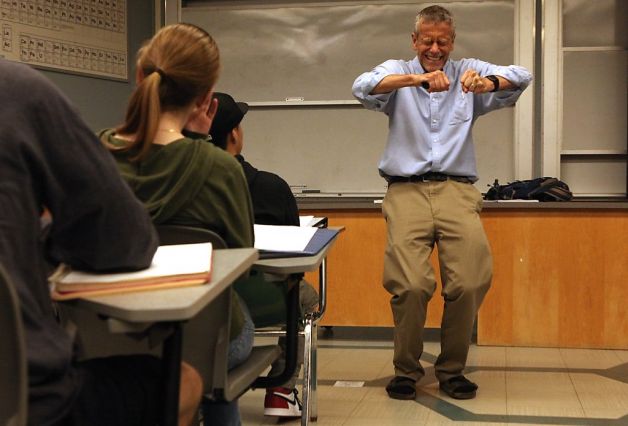
We start in a Holistic Health class where the professor intersperses his lectures with time for students to “get up and wiggle.” Professor Erik Peper ties this tool to his behavioral science research on the mind-body connection. Immediately, I was hooked in. Surely someone is going to mention theater at some point. How could they not? I read on.

The article mentions the stir psychologist William James made in the late 1800s when he ruminated on the connection between physiological and emotional responses. Which comes first, the bodily experience or the mental feeling? A chicken or egg kind of situation. Then the Gate article author jumps to early 21st century research about the influence of bodily action on mental state: a 2003 study on nodding or shaking heads that showed how the action influenced group opinions, a 2009 study showing sitting up straight improved confidence. There’s even a mention of “embodiment” —

Scientists who study the influence of the body on the mind, a subdiscipline of social psychology called embodiment, are only now beginning to understand the physiological underpinnings behind it.

— but instead of a turn to theater, the article moves further into the scientific domain, neuroscience, to illustrate emerging physiological evidence that appears to link physical action to emotional states/moods (and vice-versa).

Now, I’m not surprised. For this to be “news” it has to be illustrative of the “real world” connections and that equals scientific inquiry. I bring it up here not to chafe at the neglect of performing arts like dance & theater whose artistry is dependent upon unique strategies of connectivity between mind and body but to illustrate how certain scientific fields are studying the kind of connections you are exploring in your movement work with Kali. As we look for ways to access greater paths of connection between the physical worlds you all have been exploring in workshop and the textual landscape of the script, it seems important to recognize how these psychology and neuroscience studies are searching for some similar kinds of connections just in a different domain.

“If I do a power pose, that sends signals up to the brain, and it says ‘I’m feeling powerful,’ ” said [Dana] Carney [social psychologist at UC-Berkeley]. “It starts as a neural impulse and then ends up acting a little bit like a drug.”

In the study, those signals, for example, triggered the production of testosterone and decreased levels of cortisol, making a person feel more confident and less stressed. What is still unclear is the exact pathway those signals take.

“We are just defining now what those pathways might be,” said Carney. “The knowledge will come … but science is slow.”

Peper, the SFSU scientist, readily espouses his philosophy to any available ears – including the reporter, who he instructed to put down the phone and stretch “toward the sky” for a few minutes.

“Just get up and do some active movement for a moment, then observe yourself,” he said.

Philosophy and religion have long debated the nature of the mind-body relationship.

James, the 19th century psychologist, inspired a wave of criticism that lasted long after his death. Since James’ era, what has emerged is a picture of emotion that is much more complex. Sometimes, a mood is perhaps tied to the physiological. Sometimes perhaps it’s not. Scientists still disagree.

Don’t worry scientists. Artists disagree too.

“It’s complicated.”

Professor Erik Peper talks about stress in his holistic health class at San Francisco State University. Much of his work focuses on how posture can affect mood. Photo: Liz Hafalia, The Chronicle

Professor Erik Peper talks about stress in his holistic health class at San Francisco State University. Much of his work focuses on how posture can affect mood. Photo: Liz Hafalia, The Chronicle