


Abstract
On average, home gardens require 5 hours a week to make sure they stay healthy. This creates a problem for millions of people who want to have a garden but lack the time to care for one. To combat this, we created Irrisprout, a household scale irrigation system that adjusts output based on measured soil conditions and is controlled by an easy to use app.
Problem Statement
There has always been people who struggle with gardening and finding time to take care of their plants. Having something that can help people keep their plants alive by automating the watering and soil regulating process would greatly improve the availability of gardening. Current solutions only have industrial purposes in mind, so we have set out to create a product that is catered to the general public.
Ideation
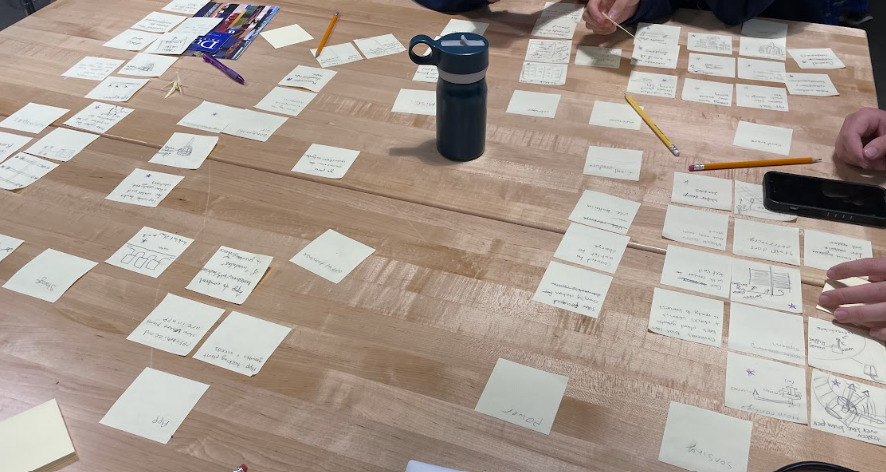
We spent 3 days using different brainstorming methods to figure out what type of irrigation system we wanted to create. We used sticky notes to brainstorm the different categories such as sensing, distribution, and the app.
Sorting our ideas by functionality
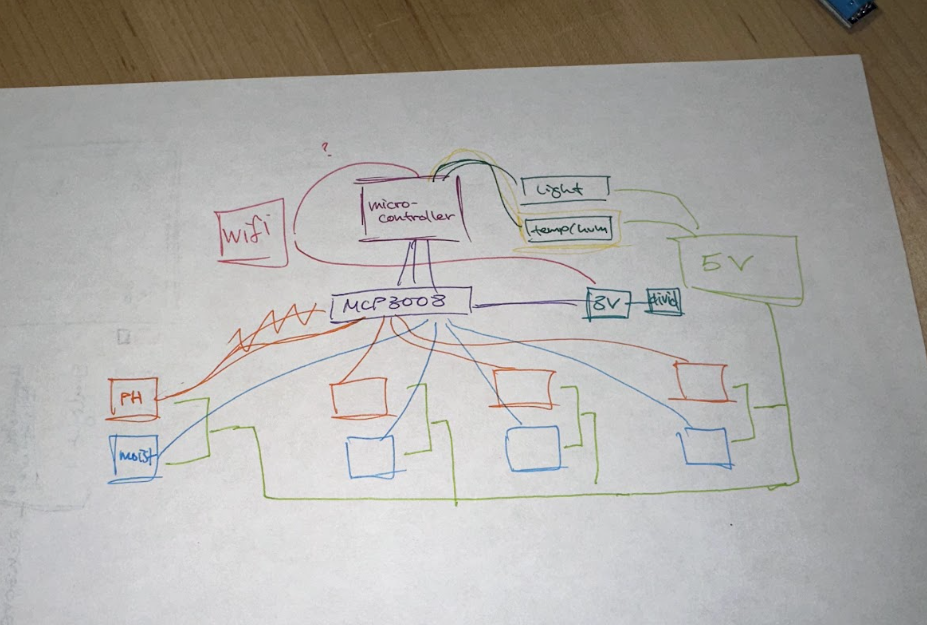
Initial system schematic
Design Criteria and Objectives
- Take soil condition measurements every 6 hours
- Sense the pH of the soil with +- 0.3 error
- Store water and pH buffer solutions for at least a week
- Easy to use and customizable mobile app
- Distribute water without much loss
Design Evolution: Sensing
Our main goal for sensing is to have a product that senses the soil accurately and efficiently. During this process, we focused on four main sensors: soil moisture sensors, pH sensors, and humidity + temperature sensors and photoresistors. The Soil Moisture sensor checks to see if the soil is damp, wet, dry, or in water, the Humidity and Temperature sensor outputs the relative humidity and temperature of the air, and the photoresistor senses the intensity of sunlight. All of this helps us better understand the environment of the plants. We also used a pH sensor to help us know if we need to send more acid or base to the plants to keep them in an optimal environment. To connect the sensors to the app, we used an ESP32, which is a Bluetooth module used with Arduino. We were able to connect the Arduino to the ESP32 and connect all of that to the App so data from the sensor can be outputted and stored in the app.
Testing the soil moisture sensors
ESP32 Bluetooth module
Design Evolution: pH Balancing
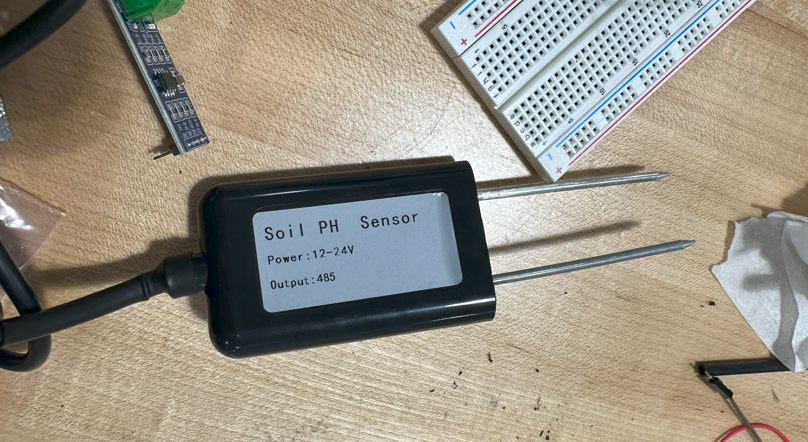
We looked around Amazon and decided on one that had an RS485 output. In order for the RS485 signal to be transmitted to the Arduino, we needed a MAX485 module connected in between the pH sensor and the Arduino. We found pH up and down solutions for the soil and researched how much solution is be needed to change the soil pH by a certain amount. Through extensive testing, we discovered that the pH sensor did not give us the correct output voltage in order for the data to be read. This then led to us doing more research on alternative sensors that have outputs that would directly translate to something the Arduino can read.
The soil pH Sensor
Design Evolution: Storage
We used two 2.5-gallon water containers to hold the pH up and down solutions and the water. We placed a water pump in each container to pump the solutions into our pipes. We added some load cells to notify the app to tell when to refill the containers.
Storage tanks for water and pH buffer solutions
Design Evolution: App
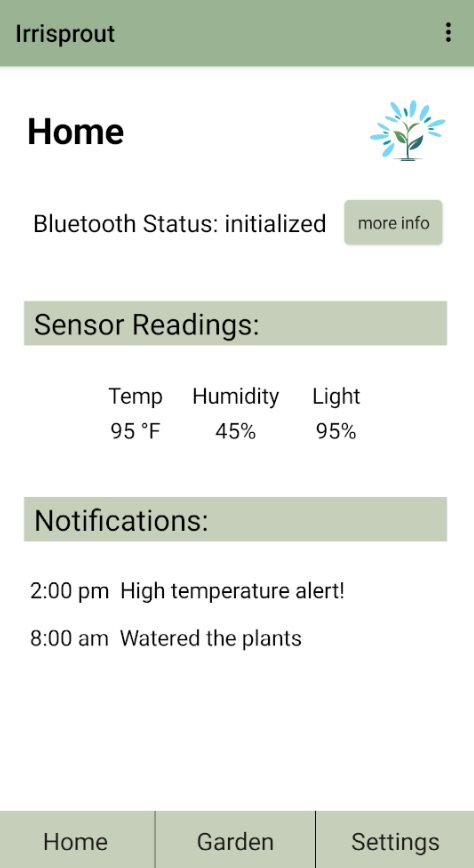
We created our app using MIT App inventor to connect with our ESP Bluetooth device. Users navigate using large and clearly marked buttons and can quickly see the status of their plants through garden summaries and notifications. Our app is able to customize to their specific garden and track when the plants have been watered. To decrease the amount of knowledge users need, it automatically compares soil readings to a chart of ideal conditions.
The app’s Home screen
A quick summary of each plant’s health
A demonstration of the setup process
Design Evolution: Distribution
We used flexible clear tubing throughout our distribution system in order to better monitor the transport of water and pH buffers so that maintenance and repairs can be streamlined. To control the flow of liquids, we are using solenoid valves, which are hooked up to our Arduino microcontroller. These valves are programmed to open when the moisture sensor detects that the soil is drier than the optimal levels and close once this set level is met. For the drip irrigation prototype, we have tubing running directly to the stems of each plant, where the liquids will be deposited.
Layout of the tubing system
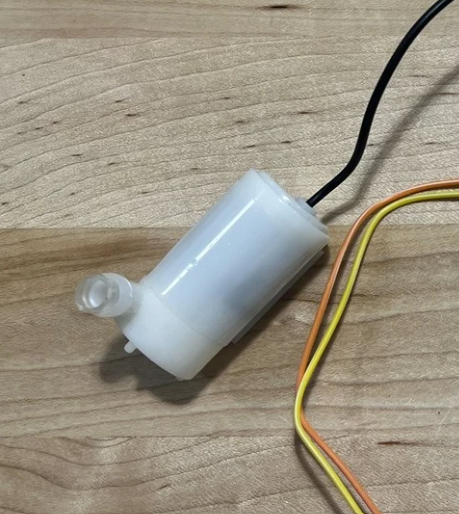
Submersible water pump
Final Product
Project Video
Future Work
We plan to scale our prototype for larger gardens, as well as incorporate nutrient sensors so the system can check the nutrients of the individual plants and better cater to their needs. We also hope to fully incorporate the pH sensors, since we started working with it but weren’t able to get accurate readings. In addition to this, we plan to send the data received from the Arduino to an online database so plant owners can monitor their garden from further away and track the plants’ needs over time.
Database References
Arcuri, Lauren. “How to Grow Garlic.” The Spruce, 23 Sept. 2021, www.thespruce.com/grow-great-garlic-3016629.
Bonnie Plants Editors. “How to Grow Lavender | Lavender Planting & Growing Tips.” Bonnie Plants, bonnieplants.com/blogs/how-to-grow/growing-lavender.
—. “How to Grow Oregano Plants | Planting & General Growing Tips.” Bonnie Plants, bonnieplants.com/blogs/how-to-grow/growing-oregano.
Iannotti, Marie. “How to Grow and Care for Oregano.” The Spruce, 10 May 2022, www.thespruce.com/growing-oregano-plants-1402818.
—. “How to Grow Fragrant Lavender.” The Spruce, 18 Mar. 2024, www.thespruce.com/growing-lavender-1402779.
Rankel, Kiersten. “What Temperature Does My Garlic Need?” Greg App, 18 June 2024, greg.app/garlic-temperature/. Accessed 9 July 2024.
Tilley, Nikki, and Bonnie Grant. “Growing Rosemary Plants: Rosemary Plant Care.” Gardening Know How, 4 July 2019, www.gardeningknowhow.com/edible/herbs/rosemary/growing-rosemary-plants-rosemary-plant-care.htm.
Meet the Team
Caroline Wang
Yinan Feng
Grace Zheng
Caden Bailey
Shreelakshya Reddi
Tubing system, programming solenoid valves, video editing, graphic design
Sensor cases, testing pH sensor, programming water pump
User interface and app design, data storage and retrieval, website design
Liquid storage, building and maintaining the garden, soldering
Soil and air sensors, ESP32 Bluetooth module, programming the Arduino