Abstract
Roughly 365 million people around the world suffer from arthritis, a debilitating disease that causes joint inflammation in various places around the body. Those who suffer from arthritis experience chronic pain, and struggle to complete basic tasks. While arthritis has no known cure, certain treatments can help alleviate the pain. Unfortunately, current solutions fail to combine heat and pressure – two proven ways to reduce arthritis pain – while remaining customizable to various individual needs. Our product, MedPress is an adjustable wrap for the wrist and thumb joints of the hand that uses pressure and heat to combat arthritis pain. Specifically, our wrap provides adjustable Acupoints designed to target pressure points, as well as heating coils that heat the skin.
Problem Statement
MedPress represents a new advancement in arthritis pain management by utilizing a combination of heat and pressure. Unlike current products on the market, which primarily rely on medication or a device with one function, MedPress offers a solution that aims to effectively alleviate arthritis pain while being both user-friendly and customizable to individual needs. MedPress aims to enhance the quality of life for arthritis patients, offering a safe and enjoyable alternative to traditional pain management methods
Design Alternatives
When we were brainstorming ideas we had a few design alternatives for multiple parts of the device:
Heating Method:
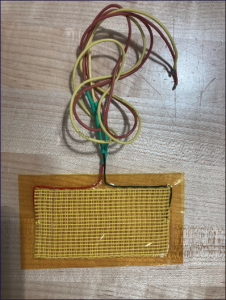
- Heating wires – This was one of our original ideas to heat our brace, however the heat emitted from the wires we originally tested was far to little to decrease arthritis pain. We looked into several other heating wire options but all of them were for industrial use only and the heat emitted was much higher then our target degrees. Additionally we couldn’t find heating wires that were the correct size and shape we needed, most were too bulky or small to fit around the wrist.
Pressure application:
- Water balloon – This was one of the first ideas we had to apply pressure: some sort of bag that the patient could fill with water until the desired pressure was achieved, however it was too messy for our liking and we didn’t think someone with arthritis could easily fill it up.
- Compression fabric – This idea was good but we couldn’t find compression fabric that would tighten enough on its own to fit our goal pressure. We did however end up implementing this in our final design because of its durability along with our pressure points and inflation method.
Tightening device (For size customization):
- Tape – This was an option we were seriously considering as the tape did a great job of letting patients tighten/loosen the brace as much as they wanted. Unfortunately though, it only had a couple of uses and the stickiness would wear out over time making it less effective.
- Magnets – This option had a lot of potential as it was very durable and pretty easy to attach, however we could only figure out how to add 3 different size options meaning it wasn’t fully customizable which was one of our design criteria. It also weighed the brace down a considerable amount making it harder to move and therefore not a good choice for patients with arthritis.
Chosen ideas
Heating Method:
- Heating wires – We chose these as they were able to fit the size of the brace, and the heating was customizable meaning patients could choose the temperature that best fit their needs.
Pressure application:
- Acupoints – We chose these as they are effectively able to target the main pressure points where patients feel the most pain. Further, the Acupoints simulate the feeling of a hand massage for patients.
- Air pressure cuff – This was the best method of applying pressure from the ones we researched. After being inflated, it pushes in the Acupoints adding more pressure to areas of discomfort making it a very effective treatment solution.
Tightening device:
- Velcro – This was comfortable, customizable, and easy to apply making it by far the most effective method of attachment we found.
Design Criteria
- Uses pressure:
- (15 -32mmHg)
- Uses heat (80-120 F)
- Targets 3 pressure points
- Lasts for more then 1 year
- Fits child and adult wrists
- Comfortable and durable
- Insulating
Design Evolution
Cloth model 1.0 – Gave us a look into the general shape and size of the brace
Cloth model 2.0 – Added Acupoints to apply pressure and velcro to make it adjustable
Cloth model 3.0 – Made acupoints adjustable and added inflatable bag to increase pressure
Testing
Heating Pad Testing
Pressure Testing
Once the air bag providing pressure was inflatable, we used a pressure sensor to test the pressure. The maximum pressure reading was roughly 92 mmHg.
Final Elements

This is the final design of our air pump. The white nozzle on the white and grey cylinder, attaches to the black tube on our rubber bubble to inflate it to the right pressure. The silver switch in the bottom right corner is the off and on switch. Patients can easily switch the pump off when their desired pressure is reached allowing them to customize their care. It is also housed in a box for easy storage and transportation.

The material we chose for our final design is a thick cotton fabric as it comfortable against the skin and acts as insulation to keep the heat in. The larger strip with the “Hand” label is the strip that will wrap around the hand while the “Thumb” strip will wrap around the thumb.

The picture above is one of our 3D printed Acupoints (Red half-sphere) attached to our adjustable loops. The adjustable loops attach to the outside strap and are movable to ensure that the patient can customize where they need the Acupoints to be.
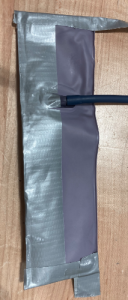
This is our inflatable bubble used to apply pressure around the wrist. We created it by deconstructing a blood pressure cuff and cutting up the rubber bladder on the inside. The black tube attaches to our pump and is able to inflate it our goal pressure (15-32 mmHg)
Final Product
Cloth model 4.0 – Has all needed features including inflatable bag, heating pad, adjustable straps, and Acupoints
Next Steps
If we had more time to work on the project some elements we would have added to our product would be:
- Ensuring more of the materials were recyclable
- Adding an embedded to make it easier for users to change their desired pressure setting
- Making the design smaller and more compact
Final presentation video
Sources
- Arthritis.org
- ArthritisFoundation.org
- Eastwestphysiotherapy.com
- Mydoctor.kaiserpermanente.org
- Nlm.nih.gov
Our Team
Left to right: Lylah Camire, Charlize Von Spiegel, Juliet Koenig, Ishaan Mangal, Lucas Duffy, and Harrison Berg