Category Archives: Uncategorized

Desan – how the plastic became alive

The words have come today. The stories make living on the sea better, they give me a chance to get away from it. The short works are worth more than any amount of Pagrus-plastious stratus that I can catch. I can tell that It is trying to wipe away my memories so books let me experience new ones.

I fear I will lose my ability to experience sensation to it. 2 years ago when I left, there were hundreds of story-makers. I used to be able to get a story in a few days for a small Mercluccius-plastious australis. But as the tides continue to rise, the story tellers are forced from their homes. No one can write on the sea, that is well known. Now I know of only 5 story makers and the price of their service has has continued to rise as the lengths between receiving stories grow. The balloon captain said that it seems like they will lose all of the native Island story tellers in the next 2 months, so they will try to expand their air routes north in hopes to find new ones.

I remember when anyone could write a story. We were warned that the amount of plastic in the animals we were eating had reach toxic levels but no one listened. No one wanted to change their regular diet. We all said it was to too hard to change our habits but now that we are living like this we realize how stupid we were.

We kept eating and eating and eating. Then, the 1-hour-WAR happened. The plastic was beginning to turn people mad all those decades ago. One of the United States 4 star generals went mad and fired the entire nuclear arsenal on the world. and the world fired back. The radiation from all the bombs caused the temperature of the world to soar and melt every piece of ice on the planet and destroy the Ozone. Waters rose hundreds of feet. What we did not see coming was the effects of the fall-out.

All the plastic inside of us became alive. The same thing happened to the animals and plants. That is why all animals know have “plastious” added on to their scientific name. No one could figure out how the radiation made the plastic alive in us and I do not think we ever will. Everyone is too infected to figure it out.

Now we just wonder the empty oceans waiting for the words. the words that will let us be free for only a moment.

It is becoming stronger, I can tell. It has taken me several weeks to record this and I have already forgotten what I have said in the beginning.

A Visual Lesson on Feminism

Reverie of a Familiar Place

(Is silence deafening?)

I often sit at the bottom of this valley at sunset, gazing lovingly across the land of my father, of his father, of his father, and of the others before him. In the faint bubbling of the stream, I hear my sister’s glee filled laugh as a rainbow trout flies out of the water and dances above his reflection on the underwater world, fighting her hook. In the distant barks of the elk, I hear my father exclaim when he spots the huge heard with binoculars during their annual migration. In the wind I hear my mother’s whispers, her words of wisdom gently shaking the pine trees that stretch to the heavens and creating waves across the sea of grass all the way to the horizon. Every small sound echoes across the landscape.

[If a person shares her thoughts, and no one is around to hear her, does she make a sound?]

In such a serene setting, hours from any light pollution, I would tell everyone at home about the innumerable stars at this amazing place. Now, I am the only one here to experience it, and have no one with which to share its majesty. In fact, I never will. I guess there is the truth that this place remains special to me, and that should be what matters. But will the streams, the elk, or the wind hold the same reverence for this place as my family did? As I still do? When I am gone as all the others have, will this place keep existing, a place of miracle, somehow untouched from the carnage we wreaked upon ourselves? Or is it only the existence of human thought that makes this place, or any place for that matter, seemingly remarkable?

{Is all beauty lost if there is no beholder?}

Photo Ark and Apathy

In a stroke of absolute luck and incalculable coincidence, I got to hear Joel Sartore speak, just three days after watching his photos project across buildings worldwide in the final minutes of Racing Extinction. Sart0re travels month after month in an attempt to photograph each of the almost twenty-thousand species currently living in captivity; a project called the Photo Ark. Through his work, Sartore has seen species after species pushed out of their habitats by human consumption, and left to fade into existence only on the pages of history books.

His portrait-style photos aim to capture charismatic vignettes of the animals, which he then gives back to the zoos to use in promotional material, or publishes online. During the Q&A session after his talk, someone asked Sartore why, if these animals are so endangered, he takes character shots, instead of more scientific ones? He replied that science already has the anatomical shots of dead animals, and that his job is to make people care about the still Very Much Alive ones. Dead animals unfortunately don’t get much press, like the extinction of the Rabb’s fringe-limbed tree frog, which was allocated a trivial 264-word story by the Associated Press. That’s shorter than this blog post, and far shorter that their 798-word story on Taylor Swift’s concert at Formula One.

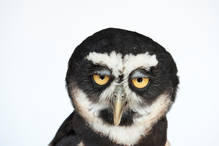
Sartore’s photos are meant to alleviate apathy, and to give the public something to connect with. Most of the animals, like those below, face this ambitious task with direct eye contact. In his talk, Sartore mentioned that his focus on the eyes is meant to humanize animals and help people find something in them worth saving.

The Photo Ark started as a passion project, and now the photos have acted as catalysts for species conservation and education worldwide. It is his hope that the Ark photographs will change the way our world views the loss of biodiversity. In addition to his environmental art, Sartore uses public speaking as a platform to call young minds action. He speaks primarily for younger audiences, imploring them to find something that they care about. He finished his Duke talk with the following:

People ask me what they can do to save these animals. You have to find something that you are fiercely passionate about and become the best at it- which will happen if you have enough passion, trust me- and then use that thing to change the world. It is folly to think that we can destroy one species and ecosystem after another and not affect humanity. When we save species, we’re actually saving ourselves.

All photos courtesy of Joel Sartore.

Blog Post 8 – Ryan Bronstein

In Carbon Diaries, Saci Lloyd introduces the carbon card, a radical concept that forces citizens to combat climate change through a carbon quota. It is my opinion that this could do a lot of good things in the United States today. Obviously, a carbon quota at the individual level could greatly reduce America’s carbon footprint, depending on the size of the quota. Additionally, in a way, it officially condemns our unsustainable overconsumption, thus creating a foundation upon which new perceptions of the environment — ones that acknowledge the need for sustainability — can be built. Despite what the carbon card could provide, a roadblock appears in its way: who is going to want it? The simple answer is that very few people will want to give up a great portion of their consumption. Whether it’s wearing a new outfit every day, drinking bottled water instead of fountained water, or watching television for hours, the average American likes to overconsume relative to what he or she actually needs. This raises the notion that perhaps a carbon card is out of reach from modern society because people simply do not want it. The story I would like you to think about is what if every citizen only did what they wanted to do at any given time? Where would our productivity come from? Would people go to work often enough to maintain economic growth? Most importantly, would anyone pay taxes? A quota has the same effect on consumer and producer surplus as a tax; therefore, if nobody wants the quota, surely nobody wants to be taxed. Yet people still pay taxes because if this country did not have taxes, it could not run effectively. There would be poor infrastructure and public schooling, if any at all. It is now easy to see that the real roadblock for a carbon card is not how we can make people want it because very few people ever will. Rather, the challenge is figuring out how to prove to the country that the needs of the environment are just as pressing as its need for tax revenue.

Blog #8 – Kevin Bhimani

Kevin Bhimani 3/24/17 Blog #8

Environmental Art

Seeing what our world has come to to express the need for change is a humbling moment. The need for ice sculptures to make an impact, or a visual representation of endangerment, or the need to show people what our future could look like with digital representations of the beautiful fauna that we see today gives a new perspective on our standing as a society. The type of environmental change art that has become an increasingly popular medium for commentary is alarming as it means we are not listening to the problems that we are facing. On one hand, the art itself is incredible at what it does. Having a visual representation of issues such as global warming for example, bring that to the front of people’s minds and they begin to inquire further as the impact that they can have is great. However, I believe the inherent notion for the need of this is what is troubling. The anti-environmental change rhetoric that is seemingly being more and more dispersed by the leaders of institutions does not bode well for our collective sentiment. The reasoning behind this is more complex dealing with private business-political ties, but that idea of greed against the well-being of our planet is an absolutely absurd concept to me. The ongoing battle between environmental artists and others in the space that are attempting to change people’s mindset and climate deniers is a discord that should not exist. Essentially it boils down to rooting for the destruction of our home vs. telling people to not partake in such activities and preserve the place we have been gifted. However, regardless of which side one lies on, nobody can deny that from the likes of Chris Jordan, Agnes Denes, Nils-Udo, and more the environmental art movement provides a great commentary on human nature and a glimpse of our future if we continue down the path we are on now.

New Lenses

Central Park, New York City Bethesda terrace “What If You Could See WiFi?”

After looking through the environmental art pieces by artist Nickoley Lamn which demonstrate what it be like if we could see seemingly intangible aspects of digital life such as cellular network and wifi, I found myself viewing the world in all new ways. I began to see the world through a lens of viewing the carbon footprint of all of my actions and products that I have bought. I want to be clear that this tale of realization is one of present times, and not a fantasy that I have imagined for some dystopian, end-of-the-world future. This is not climate fiction; this is reality. It began when I sat down for breakfast, the moment in the day in which I begin to reflect on all that needs to accomplished in the day. As flavors of tropical fruits and southern specialties exploded in my mouth, I started to taste something a little more sour, and it wasn’t the pineapple either. It was the thought of the carbon footprint that the fruit and grains had on the environment. I had never really thought about my food in this way, but the stories we have read and viewed have begun to infiltrate my thinking and behaviors. I moved on throughout my day, and I began to have this emotional tie to everything that i had already knew had a negative impact on the environment, but for some reason, now everything seemed distorted, cars seemed like monsters, trashcans seemed to be overfilling with unnecessary waste, and the sound of water running in the bathroom seemed to be beating my ears.This disgust I felt when simply eating fruit is, I suppose, the purpose of environmental humanities in the first place. To enlist an emotional response from the viewer or reader, which will in turn create a behavior change or at least a mindset change. Admittedly, the rest of the population who does not feel the importance of these issues already will not have the same response to stories and art about environmental issues. However, humanities do have the ability to tap into the subconsciousness of people that will gradually make a difference.

Blog Post 8 – Brandon Foreman

Abstract: Reading the first chapter of the Carbon Diaries introduced the possibility of living in a society drastically altered from today catalyzed by a certain occurrence. In the world presented to us, there was a great storm that ramped up pressure to cut back usage of carbon. Reflecting upon this story, I began to ponder the potential consequences of an opposite situation, where the world had tried to convert its approach towards energy; yet, as a result of a deadly explosion caused by the new approach or another failure, the world instead decided to maximize its dependence on fossil fuels, leading to extreme wealth inequality and disregard for environmental rights. The imagery of such a world is found below.