Author Archives: Jules Odendahl-James

a Chekhov to bind them

Apologies to J.R.R. Tolkien.

I’ve been thinking a great deal about the amazing work done with Kali in last Friday’s workshop. I’ve also been reading a lot from directors and actors (past and present) about their impressions about the playwright and his work, thinking specifically about how the Moscow Art Theater basically emerged as Chekhov’s theater, even though he worked with them for only the last 4-5 years of his life (since he died at age 44) and from that union of playwright and an emerging theater company grew so much of the structure, vocabulary and tone of we use in acting and playwriting study and practice today. To that end I wanted to share some observations about ensemble building from Trevor Nunn and Ian McKellen collected inThe Cambridge Companion to Chekhov (2000).

Nunn on gathering a group (which included McKellen) to work on The Three Sisters:

I could see that there was great value in doing a Chekhov; actors know that working on a Chekhov play is like to be a democratic experience and that everybody is required to provide an equal amount of contribution and initiative. The Chekhov play becomes ‘company-forming’ material. (102)

McKellen on his “next” Chekhov project:

I’m going to do Dorn in The Seagull this autumn [1998] at the West Yorkshire Playhouse, with Jude Kelly directing. That play is so essentially about theatre people that a company of actors can bring an awful lot of their own lives to it, even though it was written a hundred years ago and in another country. We’re going to set up a company of actors who can do three or four plays one after the other. As usual, in those circumstances, Chekhov immediately springs to mind as a very good way of binding a group. The major joy of Chekhov is the group that does it. Also, every detail of the relationships between the characters, whether they speak to each other much or not, is very clearly present in the text. It’s very easy and quick to read what the situation is, which isn’t true of Ibsen, for example. Chekhov is a wonderful friend to the actor. (131)

Astrov would be proud

From today’s Boston Globe story “New England Sees a Return of forests and wildlife

"Across New England, areas like the Swift River Valley (above, left, in the 1880s and in 2010) in Petersham have seen their forests, once cut down and cleared for farmland, replenished in the 21st century."

“Across New England, areas like the Swift River Valley (above, left, in the 1880s and in 2010) in Petersham have seen their forests, once cut down and cleared for farmland, replenished in the 21st century.”

“New England is undoing many excesses of the industrial age,’’ he said in an interview. “Stagnant waters aren’t just stirring — they are finally starting to flow fast. Fish are swimming freely to their ancient spawning places. Great birds are again bold in the sky.’’

Wetlands throb and slither with rejuvenated life. Rivers are quickening even in notoriously compromised corners of the region — the herring run on the Acushnet River in southeastern Massachusetts, for example, has rocketed from a few hundred fish to many thousands.

And bald eagles are soaring in skies that have not borne eagles for decades.

“Until 10 years ago, there were zero bald eagles — none — nesting in Vermont,’’ said John Buck, migratory bird project leader for the Vermont Wildlife Department. “Now there are 14 nesting pairs, hatching about 24 chicks. That sounds small, but it’s a big jump.’’

Chalk it up to taller trees, cleaner water, and plenty of prey, according to biologists.

Drawn from/of the land

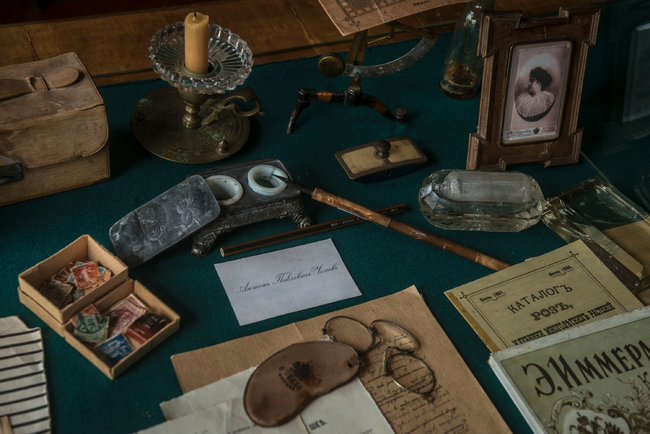
Perhaps it’s only fitting, given the prevalence of Chekhov’s plays on New York City stages in the past couple of years, but just a few weeks ago, the New York Times published this feature about Chekhov’s Melikhovo estate and the museum on/of its grounds tended so carefully (through turbulent times) by a devoted curatorial staff, especially Kseniya A. Tchailkovskaya who has worked at the estate for over 40 years (Marina?).

A couple of photographs and a section about the feel of the place when Chekhov was in his heyday caught my attention, esp. as I look at some of the place names referenced in Vanya which are thinly transformed references to the very real places and people that surrounded him and his working life (as playwright and doctor).


"Many artifacts came from the later Chekhov home in Yalta, enabling visitors today to get a full glimpse of a cramped family home in the late 19th century."

“Many artifacts came from the later Chekhov home in Yalta, enabling visitors today to get a full glimpse of a cramped family home in the late 19th century.”

When the Chekhovs lived here, she said, they entertained, gardened, painted and made music — the dacha pastimes of generations of Russians able to afford them. The playwright’s brother Aleksandr was a keen photographer, and scene upon scene of guests and family line the walls of the main wooden house, alongside works by renowned Russian artists — and visitors — like the painters Isaak I. Levitan and Vassily D. Polenov.

Chekhov, besides writing and taking part in the estate’s gostoprimstvo, or hospitality, also worked as a doctor, preparing his own medicines. He was always ready, Ms. Tchaikovskaya said, to treat even the poorest patient.

Chekhov’s guiding principle in doing so, she added, was “hasten to do good,” a maxim of Dr. Friedrich Haass, a revered chief doctor of Moscow prison hospitals in the 19th century.

Chekhov’s altruism and the modest proportions of his estate are a far cry from the all-out materialism and bigger-is-best mantra of oil-rich Russia today, where millions are still poor but millions of others are consuming as never before.

Perhaps the writer felt bound to serve not just because of his medical training but also because his own father, Pavel, started life as a serf, winning his freedom only at age 16.

"Chekhov’s country estate, which he bought at age 32, is where he wrote “The Seagull” and many other works."

“Chekhov’s country estate, which he bought at age 32, is where he wrote “The Seagull” and many other works.”

We go moment to moment

In my research, I found an amazing American Theater piece from March of 2005 curated by Todd London (Artistic Director of New Dramatists) who has interviewed Andre Gregory over the course of some years. The piece is titled “Gregory on the Non-Making of Uncle Vanya.” I’ve referenced another portion of Gregory’s “non-making” in another post and I’ll post the full text of London’s article on our Course Materials page, but I wanted to quote just a smidge here on the open blog. It’s part of a conversation Gregory had with Ruth Nelson the original actress to play Marina in the rehearsal/staged version of their Vanya (Phoebe Snow plays Marina in the film) before she died in 1992 (a death that came on the heels of a stroke she suffered the night before the Vanya stage performance’s last run-through). As you will read in the full article, much of the process of gathering the group of actors for the Vanya that we see in the movie was tinged with loss and many examples of the fragility and fleeting nature of existence but the insistence to create even (especially?) in the face of mortality.

Ruth Nelson said something amazing when I went to visit her a few days before she died. I said to her ‘Are you afraid, Ruth?’ And she said, ‘No. Dying is like our work. You just go moment to moment, and you don’t think of the end.’ “

Not only did it just choke me up immediately upon reading it, I found it an interesting contrast/compliement to Sonya’s final words about the rest and peace from toil that comes with death.


Inside-Out

The pared-down setting and the rehearsal props are reminiscent of Our Townbut Thornton Wilder used those devices to keep the audience aware that they were watching a play; Gregory and Malle use them, paradoxically, to show how little the details of setting matter when the details of character are worked through and profoundly right. At some point in the first act, we stop noticing that we’re not watching a fully designed production—or if the thought does occur to us now and then, it’s as an emissary from the real world pinching us to remind us that this is a movie of a rehearsal of a play, before we forget again and are swept up in the emotional turmoil of the characters’ lives. The key item in the movie for exploring this notion is the “I  New York” coffee cup on the dining room table, an anachronism that becomes merely part of the fabric of the setting, imbued like everything else with the indolent, unsettled atmosphere of this Russian country estate. This interaction of late-twentieth-century New York actors with a turn-of-the-century Russian text acknowledges both and celebrates the tension between them as well as the overlap. That’s why the music we hear behind the opening and end credits isn’t, say, a balalaika melody but a marvelous jazz score by Joshua Redman. The point is that Uncle Vanya speaks as powerfully to contemporary Americans as it did to Russians at the sunset of the age of the czars. The magnificence of the performers, perhaps the most extraordinary group of actors ever gathered to bring Chekhov’s play to life, confirms it.

From Steven Vineberg’s review of Vanya on 42nd Street “An American Vanya” as packaged by Criterion Collection for DVD release. The bolded section reminded me a bit of our conversation after the viewing of Gregory’s film last Friday and how this production seeks to invest the audience deeply in the complex inner worlds of these characters paradoxically (perhaps) as a way to open a window into the very constructed process of making those characters. To be both transparent and immersive … that is our challenge.

Experimental Parameters

As promised, a list of the parameters of our experiment that I read aloud at our Friday, Aug. 30th class meeting.

    1. Theater is a space of imagination, thoughtfully informed by worlds, times, and experiences outside its space.
    2. Within Uncle Vanya characters’ realities are driven by feelings and their ability/inability to be articulated through language and action.
    3. The purpose of character teams casting is to offer actors a chance to unlock a shared, yet separate, understanding of complex characters by making specific, detailed choices born in the space where language and physicality meet. This approach offers an audience the chance to pay close attention to character construction through actor performance.
    4. We seek to disrupt our audience’s nostalgia about historical realism by focusing their attention on our fabricated world within the walls of Sheafer. We are offering the audience a glimpse into the process of constructing theatrical reality — just as the characters seem to be processing the notion of “how did I get here?” in their lives. Everything is transparent and open but not improvisatory, simplistic, or unprepared.
    5. Baker writes of her approach to the text,

The goal was to create a version that would make Chekhov happy; to create a version that sounds to our contemporary American ears the way the play sounded to Russian ears during the play’s first productions in the provinces in 1898.

We seek a similar, lofty goal: to create a version that appears as something new, unseen before and yet ultimately recognizable and relatable to our contemporary Duke University audience.

And a few of the items Jeff mentioned about performance conventions:

  • We will be thinking about Chekhov’s vaudevilles and the swing of the pendulum in his major works between farce and trageey; laughter and tears.
  • Some characters will be broader in their performance than others based on their actions and given circumstances.
  • Audience members (both on and off-stage) are always aware that we are watching a rehearsal/performance of the play (as in Vanya on 42nd Street).
  • Music is used for transitions and, in vaudeville terms, interludes (possible song & dance moments).
  • Character teams work together, helping each other prepare for their chance to tell the story.
  • Age will be achieved with costume, props, movement, voice. Not makeup.

Vanya Echoes in Endgame

NAGG: Do you hear him? A heart in his head! (He chuckles cautiously.)

NELLOne mustn’t laugh at those things, Nagg. Why must you always laugh at them?

NAGG: Not so loud!

NELL (without lowering her voice): Nothing is funnier than unhappiness, I grant you that.

But—

NAGG (shocked): Oh!

NELL: Yes, yes, it’s the most comical thing in the world. And we laugh, we laugh, with a will, in the beginning. But it’s always the same thing. Yes, it’s like the funny story we have heard too often, we still find it funny, but we don’t laugh any more.

Frances Cuka as Nell and Richard Goolden as Nagg in the first English-language production in 1958.

Frances Cuka as Nell and Richard Goolden as Nagg in the first English-language production in 1958.