
About the Gene Golub SIAM Summer School
The Gene Golub SIAM Summer School (G2S3) is an annual summer school supported by the Society for Industrial and Applied Mathematics (SIAM) through the Gene Golub legacy. The program is designed primarily for graduate students in mathematics, applied mathematics, computational sciences, and related fields. Each school focuses on an active area of applied and computational mathematics and combines lectures with opportunities for discussion, problem solving, hands-on activities, and mentoring.
The 2026 Gene Golub SIAM Summer School on Quantum Computing at Duke University brings together students, lecturers, and researchers to study the computational and mathematical foundations of quantum algorithms, with an emphasis on fault-tolerant quantum algorithms and their applications. This year, we are excited to bring together about 75 participants, mostly PhD students in applied mathematics, mathematics, and computational science. The program will also feature 16 lecturers, panelists, faculty organizers, and faculty guests who will engage with participants at various points during the summer school.
More information about the Gene Golub SIAM Summer School series, including past schools, can be found on the
Acknowledgements
We thank the faculty organizing committee for their guidance and contributions to the scientific program:
 Robert Calderbank |
 Di Fang |
 Jianfeng Lu |
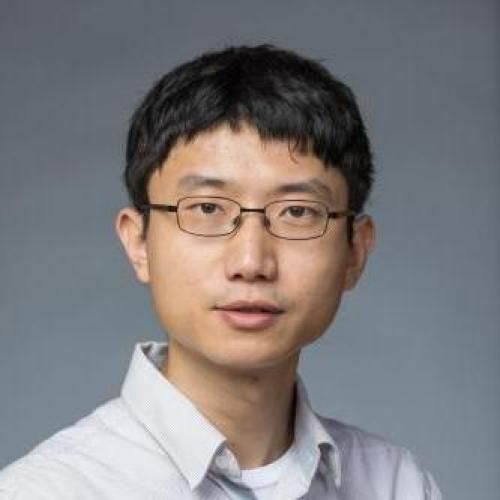 Yu Tong |
 Hongkai Zhao |
We are grateful to the leadership of the Duke host units for their support of the summer school:
Hongkai Zhao, Chair of the Department of Mathematics; Jonathan Mattingly, Director of the Rhodes Information Initiative at Duke; and Ken Brown, Director of the Duke Quantum Center.
We are especially grateful to the staff supporters and volunteers whose administrative, logistical, and programmatic support has been essential to the organization of the summer school: Kristen Gerondelis (Duke Rhodes iiD), Griffin Orlando (Duke Research & Innovation), Sheronda Toomer (Duke Math), Stacey Johnson (Duke Math), Margo Ginsberg (Duke Quantum Center), Ariel Dawn (Duke Rhodes iiD) and Kei George (Computer Tech at Duke).
We also thank the student organizing assistants and volunteers: Jiaqi Zhang and Volya Okrut.
We also thank all of the Duke Quantum Center student/postdoc/faculty volunteers who led the Duke Quantum Center lab tours, including those who joined on site! A non-exhaustive list of DQC volunteers is:
- Duanyang Wang (Ken Brown Lab)
- Prof. Marko Cetina, Damian Schon, Nathan Taylor, Jonas Tost, and Tianyi Wang (Marko Cetina Lab)
- Kate Choi, David Lloyd George, and Ian Wildemann (Jungsang Kim Lab)
- Sujay Kazi (Iman Marvian Theory Group)
- Vivian Zhang (Chris Monroe Lab)
- Connor Bowerman and Ryan Cody (Travis Nicholson Lab)
- Jerry Chen (Crystal Noel Lab)
We gratefully acknowledge the support of SIAM, the Duke University Department of Mathematics, the Rhodes Information Initiative at Duke, the Duke Quantum Center, the DOE QUACQ collaboration DE-SC0025572, and the NSF DMS-2438074. Their support makes it possible to bring together students and lecturers for this two-week program at Duke.


