
1) Goal Directedness, Purpose, & Passion
Boyle, R., E. Moody, G. Babcock, D.W. McShea, S. Álvarez-Carretero, T. Lenton, and P. Donoghue. 2025. Persistence-selection between simulated biogeochemical cycle variants for their distinct effects on the Earth-system. Proc. Nat. Acad Sci. USA. https://doi.org/10.1073/pnas.2406344122. Persistence selection.
McShea, D.W. and G. Babcock. 2024. Elusive but everywhere: A new theory argues that unseen ‘fields’ guide all goal-directed things in the Universe, from falling rocks to voyaging turtles. Aeon. 4 November 2024. https://aeon.co/essays/a-new-field-theory-reveals-the-hidden-forces-that-guide-us. Elusive but everywhere.
McShea, D.W. and G Babcock. 2024. Four false dichotomies in the study of teleology. Ratio. 37:358–372. http://doi.org/10.1111/rati.12422. Four false dichotomies.
Babcock, G. and D.W. McShea. 2024. Goal directedness and the field concept. Philosophy of Science 91(5):1435-1444. https://doi.org/10.1017/psa.2023.121. The field concept.
Babcock, G. and D.W. McShea. 2024. Agency as internal control. In: A.Fabregas-Tejeda, J. Baedke, G.I. Prieto, and G Radick, eds. The Riddle of Organismal Agency: New Historical and Philosophical Reflections, pp. 207-222. London: Routledge. Agency as internal control.
McShea, D.W. 2023. Evolutionary trends and goal directedness. Synthese. 201:178. https://doi.org/10.1007/s11229-023-04164-9. Trends and goal directedness.
Babcock, G. and D.W. McShea. 2022. Resolving teleology’s false dilemma. Biological Journal of the Linnean Society. https://doi.org/10.1093/biolinnean/blac058. False dilemma.
Babcock, G. and D.W. McShea. 2021. An externalist teleology. Synthese,199:8755–8780. https://doi.org/10.1007/s11229-021-03181-w. Externalist teleology.
Lee, J.G. and D.W. McShea. 2020. Operationalizing goal directedness: An empirical route to advancing a philosophical discussion. Philosophy, Theory, and Practice in Biology, 12, 5. Operationalizing goal directedness
McShea, D.W. 2017. Logic, passion, and the problem of convergence. Journal of the Royal Society Interface Focus 7: 20160122. http://dx.doi.org/10.1098/rsfs.2016.0122. Logic, Passion
McShea, D.W. 2016. Hierarchy: The source of teleology in evolution. In: Evolutionary Theory: A Hierarchical Perspective, N. Eldredge et al., eds., pp. 86-102. University of Chicago Press, Chicago. Hierarchy and teleology
McShea, D.W. 2016. Freedom and purpose in biology. Studies in History and Philosophy of Biological and Biomedical Sciences 58:64-72. Freedom and purpose
McShea, D.W. 2013. Machine wanting. Studies in History and Philosophy of Biological and Biomedical Sciences 44:679-687. Machine wanting
McShea, D.W. 2012. Upper-directed systems: A new approach to teleology in biology. Biology and Philosophy 27:663-684. Teleology
McShea, D.W. 1999. Feelings as the proximate cause of behavior. In: Where Psychology Meets Biology: Philosophical Essays, V.G. Hardcastle, ed., pp. 181-200. Cambridge, MA: MIT Press. Feelings as proximate cause
McShea, R.J. and D.W. McShea. 1999. Biology and value theory. In: Biology and the Foundations of Ethics, J. Maienschein & M. Ruse, eds., pp. 307-327. Cambridge: Cambridge U. Press. Biology & value theory
2) The Zero-Force Evolutionary Law
Brandon, R.N. and D.W. McShea. 2020. The Missing Two-Thirds of Evolutionary Theory. Cambridge University Press. Missing Two Thirds
McShea, D.W., S.C. Wang, and R.N. Brandon. 2019. A quantitative formulation of biology’s first law. Evolution. 73(6): 1101-1115, DOI: 10.1111/evo.13735. Quantitative formulation
Fleming, L. and D.W. McShea. 2013. Drosophila mutants suggest a strong drive toward complexity in evolution. Evolution and Development 15:53-62. Drosophila complexity
McShea, D.W. and W. Hordijk. 2013. Complexity by subtraction. Evolutionary Biology 40:504-520. Complexity by subtraction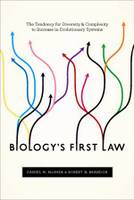
McShea, D.W. and R.N. Brandon. 2010. Biology’s First Law, University of Chicago Press.
McShea, D.W. 2005. The evolution of complexity without natural selection, a possible large-scale trend of the fourth kind. Paleobiology (Supplement) 31:146-156. Trends of the fourth kind-ZFEL
3) Complexity
McShea, D.W. 2021. The evolution of complexity. In: Evolutionary Developmental Biology, L. Nuño de la Rosa and G.B. Müller, eds. Springer. https://doi.org/10.1007/978-3-319-33038-9_123-1. Evolution of complexity.
McShea, D.W. 2002. A complexity drain on cells in the evolution of multicellularity. Evolution 56:441-452. Complexity drain
McShea, D.W. and E.P. Venit. 2001. What is a part? In: The Character Concept in Evolutionary Biology. G.P. Wagner, ed., pp. 259-284. San Diego: Academic Press. What is a part?
McShea, D.W. 2000. Functional complexity in organisms: parts as proxies. Biology and Philosophy 15:641-668. Parts as proxies
McShea, D.W. 1996. Metazoan complexity and evolution: Is there a trend? Evolution 50:477-492. Metazoan complexity
McShea, D.W. 1994. Mechanisms of large-scale evolutionary trends. Evolution 48:1747-1763. Mechanisms
McShea, D.W. 1993. Evolutionary change in the morphological complexity of the mammalian vertebral column. Evolution 47:730-740. Vertebral column
McShea, D.W. 1992. A metric for the study of evolutionary trends in the complexity of serial structures. Biological Journal of the Linnean Society 45:39 55. Metric
McShea, D.W. 1991. Complexity and evolution: what everybody knows. Biology and Philosophy 6:303 324. What everybody knows
4) Hierarchy & the Major Transitions
McShea, D.,W. 2023. Four reasons for skepticism about a human major transition in social individuality. Phil.Trans. R. Soc. B. 378: 20210403. https://doi.org/10.1098/rstb.2021.0403. Four reasons for skepticism.
de Castro, C. and D.W. McShea. 2022. Applying the Prigogine view of dissipative systems to the major transitions in evolution. Paleobiology, 48(4), 711-728. https://doi.org/10.1017/pab.2022.7. Prigogine and the major transitions.
McShea, D.W. and C.G. Simpson. 2011. The miscellaneous transitions in evolution. In: The Major Transitions in Evolution Revisited, B. Calcott and K. Sterelny, eds., pp. 19-33. Vienna Series in Theoretical Biology. The MIT Press, Cambridge, MA. MiscellaneousTransitions
Marcot, J. and D.W. McShea. 2007. Increasing hierarchical complexity throughout the history of life: phylogenetic tests of trend mechanisms. Paleobiology 33:182-200. Hierarchy trend mechanism
McShea, D.W. and M.A. Changizi. 2003. Three puzzles in hierarchical evolution. Integrative and Comparative Biology 43:74-81. Three puzzles
McShea, D.W. and E.P. Venit. 2002. Testing for bias in the evolution of coloniality: A demonstration in cyclostome bryozoans. Paleobiology 28:308-327. Testing for coloniality bias
McShea, D.W. 2001. The hierarchical structure of organisms: a scale and documentation of a trend in the maximum. Paleobiology 27:405-423. Hierarchical structure
Anderson, C., and D.W. McShea. 2001. Individual versus social complexity, with particular reference to ant colonies. Biological Reviews (of the Cambridge Philosophical Society) 76: 211 237. Individual vs. social complexity
McShea, D.W. 2001. The “minor transitions” in hierarchical evolution and the question of directional bias. Journal of Evolutionary Biology 14:502-518. Minor transitions
5) Evolutionary Progress
McShea, D.W. 2023. Evolutionary success. In: H. Desmond and G. Ramsey, eds., Human Success: Evolutionary Origins and Ethical Implications, pp. 17-39. Oxford University Press. Evolutionary success.
Rosenberg, A. and D.W. McShea. 2007.  Chapter 5, Evolutionary Progress, from: The Philosophy of Biology: A Contemporary Introduction, Routledge. Excerpt: Evolutionary Progress
McShea, D.W. 2011. Evolutionary progress. In: Evolution: The First Four Billion Years, M. Ruse and J. Travis, eds., pp. 550-557, Harvard University Press, Cambridge, MA. Progress
