Environmental Psychology

Social media is full of suggestions for productive habits to form that are guaranteed to benefit your physical health, mental health, relationships, friendships, parenting abilities, intellect, and the list goes on. But at the same time, a trend has emerged on those same platforms in which everyone shares updates and stories about these supposedly wholesome and helpful habits. As well-intentioned as people may be, the result is still a pivot away from improving one’s life and towards presenting a facade to the public in which you appear to live the perfect life. It becomes more of a burden to keep up with the Joneses than a way to find peace and balance in a busy world.

As a psychologist as well as an environmental scientist, I sometimes take an odd perspective on current issues. I am interested in not only the scientific and ecological factors at play in studying climate change and other problems, but also the way that people respond to different challenges and what the best approaches are to finding solutions. I began to realize the intersection between social media’s fascination with healthy lifestyles/habits and environmental issues during our class activity on Tuesday.

The benefits of going outside and spending time in nature are extremely well-documented (see articles below), but these are usually portrayed as being on a personal, individual level: you are happier, healthier, and more creative.  After walking around Durham and parts of East Campus, I got back to my dorm and felt not only relaxed, happy, and motivated, but also more connected with both the natural world and the people around me. I wanted to see if this was a universal experience, so I did a bit of research and found a study by the University of Rochester that found that people feel significantly more energetic when they spend time outdoors. More importantly, though, they had to be among nature to feel the largest effects, not just simply outside.

This led me to wonder if environmental activists could take advantage of these effects through the social media healthy habits trend that I noticed. It wouldn’t be hard to spread the idea of spending time outside in nature as an extremely beneficial activity to incorporate into one’s daily or weekly routine (especially because the benefits are so numerous and well-supported by research!) However, this is one pop-wellness trend that I think would be more effective if it became integrated into the share-everything culture of social media. I noticed that as I tweeted my pictures, I was more deliberate about observing my surroundings, and I found myself paying more attention to both the details of nature and the trash that was everywhere on my walk. On a personal level, I also felt more connected to the natural world that I encountered- and therefore more protective of it.

Starting the trend (perhaps through the #OptOutside hashtag or some other social media campaign) of spending time outdoors and sharing photographs and stories about this new practice on social media could have numerous benefits, even beyond the personal and psychological. Caring for nature becomes a personal investment, as nature has become part of your own life and you are more attached to it. People will also be more aware of the ecological and environmental challenges faced in their area, and if they care more about nature, they may be more likely to start picking up trash, and as Pope Francis accurately described, such small changes can have large ripple effects. Finally, the social aspect of sharing your experiences with others (in person as well as on Facebook, Twitter, or other platforms) will draw others into the trend, thus multiplying the benefits exponentially as it becomes a commonly-encouraged practice.

Of course, this is an extremely idealistic view of how the world works. Many people do not have the time or the ability to regularly spend time in nature, and others may simply have no interest in doing so in the first place. But I’m an optimist, and if this catches on in just a tiny percentage of people, I think it will be worth it. After all, part of enjoying nature involves being a bit of a romantic, a bit of a dreamer, and a bit of a poet. And we all have a little bit of that inside us.

Some of my favorite photos from my wanderings:

Benefits of nature: South University / American Psychological Association / University of California, Berkeley /  New York Times / Psychology Today / The Atlantic / National Geographic / VICE

The paris agreement

The most powerful members of society belonged to this family. After many years of internal contention due external pressures, they engendered an offspring. Due to the family’s preeminence and power, the rather vacuous offspring came to be much celebrated. There was much a-do about nothing.

I felt the need to poorly personify the Paris agreement, just to make lucid how poorly fruitful the agreement was. The time, effort and resources used to produce it were all but effectual. After analyzing and scrutinizing the particulars of the Paris Agreement, one can conclude that the most prominent achievement of the Paris climate agreement is perhaps, that there was an agreement at all.

We have been lingering in an old paradigm for a long time. It was over 2 decades ago, in 1992 that the UN officially acknowledged the hazards of greenhouse gasses, and the greenhouse effect. It in turn adopted the Framework Convention on Climate Change. It has been an annual reoccurrence since 1994, that the members of the convention “meet in one place, call for reports, work out procedures, discuss and bicker and walk out on each other, able to do much except the one, crucial thing: formulate a global resolution that would slow and eventually halt climate change” (Meyer)

To my mind, climate change is our modus operandi. The great story of the 21st century man. No other narrative enshrouds the human race in quite similar a manner. Climate change forces answers about: the ethics of the global economy, of oil and gas, of technology and innovation, of food security, of democratic republics and command capitalism, of colonialism, dictatorships and the indigenous peoples, of who is rich and powerful and who is poor and voiceless.

We are living in the middle of history. As countries continue to have conflicts over boarders, increase investment in weapons of mass destruction, and abominate refugees in their midst. In Paris, they tried, miraculously and inadequately, to care for their common good. (Meyer)

So, if climate change does pique your curiosity, and you too feel worried about our not so distant future, then make an effort. Its individuals who make the government, the state and the nation. It may sound clichéd, but individual action leads to collective action. We cannot expect a piece of paper to miraculously save us from a mess we’ve been making for years. We cannot stagnate and continue to cling to models of the past, because the future is now. We need to show concern for our environment in the way we vote, in the way we spend our civic attention and in the way we communicate our concerns to the policy makers. We have been having the same discourse of the ruination of our environment and the depletion of our scarce resources. We need to act. Fast.


References

Corbyn, Chloe. “The Paris Agreement on Climate Change – A Summary.” In Brief. Assemblywales.org, 04 Apr. 2016. Web. 10 Mar. 2017.

Meyer, Robinson. “Is Hope Possible After the Paris Agreement?” The Atlantic. Atlantic Media Company, 12 Dec. 2015. Web. 10 Mar. 2017.

Blog Post 7 – Ryan Bronstein

Our perceptions of the environment largely shape the way in which the environment is treated. This week, I took a walk with nature to remind myself of its beauty. Upon my exploration of the Duke Gardens, I came across a mother instilling in her young child a reverence towards nature as they observed the many fish of a Koi pond. What I also noticed was that the fish were gathering and swimming towards the mother and child, making their own observations as well. Thus, this image represents the symmetry between human interactions with nature and nature’s interactions with humans. Every individual is a part of nature and to disrespect the environment is to disrespect oneself.

The Encyclical of Pope Francis does a tremendous job of declaring man’s role as a part of nature. Pope Francis makes it clear that the unsustainable lifestyles largely lived today are degrading the environment. More importantly, he emphasizes that every individual has to act to heal the wounds of mother nature because that is the only way she can be saved. In order to do this, individuals must perceive nature not as something that can be owned, but rather as something that provides for each of us. Through this shift in mindset, we can learn to appreciate nature and live sustainably.

On the other hand, the Paris Agreement does not set forth the responsibility of the individual to save the environment. Instead, it sets the power with the governments and only encourages them to volunteer their assistance. Thus, it is my belief that this is a very weak agreement, made in a time when the world needs a strong declaration and commitment such as the one provided by Pope Francis. As the world degrades around us, it is time to demand action, not simply ask for volunteers. It is understandable that some nations, such as developing nations, simply do not have the resources to fight climate change. This is why the battle cannot be fought solely by the governments. Climate change must also be combatted at the individual level by living more sustainably. These lifestyles only arise out of a specific perception of the environment, one of reverence, which can be instilled at any time. It could happen to a Miami citizen as the city drowns around him, or it could even happen to a little boy observing the beautiful fish of a Koi pond for the very first time.


The Pope Knows: Living in a Throwaway Culture

The Popes ENCYCLICAL LETTER “LAUDATO SI’” does a great job of putting forth a moral argument for why we need to take action on saving our planet. “Our planet” is exactly how he describes our earth. It is up to all of us to take care of our common home. He makes a plea to humanity to start to recognize the signs and symbols that we are hurting our earth and need to seek a sustainable future.

What I think stuck with me the most in this is that he talked about how we live in a “throwaway culture” in which we are quick to throw things away rather than recycle them or fix them. I think most people have the money to get the newest and best thing and are quick to abandon whatever they don’t need anymore. I think we can find a middle ground here though. We need to make better choices, make more effort, and find the places in which we can donate things for reuse. One thing I do in which I feel finds this middle ground is that when I declutter my house or get rid of old clothing I take it to the thrift store for them to reuse things. Instead of going to the mall to buy new clothes, I shop at the thrift store and buy clothes other people didn’t want anymore. I think that is a proper way of doing things.

I am sure everyone has heard of the saying “One mans trash is another mans treasure” and I think this can apply to today as well. We need to get over the “ick” factor of buying used products and spend less on new items. I think I have saved hundreds if not thousands of dollars buying things second hand rather than brand new. This includes clothing, furniture, shoes, appliances, etc. I have no shame in buying used things because in my mind we are all the same and we can all benefit from sharing things. I think the pope would agree that we can all make moves big or small to save our earth from ourselves.

http://thoughtcatalog.com/rebeca-gomez/2014/10/dos-and-donts-of-thrifting-by-a-thrift-store-shopaholic/

Using Social Media for Good

I, quite frankly, am not good at social media.

I do not have the most friends on Facebook.

I rarely post – if at all – on Instagram.

I wouldn’t know where to start if I decided to get a Twitter.

However —

Social media has power. It influences not only our thoughts but also the very issues we think about – the issues we deem worthy of spending those few extra seconds we have before class starts or the last couple minutes before we go to sleep at night contemplating. For some, it means indulging in Tastemade videos on Snapchat, for others, scrolling through women’s fashion on Pinterest. Or, it could mean spreading awareness about environmental issues and the choices we can make to lessen our negative impact on climate change.

https://www.instagram.com/p/BRWe6elA5M8/?taken-by=life_in_the_anthropocene&hl=en

It could mean posting pictures of the world around us, of nature’s many wonders which may not be here in ten years or twenty years for future generations.

https://www.instagram.com/p/BRWej0vA_Dn/?taken-by=life_in_the_anthropocene&hl=en

It could even mean exposing the harmful impacts of everyday activities that society has deemed acceptable (i.e. both the cars we drive and the roads we drive on).

https://www.instagram.com/p/BRdu6aRACxs/?taken-by=life_in_the_anthropocene&hl=en

Media options are numerous, and opportunities are infinite. Coming from someone who owns up to her poor social media skills, if I can make an Instagram account, spread awareness through environmental photography, and have my posts be “liked” by complete strangers, you can too.

Don’t just make a post, make an impact.

Follow me on Instagram: life_in_the_anthropocene

Also, for more information on how social media can help save the environment, check out this article by the Huffington Post.

**One thing to remember as you go forward is to always act – and post – purposefully. Drawing a parallel to two recent and critical environmental documents, the Paris Accords and Popes Francis’ encyclical on the environment, Laudito Si, I encourage you all to follow in Pope Francis’ footsteps. In his multiple chapter long encyclical, Pope Francis delves deeply into the real issue of climate change is at hand and the effects it will have on us all, focusing specifically on impoverished nations. He calls on Christians – using the Bible as evidence – to protect the Earth we live in, to not see it as a cheap and bottomless source of resources meant for us to exploit, but rather a gift in which we are meant to coexist. This encyclical calls on the individual to act, to change behaviors, and in essence,”be the change you want to see in the world,” to quote a very wise man ~ Ghandi. In contrast, the Paris Accords, the product of almost fifty years of deliberation among the international community, failed to put forth anything substantial regarding the issue of climate change, instead encouraging participating nations to follow protocol which is best for their own country and, for developed nations, to help out undeveloped nations when possible. Though both are key documents in the global climate change conversation, one is far more substantial than the other and thus has far greater impact.


Take a Hike

On Tuesday, I took off to Eno River State Park and hiked the Laurel Bluffs Trail. It follows the river as it winds up into the forest, and circles around the old rock quarry. Setting out, my feet hit the packed orange clay with enthusiasm and my fingertips brushed up against wildflowers. The trees cast dappled sunlight on the shallow river, as it mumbled softly in the back ground. Decaying leaves were spotted with spring moss, and all was warm and peaceful.

Then the incline changed, not remarkably, but just enough to bring me above the river as it rambled off softly in the opposite direction. The trees were taller here, the sky darker. Nothing grew beneath the evergreen canopies. The blanket of slick pine straw dampened my footsteps, and the shadows drew long lines in the dirt, like bars of a cell.

I’ve hiked the trail before, but no matter what time of day or season, this particular bluff always makes me pause. It sets me on edge, as if something is going to step out from behind one of the conveniently human-size trees. This goose-bump inducing phenomenon made me wonder why one section of a trail could make me feel so much more uncomfortable than another section. Despite months of consideration, I’d never landed on an answer until Tuesday. Perhaps it was that I was looking at the trail through the lens of a camera, but suddenly is was so obvious.

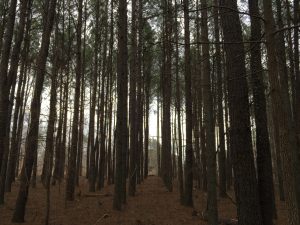
Rows. The trees are growing in rows. The uniformity must be what puts me off when I walk this particular stretch. It seems so distinctly man-made and “unnatural” (in the sense that it has clearly been cultivated by human hands). The discovery seemed so clear, and yet it took me months to nail down. Below is an image showing the clear rows of pine, and it’s hard to miss when I really look back at it.

My discovery, as most do, unearthed a more questions than it answered. How long ago were the trees planted? What was this land before it was a state park? Why were the trees planted in rows, instead of a seemingly random orientation? Why does this striking uniformity unsettle me so much, when this is exactly the type of suburban uniformity I see in Durham every day? And finally, what separates our urban landscapes from the wild ones?

I don’t have all the answers, but I am happy to have figured out what makes that bluff so unpleasant. It serves as evidence of humans changing the environment, and now that I am aware of it, I can look for evidence of human development everywhere I go.

How to Care?

Pope Francis’s encyclical created a moving call for action. He beautifully described the human role of climate change. The encyclical was not a complicated science publication and did not contain much scientific evidence which added to his argument rather than weakened it. His defense came from texts and people in a language which could be easily comprehended by the common man. His words were moving and surely impacted the many people who heard or read the encyclical yet, there still has not been much change seen in the world. The Pope has often been in the top spots for the most powerful leader in the world in Forbes magazine. He reaches millions of people with his words and influences a major religion but, even when he speaks on climate change and the moral responsibility people have, there are no major changes seen. How do you make someone care?

One of the most powerful leaders in the world called you out and said change your ways but, you agree with what he said and move on without taking real action. The encyclical should be a motivator for change but, people still do not care. Climate change is not affecting them now so it is not a problem. The problems others are experiencing are not yours so ignore them. We talked about factories in class and a point was made about factory managers not thinking about factory conditions because, they may have their own families and are concerned with their own well being. While that is somewhat reasonable (I still think it’s a problem when you are okay with poisoning people so your family can eat.), what is the moral debate with the CEO’s of huge corporations? The people of Nike who make millions annually and live lavishly know the conditions of their factories but, they can’t take a slight pay cut so people can have enough to eat. They can’t pay less for or not have a celebrity endorsement so dyes are properly disposed of and not going into people’s water. That’s nonsense!

There’s no reason to justify the wrongs you are committing. If you are in the wrong and have to try and justify what you are doing, you are wrong despite your reasoning. People see the damage being done to the world; they see what their actions are doing and still don’t care. I see what is wrong and want to fix it. I want to do my part to make a difference but, there are not enough people doing little things to fix the problem and too many people denying that there is a problem. Showing pictures of what will be lost does not influence these people and scientific evidence does not prove anything to them. The Pope could not change their minds. How do you make people understand when they refuse to listen?

 How can people be okay with living in a world without sights like this?


Blog #7 – Kevin Bhimani

Kevin Bhimani 3/10/17 Blog #7


By spending some time after class and really thinking about what we did, I decided to make this blog post about the Paris Agreement. The obvious answer when you think of something like the Paris Agreement, a multi-national agreement on climate change detailing the future of our world in terms of actionable items by the member countries—you would think that the actual document itself would be almost unreadable by your average citizen. But it is just the opposite. The actual Paris Agreement is almost trivial, looking like something that we could have came up with in class as opposed to a masterfully synthesized piece of international legislation. By going over it article by article, one can quickly see that there is nothing in the actual piece that calls to any tangible action items, rather most of the rhetoric is along the lines of “we should be doing this” and “these countries should invest in this and that”. Even the Pope, who has published his own encyclical, Laudato Si, on climate change praised the “historic” agreement. In my opinion, it is likened to more of a recommendation document than something that has been hailed as a transformative agreement to our society as a whole. This is incredibly concerning for the future of our planet as we see our world leaders coming together and producing effectively nothing. Nothing for countries to be held accountable for, nothing specifically delineating steps that countries will be taking, just a few general takeaways to maybe put in motion, maybe not. Even if President Trump wants to abandon the Paris Agreement, will it do anything? I think that reading this has made it clear that although I still believe the best way to get true change to occur for our planet is through institutions such as our government, we can not trust them to actually make that effort. As people, we have to recognize the problem and ensure that the fate of our collective home is in our hands. With or without the support of our respective governments, we need to take steps sustain what we have.


Sources:

https://cruxnow.com/life/2015/12/14/pope-francis-praises-historic-paris-climate-change-agreement/

https://www.theguardian.com/environment/2015/dec/13/paris-climate-deal-cop-diplomacy-developing-united-nations

https://www.theatlantic.com/science/archive/2016/11/the-problem-with-abandoning-the-paris-agreement/508085/

Aesthetics and Behavioral Changes

Using the aesthetically qualities of vegetation to entice an environmentally friendly behavioral change

There is no doubt that we as a people base our reactions and sentiments on visuals. For example, there is an entire field called “color study” in which analyzes the way in which certain colors affect the human mood. What is interesting is when companies and organizations capitalize on the aesthetic aspects that cause people to behave in a certain way.

On our nature hunt this week, I became aware of the visual aspects of the campus in a way that I hadn’t experienced before. It is pretty interesting that it take consciously taking in the aesthetics of a place to understand the impact that visuals have on my own daily decisions. I came across many environmental visuals that communicated to me different ideas. Take the construction on east campus versus the heavily wooded areas on west campus for example; I had more feelings that the campus was environmentally friendly when I was surrounded by green space, rather than overturned soil and construction trucks. This idea connects to the discrepancy of green spaces in Durham leading to an overall decrease in mental happiness in East Durham compared to their green heavy counterparts. 

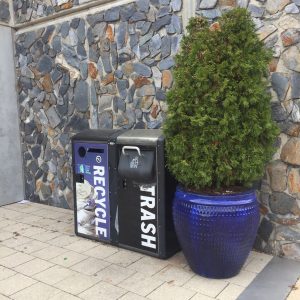
I was most captivated by the ways in which visuals were used on campus to entice people to behave differently. For example, the simple placement of bike racks around campus can change the culture around biking versus riding the bus. Also, Duke like to brag when they are working towards sustainability; they place lots of stickers and plaques on buildings and classrooms that meet certain energy and sustainability goals. This also relates to the idea that people are motivated by small positive, visual reinforcements. The biggest push to change behavior that I witnessed was the usage of vegetation around areas in which contained recycling and trash bins. As if a the site of the plant would remind the person throwing something away, that they were indeed making an environmental decision. While I may be looking into the placement of items on campus too closely, it is still vital to understand environmental communication and behavioral changes by analyzing the visuals tied to those ideas.