
Standardized Content Analysis of North Carolina College and University Student Health Websites
Key Findings
- Less than one third of colleges or universities in NC listed comprehensive sexual and reproductive health services on their student health website
- Public institutions are more likely to have comprehensive reproductive health services listed
- Larger institutions had a more comprehensive listing of reproductive health on their student health sites
- Zero universities listed abortion as an offered service, with only four having any mention of abortion as a pregnancy option on their site
Our Methods
We performed standardized content analysis on student health websites of 55 North Carolina 4-year colleges and universities that had more than 200 students enrolled using 16 pre-defined reproductive health terms.
More Information
We used the NCES IPEDS database to determine the average annual net price (as of 2020-2021), religious affiliation, public/private status, and student enrollment. We searched for terms including abortion language (abortion did not have to be a service provided, but had to be mentioned on the site in some way), campus pharmacy, confidentiality (related to STI testing), contraception, emergency contraception, HIV PrEP, HRT/gender affirming care, pregnancy care, pregnancy testing, primary care, sex education, STI testing, telehealth, pap smear, breast exam, and pelvic exam. When examining the results and looking at the information in more detail, we did not include the terms telehealth or confidentiality due to not being able to fully recognize the breadth of their telehealth options and confidentiality being a generic term. While not all student health centers listed confidentiality on their sites, we can assume that based on HIPAA and patient privacy that student services are confidential. Additionally, if a university or college listed any one of the services pap smear, pelvic exam, and breast exam they were counted as having listed women’s wellness exam. Typically, pelvic exam and pap smear were listed by the institutions that were then counted as women’s wellness exams.
Overall Results
For all of the institutions analyzed, the most commonly listed services were primary care, STI testing, and women’s wellness exams. Less than 20% of colleges or universities listed pregnancy care, abortion language, gender affirming care, or HIV PrEP as services. Only four institutions referenced abortion with language like all–options or comprehensive pregnancy options counseling or denoting off campus clinics providing abortion.

Trends in Reproductive Health Services by School Characteristics
Public vs. Private Institutions
Out of the 55 colleges and universities, 17 institutions were public, 11 were private with no religious affiliation, and 27 were private with religious affiliation. For public universities, 94.12% listed primary care, whereas private counterparts of religious and non-religious affiliations had 52.63% and 18.42%, respectively. On average, public institutions listed 6.4 services, which was double that of private and non-religious institutions. The majority of public institutions listed pregnancy testing, contraception, emergency contraception, campus pharmacy, STI testing, and women’s wellness exams on their student health websites, whereas under 21% of private institutions (religious and non-religious combined) listed these same services. Only 11.76% of public institutions and 2.63% of private religiously affiliated listed pregnancy care, but no private institutions non-religiously affiliated listed pregnancy care on their student health website.

Student Enrollment Population Size
Out of the 55 colleges and universities analyzed, 14 were large with more than 7,000 students, 12 were medium with 2,000 to 7,000 students, and 29 were small with fewer than 2,000 students. Most large universities are public institutions with 11 public colleges and universities having over 7,000 students.
We found that all institutions with greater than 7,000 students enrolled had six or more services listed on their site. In contrast, most (87.9%) of institutions with fewer than 2,000 students enrolled had three or fewer services listed on their student health site.

Institutions with Medical School Programs
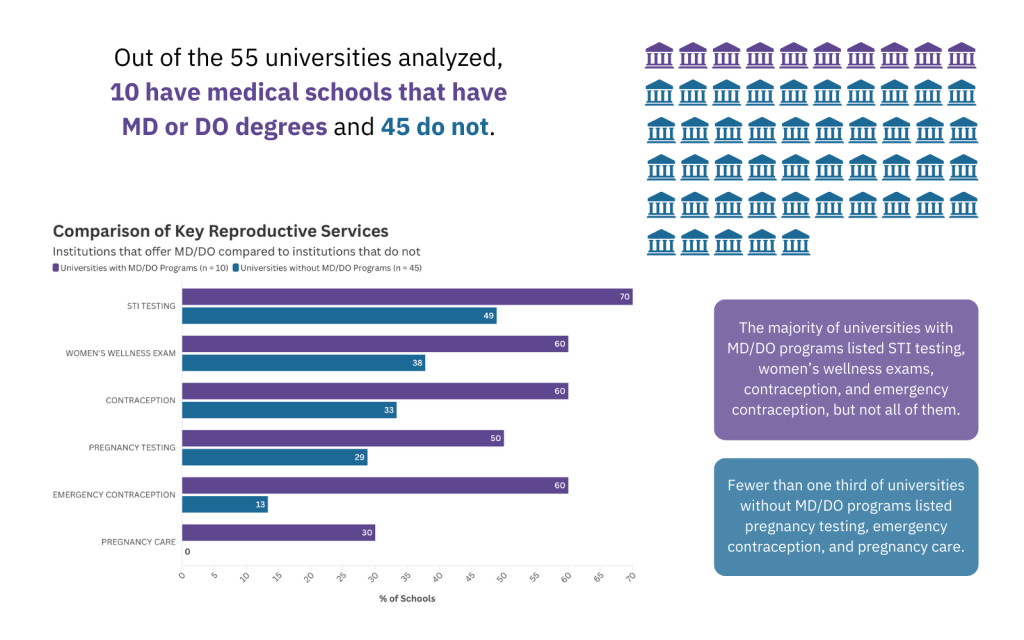
Out of the 55 institutions we analyzed, 10 of them had MD or DO medical school programs. We evaluated the percentage of these schools to list what we consider key reproductive health services: STI testing, women’s wellness exams, contraception, pregnancy testing, emergency contraception, and pregnancy care. Overall, schools with MD or DO programs had more comprehensive listing rates for services. Out of the 10 schools with medical school programs, the majority listed STI testing, women’s wellness exams, contraception, and emergency contraception. To our surprise, none of these services had a 100% listing rate on student health websites for the colleges and universities that have medical school programs. Only half of the schools with MD or DO programs listed pregnancy testing, and 30% listed pregnancy care.
Summary of Findings
Through our standardized content analysis of student health websites for colleges and universities in North Carolina, we found that around one third of colleges and universities listed 6 or more reproductive health terms. Only 1 university in the state listed all our standardized terms on their student health website. We found that 100% of universities with 7,000 or more students had 6 or more terms listed, but 87.9% of universities with under 2,000 students had 3 or fewer terms listed, with 9 of those small institutions listing 0 terms. Public schools, which are also generally larger, listed a higher mean for number of services compared to their private counterparts. From this analysis, it appears larger campuses offer, or at least list, more services. However, students on campuses of all sizes are likely to need these services.
We observed wide variation in the spectrum of services listed on North Carolina college and university campus health websites. One limitation of this analysis is that some services may be offered but not listed publicly. Regardless, our overall results leave room for improvement for most of the websites we reviewed. Students often face barriers to accessing care due to being unaware of services, misinformation, and privacy concerns according to the U.S. Government Accountability Office. Having reproductive health services available at student health centers helps students reach their education aspirations. For students trying to find service availability at their college, easy to access information should further lower barriers to students getting needed care.
We noted websites could also provide a resource to students even if they did not offer some services by identifying and listing nearby community resources for reproductive healthcare. Additionally, some services like emergency contraception and pregnancy testing require a lower financial investment or additional personnel, especially with the availability of emergency contraception vending machines that can be used for distribution. If universities are providing services but not marketing them on their student health website, we encourage these universities to be transparent about services provided to ease student accessibility and allow more students to seek care on their campus.

Limitations
Standardized content analysis of student health websites offers an idea of services offered at campus health; it cannot fully account for services that may be offered but are not listed.
