
Crisis Pregnancy Centers in North Carolina Target College Students and Under-Resourced Communities
Summary
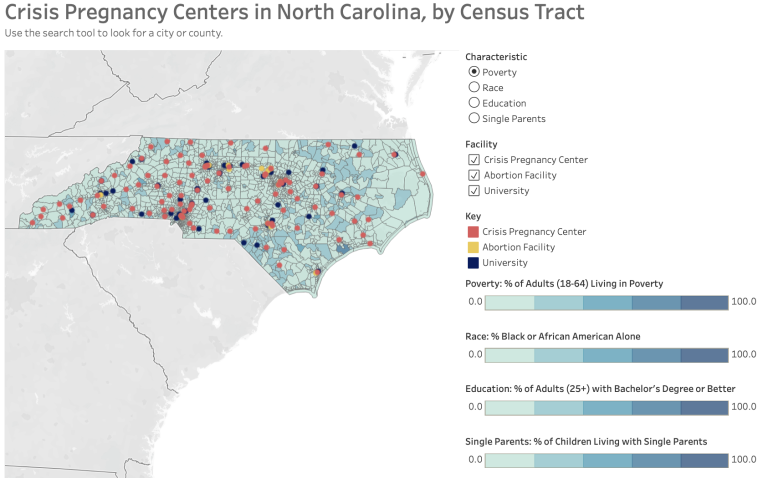
- Crisis pregnancy centers (CPCs) in North Carolina are located in communities that have higher poverty, more single parents, and less education on average.
- These findings point to the relationship between educational opportunities, socioeconomic status, and the placement of these CPCs.
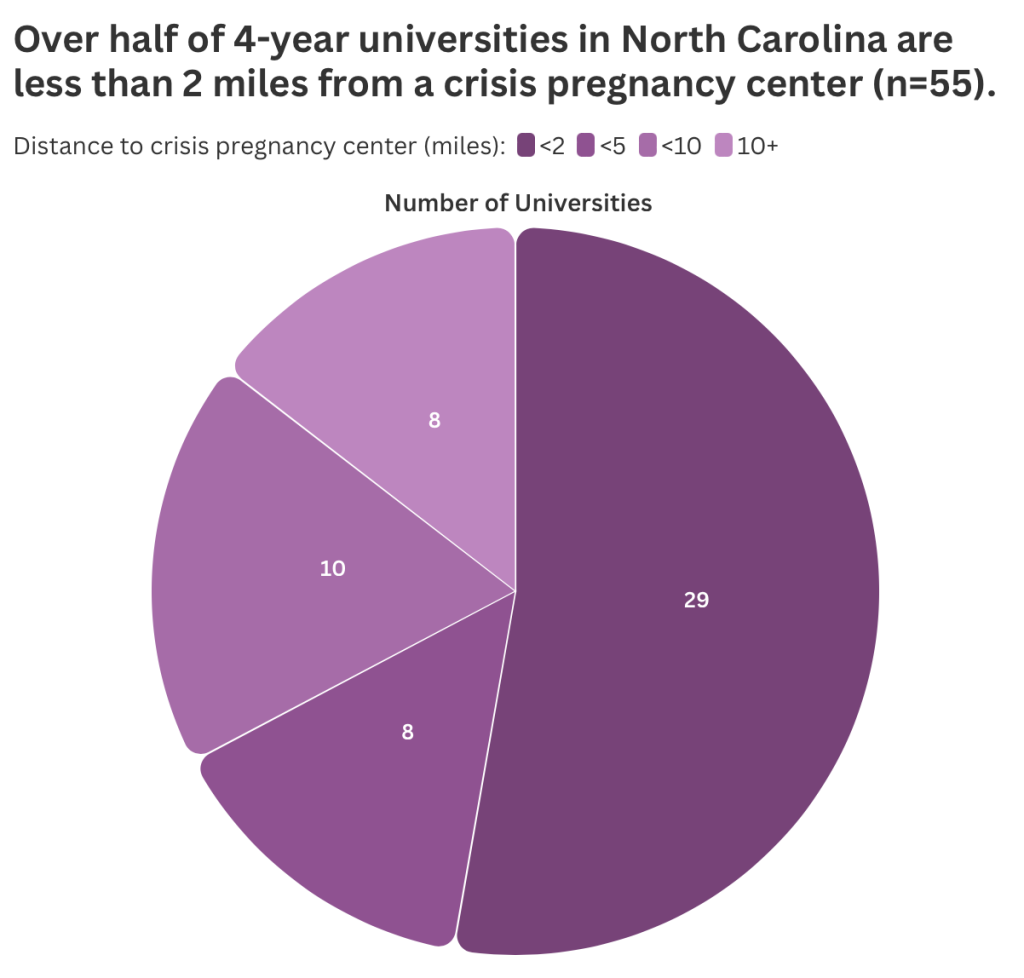
- The majority of 4-year universities in North Carolina are less than 2 miles from a CPC.
- CPCs are also in close proximity to abortion clinics. 10 out of North Carolina’s 18 abortion clinics are within 1 mile of a CPC.
Background
Crisis pregnancy centers (CPCs) are anti-abortion organizations that take on the appearance of abortion clinics, using deceptive tactics to dissuade or prevent pregnant people from getting abortions. For instance, many CPCs assert that abortion causes breast cancer and infertility, which are debunked and unscientific claims. As of 2024, there are 99 CPCs in North Carolina.
Nationally and in other states, CPCs are known to have a low-income clientele, and research also shows that Black women are more likely to be geographically closer to a CPC than an abortion facility and are more likely to enter CPCs for pregnancy-related care. However, these patterns are not well understood in North Carolina. Hence, the objective of this research was to understand some of the characteristics of the communities that North Carolina’s CPCs are located in or near.
Based on a literature review, we selected four characteristics for analysis: percent of adults (18-64) living below the federal poverty level, percent Black or African American, percent with a Bachelor’s degree or better, and percent of children living with a single parent. We also analyzed the distance between North Carolina’s 4-year universities and abortion clinics and the nearest CPC.
Results
We found that on average, census tracts containing or closely bordering CPCs have more single parents (+7.5%), a lower education level (-3.8%), and a higher poverty level (+4.3%). There was no statistically significant difference between the African American or Black population in census tracts containing or bordering CPCs in comparison to the state average.

Pregnant people of lower socioeconomic status are more likely to seek abortions but— per our findings— also more likely to be located near CPCs, which obstruct access to abortion. Notably, federal and North Carolina state laws prohibit Medicaid from covering abortion and make low-income individuals further vulnerable to CPCs, since CPCs often draw in pregnant people by advertising free resources.
Additionally, we found that over half of 4-year universities and nearly three quarters of abortion clinics are within 2 miles of a crisis pregnancy center. Further research controlling for variables like population density would be needed to confirm if these trends are statistically significant or merely reflective of broader geographic and demographic patterns.

Methods
We used the most recently available data from the American Community Survey to map the four characteristics across all census tracts in North Carolina (see dashboard above). Then, we used the CPC Map—a tool developed by researchers at the University of Georgia—to identify the 99 CPCs in North Carolina and overlay their locations onto our map. In addition, we included abortion clinics and 4-year universities in North Carolina to analyze where they are located relative to crisis pregnancy centers.
The majority of CPCs in North Carolina are located near the border between two census tracts. Hence, to more accurately capture the characteristics of the areas where CPCs are located, we recorded data for the census tract containing each CPC as well as the census tract most closely bordering each CPC. Then, we used one-sided t-tests to compare the averages for CPC census tracts to the averages for all census tracts in North Carolina.
We also used the geographical coordinates of the 99 CPCs, 55 4-year universities, and 18 abortion-providing facilities in North Carolina to calculate the distance between each university or abortion clinic and the nearest CPC.
