Category Archives: Uncategorized

Octopus Farming –– Is It Ethical?

By Hope Jackson, Paige Bernstein, Lydia Sellers, and Natalie Turner

Background:

Octopus are cephalopods and members of the order Octopoda. Cephalopods have the largest brain per unit body weight of any invertebrate, and octopus are among the most highly intelligent and neurologically advanced of all invertebrates. Octopus have been known to escape complex enclosures, use extreme camouflage techniques to escape their predators, use tools, pick locks, raid lobster traps, solve problems, and more. They can recognize human faces, have been shown to have long-term and short-term memory, and some evidence even suggests that they can experience pain and suffering. They are carnivores who eat clams, shrimp, lobsters, fish, sharks, and even sometimes birds. They can be found in oceans all over the world, but mostly being found in pelagic habitats near the water’s surface. 

Octopus demand has exponentially increased over the past decade. Over 100 species of octopus are currently caught in the wild. It is estimated that over 350,000 metric tons of octopus are caught from the ocean every year, with the highest demand coming from Korea, Japan, Spain, Portugal, Greece, and Italy. 2/3 of the annual catch comes from Asia, and at least half of that is from China. Since the 1980s, consumer demand has grown so much that octopus populations have decreased significantly as a result of overfishing. Their mild, chewy, and delicate meat is popular in a variety of dishes like poke, sushi, and tapas. It is also high in vitamins, minerals, and healthy fats. In Korea, octopus is sometimes even eaten live. The demand for octopus meat is continuing to grow quickly across the world and to meet this growing demand, many countries are experimenting with raising octopus in captivity.

Aquaculture:

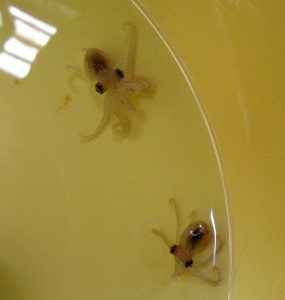
Aquaculture is defined as the breeding and harvesting of animals or plants in water environments. On a global scale, marine aquaculture provides over 50 percent of all human consumed seafood and is used to restore habitats, replenish wild stocks, and rebuild populations. Marine fish farming usually begins with hatcheries and then moves to net pens in water or in tanks on land. For octopus, males and females are caught using nets, lines and traps. Then, they mate and the female’s eggs are placed in an “incubator” which is dark and cool. Once hatched, the juveniles are moved into larger tanks or pools and usually hand fed using a paste of squid and crab. Once they reach a mature weight, they can be sold. However, some octopus hatch into a paralarval stage in which they have stubby arms and float through the water column like plankton, eating whatever microscopic food that comes their way. They eventually settle at the bottom of the sea and for scientists, recreating these environments is a major difficulty. Some of the key variables that must be monitored and maintained diligently in a tank or pen, which is a difficult task, include temperature, dissolved oxygen levels, space, and salinity. 

Ethical and Ecological Concerns:

Although at first thought aquaculture may seem like a viable solution to the growing consumer demand for octopus, farming octopus through aquaculture actually has an overwhelming amount of ethical and ecological concerns. The main ethical concern is the welfare of an octopus in factory-farming or domesticated environments. Octopus are highly intelligent and complex animals that require stimulating and dynamic environments for maximum success, something that would be very difficult to replicate in aquaculture, which relies on controlled and monotonous environments. Not only would overcrowding be an issue, but octopus can also experience frustration and boredom without proper mental stimulation. Additionally, intense farming systems have been shown to be linked to increased mortality rates, increased aggression and more frequent infection.
The main ecological concern surrounding the farming of octopus is the additional pressure that would be placed on other fish and invertebrates in the wild. Because octopus are carnivores, they rely on fish protein and oil for nutrition, and this live food must come from somewhere. Increasing the population size of octopus through methods of factory farming puts extra pressure on wild fish populations that must be used for fishmeal. Currently, about one-third of the global fish catch is used to feed other animals, with about one half of that going to aquaculture. Because octopus eat about three-times their body weight over their lifetime, keeping octopus fed in captivity would put even more strain on already over-taxed fisheries, and would likely contribute to declining food security for humans as well. Aquaculture has many additional negative environmental impacts as well including pollution and contamination caused by feces, food waste and fertilizers, and the loss of natural habitats used for farms.

Looking to the Future:

When looking to the future, cephalopod farming should not be a part of it. Conscious diets that avoid high ecological footprints and primary education that encourages community investment for the protection of these animals are part of the solution to this pending problem. Alternative protein markets could also respond to this demand. Companies like Beyond Meats and Toona already impact traditional seafood markets and clearly demonstrate a market response to alternative meat solutions. Consumers have the direct power to end the demand for octopus cuisine now!  

Original Article: http://www.digitaljournal.com/news/environment/marine-researchers-we-must-absolutely-not-farm-raise-octopuses/article/564399

Works Cited:

Fail, Robin. (2020, February 12). Lecture on Cephalopods. Duke University, Durham NC.

Graham, K. (2019, December 30). Marine researchers – We must absolutely not farm-raise octopuses. Retrieved April 12, 2020, from http://www.digitaljournal.com/news/environment/marine-researchers-we-must-absolutely-not-farm-raise-octopuses/article/564399 

Knowles, D. (2019, May 13). Millions of people eat octopus- here’s why we shouldn’t. Retrieved April 16, 2020, from https://www.weforum.org/agenda/2019/05/millions-of-people-eat-octopus-heres-why-we-probably-shouldnt/ 

Root, T. (2019, August 21). The Race to Produce the World’s First Farm-Raised Octopus. Retrieved from https://time.com/5657927/farm-raised-octopus/

Simke, A. (2019, December 13). The World Is Hungry For Octopus, What’s Wrong With Farming Them? Retrieved April 16, 2020, from https://www.forbes.com/sites/ariellasimke/2019/12/13/the-world-is-hungry-for-octopus-whats-wrong-with-farming-them/#632166c02302 

US Department of Commerce, & National Oceanic and Atmospheric Administration. (2019, April 2). What is aquaculture? Retrieved fromhttps://oceanservice.noaa.gov/facts/aquaculture.html

Zimmer, C. (2018, November 30). Yes, the Octopus Is Smart as Heck. But Why? Retrieved April 14, 2020, from https://www.nytimes.com/2018/11/30/science/animal-intelligence-octopus-cephalopods.html

Photos:

https://www.scientificamerican.com/article/rolling-under-the-sea-scientists-gave-octopuses-ecstasy-to-study-social-behavior/

http://www.bbc.com/earth/story/20160527-eight-reasons-why-octopuses-are-the-geniuses-of-the-ocean

https://ocean.si.edu/human-connections/seafood/drying-octopus

https://www.newscientist.com/article/dn28194-zoologger-octopus-makes-own-quicksand-to-build-burrow-on-seabed/

https://food52.com/recipes/33967-grilled-octopus

Whales and Marine Gigantism

Ashley Marko, Hannah Folks, Dana Adcock, Madison Ding, Mara Turkieltaub Paredes

Overall Summary:

In a recent news article by Inside Science, Joshua Learn discusses the advantages and evolutionary history of gigantism as it relates to the largest of all cetaceans–whales. Whales have evolved a long way from the dog-sized organisms they were millions of years ago, he notes, and the limitations to marine gigantism were for many years obscure and unknown. In an effort to identify what limits the body size of these massive marine mammals, Learn introduces a critical research study by marine biologists J.A. Goldbogen and others at the Goldbogen Lab in Stanford. In this study, data was taken from multisensor devices, acoustic devices, and the stomach contents of beached whales in order to determine energy expenditure and intake during feeding. Through such collection and analysis, it was found that while the gigantism and overall body size of toothed whales were limited mainly by the body size of their prey, baleen whales were limited by the availability and temporality of their prey. That being said, Learn does conclude the article by discussing the possibility of seeing even larger whales in the far future. 

Introduction:

   From avoiding predation by smaller organisms to allowing for a more efficient metabolism, gigantism—very large body size—serves as an incredibly useful adaptation in most marine environments. However, the utility and advantage of gigantism become more nuanced and multi-faceted when it comes to whales. In fact, a recent news article by Inside Science shows that the evolutionary pathway for gigantism is split for rorqual and toothed whales—each group’s unique foraging strategies (filter-feeding, bio sonar-guided hunting on individual prey) spurred a propensity towards a large body size in order to better adapt to the spatial, temporal, and physiological characteristics of their prey and environment.

Background:

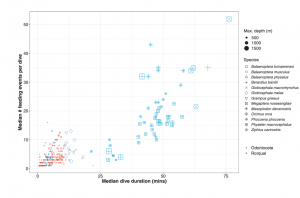
   During the Oligocene, specialized foraging mechanisms likely led to the diversification of cetaceans. Odontocetes used biosonar-guided foraging to capture individual prey, while mysticetes used engulfment and lunge-propelled filter feeding. These differences in evolved behavior enabled separate pathways to gigantism, which had also evolved in order to promote greater metabolic and locomotion efficiency. For toothed whales, a bigger body size allows them to dive deeper, granting them the ability to catch a greater abundance of fish at lower water levels, rather than having to depend on populations that thrive on the near surface. The body size of baleen whales has evolved to improve their efficiency in catching abundant, yet patchily distributed small prey. These advantages are a direct result of the relationship between body size and respiratory functions. As body size increases, mass-specific oxygen storage is constant, while mass-specific oxygen usage decreases. Therefore, larger deep divers spend less energy while feeding for prey, making them more efficient predators than their smaller counterparts. Despite this, the energy toothed whales obtain from successful hunting does not outweigh the costs associated with a larger body size and the effort needed for deeper diving. Baleen whales, on the other hand, are relatively more efficient. Thanks to their filter-feeding foraging strategies and massive size, larger baleen whales perform fewer feeding events per dive and are able to engulf a greater biomass of prey, all at lower trophic levels than their deep diving counterparts. As such, rorquals are on average able to gain higher amounts of energy per feeding event.

 Methods:

    Learn highlights that the researchers studied foraging performance using multisensor tags. The data from these tags showed the largest odontocetes exhibited high feeding rates during long, deep dives. The energetic efficiency of the dive was determined mostly by the number of feeding events and the amount of energy obtained during each feeding event. The amount of energy obtained per feeding event was calculated from prey type and size distributions historically found in the stomachs of odontocetes and the acoustically measured biomass, density, and distribution of krill at rorqual foraging hotspots.

Results:

   The results of the study demonstrate that larger odontocetes (toothed whales) appear to feed on larger prey relative to the size of the prey of its smaller counterparts. However, these prey were not disproportionately larger, and smaller toothed whales fed more frequently. Therefore, the energy obtained from prey didn’t quite outweigh the increased costs of having a larger body size or undergoing deeper dives, which means there is actually a decrease in energetic efficiency observed with increasing body size in odontocetes. 

    However, in the case of rorquals (largest group of baleen whales), the measured distribution and density of krill biomass suggest that larger rorquals are not limited by the size of their prey on individual dives. In fact, baleens experience more rapid increases in energy from their prey along with increasing body size, as larger rorquals have larger capacities for engulfment. Rorquals also have the ability to maneuver more than their toothed counterparts, and increase feeding rates per dive when krill density is higher, indicating that their energy efficiency would increase in conjunction with their body size. These results were robust to assumptions about trait similarity from shared ancestry as well as the scaling of each group’s metabolic rates. This implies that it is evolutionarily advantageous for rorqual whales to increase in body size. Because of this, provided the availability of its prey can keep up, these whales could get bigger.

Conclusion:

    Gigantism in cetaceans has many benefits, including energy storage for more efficient and prolonged migration as well as granting the ability to better retain heat, making these animals incredibly productive predators. Whales are perhaps some of the most recognizable marine megafauna and vary widely in size across species, leading scientists to question the differing limitations between groups. Goldbogen et al. found that prey availability is the primary restriction on marine gigantism in whales. For toothed whales, a higher abundance of larger prey could make them even more massive, and the same goes for baleen whales, whose prey consists of small krill with variable availability and concentration throughout the year. In the past 50 million years, whales have nearly grown 10,000 times larger, and depending on the future availability and temporality of their prey, Goldbogen believes they could get even larger.

Significance and Future Studies:

  Gigantism is a particularly interesting adaptation in an ecological and environmental context given our current battle against climate change. Although their large body size allows for these massive creatures to act as the efficient and successful predators they are, the issue of commercial overfishing is utterly devastating to cetacean populations. Historically, the overall body size of many whale species has been decreasing, and now that we know how prey abundance and body size affects the body size of whales, a direct correlation between these events is clear. This news article and study give us further insight on the ecosystem dynamics and evolutionary history behind gigantism and how both top-down and bottom-up interactions yield a balanced yet fragile food web. Future research should focus on how physical changes in an ecosystem (such as temperature, oxygen availability, and turbidity) can affect prey populations and marine gigantism, which inherently impact predator-prey dynamics. Furthermore, future studies could focus upon marine gigantism in other endothermic and exothermic species, relating the similarities and differences in limitations on body size against cetaceans.

News Article:

https://www.insidescience.org/news/how-whales-got-so-large-and-why-they-aren%E2%80%99t-even-bigger

Scientific Study/Article:

https://science-sciencemag-org.proxy.lib.duke.edu/content/sci/366/6471/1367.full.pdf

References

Arnold, Carrie. 2018. “Why Do Whales Get So Big? Science May Have an Answer.” National 

Geographic, 26 Mar. 2018, nationalgeographic.com/news/2018/03/whales-size-animals- ocean-marine-mammals/.


Goldbogen, J. A. et al. (2019). Why whales are big but not bigger: Physiological drivers and 

ecological limits in the age of ocean giants. Science, 366(6471), 1367–1372. doi: 10.1126/science.aax9044


Learn, Joshua. 2019. “How Whales Got So Large — And Why They Aren’t Even Bigger.” Inside

Science, 12 Dec. 2019, insidescience.org/news/how-whales-got-so-large-and-why-they-  

aren%E2%80%99t -even-bigger.


Williams, T. M. (2019). The Biology of Big. Science, 366(6471), 1316–1317. doi:

10.1126/science.aba1128


Yong, Ed. 2018. “Why Whales Got So Big” The Atlantic, 4 Apr. 2018,

theatlantic.com/science/archive/2018/04/why-whales-got-so-big/557213/.

Cuttlefish 3D Vision

Chumba Koech, Gus Dodd, Maria Zurita Ontiveros, Flo Cordova, Maya Suzuki

Introduction

Scientists know that the human brain is far different from that of a cuttlefish, but what they aren’t so sure is how cuttlefish use depth perception in the same way humans do. For this study, scientists focus on the common European cuttlefish, Sepia officinalis. They are in the subclass Coleoidea, “soft-bodied”, with octopus and squid, live one to two years, and have eight arms and two tentacles. This species of cuttlefish preys on fish and small crustaceans, including crabs, shrimp, and prawns. They forage in 4 stages: detection, positioning, strike start, and prey seizure. Cuttlefish must obtain a distance close enough to grasp the prey with its tentacles, but far enough away to not startle the prey. An example of a foraging strategy includes hypnosis, where cuttlefish use their color-changing abilities to stun their prey and eat them while they are distracted. This particular study focuses on the use of stereopsis for depth perception as they forage.

Background

Stereopsis can be defined as “3D vision”, or how eyes perceive depth.  It is documented in many mammals such as primates (including us), birds, cats, horses, and praying mantises.  However, there have been no previous studies conducted on marine megafauna, thus this study gathered a fair amount of scientific attention.  There had been previous evidence suggesting that cuttlefish may have depth perception. First, the cuttlefish’s camouflage ability is thought to be influenced by depth perception.  Experiments on checkerboard and pebble backgrounds suggested that cuttlefish produced more effective disruptive patterns when a light object was placed in front of a dark object, and when backgrounds had edges and contrast.  Regarding cuttlefish’s hunting, prey attacks were confirmed to be initiated purely by visual cues. Other studies concluded that cuttlefish use pictorial cues and directional illumination, but it was not clear whether cuttlefish could calculate attack distance.  The design of this experiment allowed for isolation and testing of cuttlefish’s stereoscopic vision.

Methods

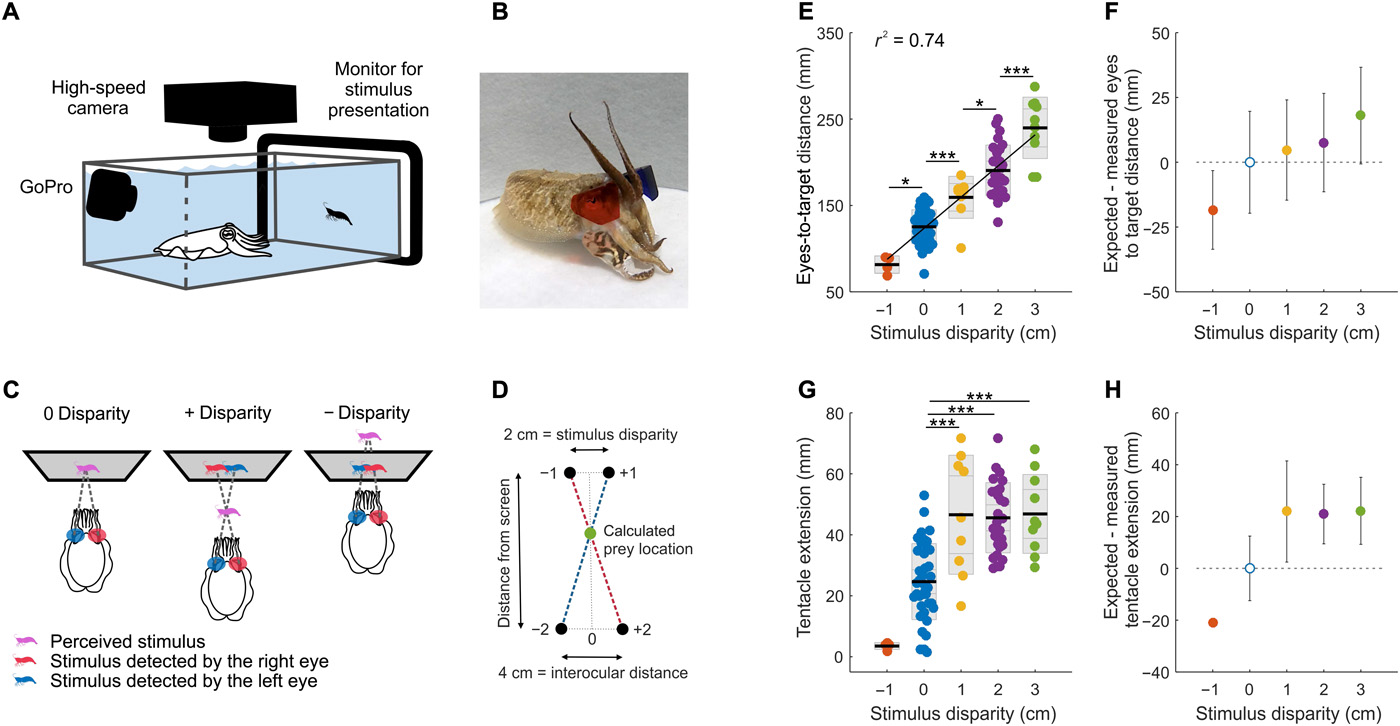
The study used 11 adult cuttlefish. The researchers created a fish tank that had two cameras and a monitor used to display the moving shrimp images. The cuttlefish were trained to attack the screen image of the two differently colored shrimp while wearing the 3D glasses. The “attack” was defined by the cuttlefish deploying their tentacles. The researchers offset the images of the shrimp to test the disparity. Stereopsis was tested by isolating the use of one eye through various disparity distances.

Results

When faced with the visual stimulus of the shrimp with disparity (a shift between left and right eye visuals), the cuttlefish would adjust its position relative to the screen, and the larger the disparity, the further away the cuttlefish would position itself before striking. When faced with only one eye (quasi-monocular) stimulus, the cuttlefish took longer to strike, travelled farther, and struck at prey from a closer distance than when faced with two eye (binocular) stimulus. This shows that cuttlefish do use stereopsis when hunting, since they compare visual images from both eyes. Cuttlefish also struck at the TV shrimp when both eyes received the exact same stimulus (correlated) and when each eye received the same stimulus but with reversed luminosity (anticorrelated), but not when the stimulus was completely different for both eyes (uncorrelated), which requires different cognitive abilities than those in mammalian and praying mantis stereopsis. Finally, the study found that cuttlefish eyes can move independently and the eyes don’t need perfect convergence in position in order to use stereopsis, another marked difference with humans.

Significance

As we have seen, stereopsis was originally considered undiscovered among marine megafauna. The fact that the cuttlefish has evolved to be able to use stereopsis has significant implications for the way that it has evolved. The ability to perceive depth grants enormous benefit to the cuttlefish, particularly in relation to the way that it hunts; namely, stereopsis allows them to detect prey faster and strike from a further distance and with greater accuracy than other cephalopods. Despite increasing fishing levels, cuttlefish are not an endangered species. Thus, there exists an opportunity to conduct more tests on them in order to understand the origins of stereopsis, particular in relation to marine life. Why this diversification amongst cephalopods has taken place is not obvious but it paves the way for greater research into why certain marine species have this ability and others do not.

<References>

Feord, R. C., Sumner, M. E., Pusdekar, S., Kalra, L., Gonzalez-Bellido, P. T., & Wardill, T. J. (2020). Cuttlefish use stereopsis to strike at prey. Science Advances, 6(2), eaay6036.

Kelman, E. J., Osorio, D., & Baddeley, R. J. (2008). A review of cuttlefish camouflage and object recognition and evidence for depth perception. Journal of Experimental Biology, 211(11), 1757-1763.

Messenger, J. B. (1968). The visual attack of the cuttlefish, Sepia officinalis. Animal Behaviour, 16(2-3), 342-357.

Nityananda, V., & Read, J. C. A. (2017). Stereopsis in animals: evolution, function and mechanisms. Journal of Experimental Biology, 220, 2502–2512. doi: 10.1242/jeb.143883

Zylinski, S., Osorio, D., & Johnsen, S. (2016). Cuttlefish see shape from shading, fine-tuning coloration in response to pictorial depth cues and directional illumination. Proceedings of the Royal Society B: Biological Sciences, 283(1826), 20160062.


The Effect of Heatwaves on Whale Entanglements 

Ansley Arnow, Caleb Stevens, Giselle Wang, Nathan Cho, Rahul Sengottuvelu

Introduction

As human civilization grows ever greater, we are placing more and more impact on nature, especially the ocean. One specific conservation issue that emerges from humans’ extensive use of the ocean is managing shared space between marine animals and fisheries. It is estimated that each year, over 300,000 marine mammals die from entanglement with fishing gear. This problem is exacerbated on the west coast of the United States where people have observed an increasing number of entangled humpback whales that are coming to the coast more often, where there is a high density of crab-fishing operations. The whales seem to be coming to the coast because an increased number of marine heatwaves caused by climate change are compressing their habitats and pushing them to the coast to feed. It is a stark reminder that the ocean is a vast and extremely interconnected system. This particular issue raises awareness for the location-specific and indirect impact of climate change and calls for a better approach to managing the co-existence of humans and marine animals.

Background

When the temperature of the ocean is significantly higher than the expected value at a certain time of year for an extended period of time, it is defined as a marine heatwave. Its causes can be simply the movement of marine currents and an increase in atmospheric temperature. Climate change has induced more frequent marine heatwaves, which greatly affects biodiversity. Some organisms benefit from it and some are suppressed, leaving a significant imbalance in the ecosystem. 

Humpback whales are filter feeders, eating krill, plankton, and small fish. Marine heatwaves narrow the range of ocean zones that benefit from coastal upwelling to areas that are more inshore, so whales come to these areas to feed on the great abundance of food brought to inshore waters from the deep sea or surface currents. 

Methods 

Santora (2020) evaluated the relationship between the extent of habitat compression and the number of whales that share space with crab-fishing activities and found a positive relationship. They took into account factors such as normal ecosystem biodiversity, whale occurrence, entanglement records, habitat compression, and fishing operation locations.

The study also interviewed fishermen and provided management solutions to reduce harm for marine bycatch species.

Results

The study found that the behavior of coming further inshore to feed is indeed a probable cause for higher entanglement rates, as their feeding area now overlaps with crab-fishing operations. This area manifests unusually high biodiversity from marine heatwaves and upwelling, making it an attraction for both predators and fishermen, which can be problematic.

Therefore, the study provides a few policy solutions, including a more dynamic management approach that adjusts according to seasonal changes in the ecosystem, especially in the face of MHW. It would also be helpful if ecologists provide fishermen with easily caught indicators of ecosystem health, so they can act quickly and effectively. 

Conclusion & Future Studies

Apart from bycatch, the decrease in prey species also causes other problems for humpback whales, including a lack of nutrition and thus a decrease in reproductive success and increased calf mortality. We might observe a sharp decrease in the overall humpback whale population if marine heatwaves become a frequent phenomenon. 

A study in Alaska shows that when the region was affected by a prolonged marine heatwave from 2014 to 2016, sand lance, a key prey fish, decreased in abundance and size, causing a shortage of food for various marine mammals, seabirds and large fish. This shows how marine heatwaves can affect the whole marine ecosystem in a bottom-up fashion, and further studies on this phenomenon are crucial to understanding its impact.

More research into indicators of a potential marine heatwave is also highly recommended. Such indicators could include changes in the diet of certain predators, lack of abundance of prey fish or change in thermohaline movement. If we can predict and map marine heatwaves, we can set up policies in advance to minimize anthropogenic damage when new animals move into a habitat. It is also recommended that further studies be done on what triggers marine heatwaves and provide projections for how frequent they will be in the future. 

A new wave of the marine heatwave we call “the blob” is coming back as of 2019, and if we learn from past experiences in dealing with them, maybe we can protect the lives of more animals and fishing businesses this time.

This is the original research paper mentioned in the article

https://www.nature.com/articles/s41467-019-14215-w

Santora, J.A., Mantua, N.J., Schroeder, I.D. et al. Habitat compression and ecosystem shifts as potential links between marine heatwave and record whale entanglements. Nat Commun 11, 536 (2020). https://doi.org/10.1038/s41467-019-14215-w

Related Articles:

https://www.nature.com/articles/s41586-018-0383-9?source=post_page—————————

Marine heatwaves become more frequent under global warming

https://www.nature.com/articles/s41558-019-0412-1

Marine heatwaves threaten global biodiversity and the provision of ecosystem services

https://wwf.panda.org/our_work/oceans/problems/bycatch222/bycatch_victims/

Bycatch number

https://journals.ametsoc.org/doi/pdf/10.1175/BAMS-D-17-0119.1

Multiyear Marine Heatwaves

https://www.int-res.com/abstracts/meps/v613/p171-182/

Decline in prey species due to MHW

Great Barrier Reef decline over the last 90 years and how to save them!


Introduction

The Great Barrier Reef, home to the largest coral reef system and thousands of species of organisms, faces threats of climate change, pollution, and fishing, bringing its health into great concern. The decline of reefs due to changes in the way they build and the species that inhabit them risk the food and livelihood of hundreds of millions of people. This study examines data collected over the past 91 years to better understand the survival of coral reefs, exploring the documented environmental conditions surrounding coral reefs, community structures of organisms there, and highly accurate mapping of the reef. 


Methods

The researchers selected a reef that had been subject to study a number of times in the past, dating back to a quadrat-based survey that ran from 1928 to 1929. They observed coral and marine species biodiversity, supplementing their work with photographs. Areas previously studied were photographed and these photographs edited into one continuous mosaic. Comparing that mosaic (and the species it featured) to reports from previous expeditions allowed the researchers to determine the nature and extent of major trends in the reef.


Results

The barrier reef has seen the worsening of coral cover, colony size, and species diversity over the last 90 years. Coral cover and colony size have declined, with no corals in many intertidal areas named for their dominant reef-building coral. There has been a drastic fall in species richness. Revisiting 13 sites from 1954 found that many species of coral were near extinction and all the sites saw their population decline to half. Corals forms have changed from hard corals to soft corals and from branching corals to massive corals. Many invertebrates that called these intertidal coral colonies home have vanished.


 Figure 1: Dead coral reefs near Low Island


Discussion

In the past, coral cover has been used as an indicator for reef health as it strongly predicts the capacity of a reef to track sea-level rise and resist drowning. However, species diversity and richness are crucial indicators of reef health. In addition to lower coral cover and size, there has also been a huge drop in species diversity and richness since 1928. This lower diversity is likely as a result of chronic stress and disturbances. These conditions select for coral species which are disturbance resistant and slow-growing, such as soft corals and massive corals. Coral now takes longer to recover following a disturbance such as a cyclone. Additionally, coral reefs which fail to reassemble a diverse community have higher vulnerability and sensitivity to future disturbances. Low Island has failed to reassemble a diverse community and is more susceptible to both drowning and cyclones than it was in the past. Reports since 2000 suggest identical effects in inshore and offshore reefs globally. Hence, the decline of reefs on low isles provides an unfortunate story for coral reefs globally. 


Potential Solutions

Solving the Coral reef problem requires pollution control, better fishing policies, reducing CO2 emissions and extreme temperatures. Better fishing practices improve reef health by preventing overfishing of keystone species crucial to the local ecosystem(Health Fisheries). One example is the decline of shark populations(keystone species) due to overfishing. It has lead to an increase in mid-level feeders, a decline in herbivores and an increase in algae, which harms the coral reefs(Earthsky). Extreme high temperatures due to climate change can potentially destroy 90% of the reefs. Scientists like Daniel Harrison believe that reducing CO2 is insufficient. Instead, they propose reducing reef water temperatures by making clouds brighter and reflecting more sunlight in a process called Marine Cloud brightening(Temple, J.).

Figure 2: Impact of overfishing and loss of species diversity on coral reefs


Figure 3: Mechanism of action of Marine Cloud brightening


Sources:

  1. Fine, M., Hoegh-Guldberg, O., Meroz-Fine, E. et al. Ecological changes over 90 years at Low Isles on the Great Barrier Reef. Nat Commun 10, 4409 (2019). https://doi.org/10.1038/s41467-019-12431-y
  2. Bar-Ilan University. “Longest coral reef survey to date reveals major changes in Australia’s Great Barrier Reef.” ScienceDaily. ScienceDaily, 27 September 2019. <www.sciencedaily.com/releases/2019/09/190927074930.htm>.
  3. Chemical & Engineering News. “Climate Change Is Destroying Our Coral Reefs. Here’s 3. How Scientists Plan to Save Them.” Accessed February 11, 2020. https://cen.acs.org/environment/climate-change/Climate-change-destroying-coral-reefs/98/i6.
  4. Healthy Fisheries. (n.d.). Retrieved from https://coral.org/what-we-do/healthy-fisheries-for-reefs/
  5. Earthsky, Researchers find coral reefs at risk when sharks overfished. (n.d.). Retrieved February 12, 2020, from https://earthsky.org/earth/researchers-find-coral-reefs-at-risk-when-sharks-overfished
  6. Temple, J. (2017, April 20). Are brighter clouds the best bet for the Great Barrier Reef? Retrieved February 12, 2020, from https://www.technologyreview.com/s/604211/scientists-consider-brighter-clouds-to-preserve-the-great-barrier-reef/

Article Source


https://www.sciencedaily.com/releases/2019/09/190927074930.htm -Online article


https://www.nature.com/articles/s41467-019-12431-y Actual Study article references

Melanism in Manta Rays

manta ray

After reading a New York Times article on melanism in manta rays, our group felt inspired to learn more about the species and its interesting condition. For more information, the article is linked here, as well as in the References section!

Background on Manta Rays

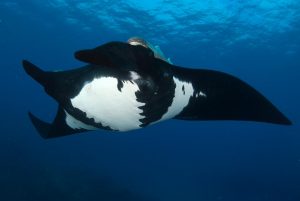
There are many organisms of astonishing size in the ocean, but one of the biggest and most magnificent is the manta ray. They are about 25 feet long wing to wing, and due to their extreme size, they have very few predators. There are two different species: the Mobula birostris (the pelagic type) and the Mobula alfredi (the reef type), both of which generally reside in the Indo-Pacific waters. Both species are listed as vulnerable on the IUCN Red List of Threatened Species. When viewed from below, one can observe that most manta rays have a solid white stomach; however, some have unique black spots. These black spots result from melanism—a common condition among land animals but very rare in aquatic animals.

What is Melanism?

Melanism is defined as an increased production of melanin pigments, resulting in darker colored individuals. This is very common on land and has been linked to evolutionary advantages across land animals such as pocket mice, snakes and insects. Underwater, however, melanism is highly uncommon, and out of hundreds of species of cartilaginous fish only two species—both the only known mantas—exhibit melanism. Additionally, melanism exhibited in these mantas only occur in some populations. The variation in melanism frequency in mantas from different locations has caused researchers to wonder if this phenotype provides any evolutionary advantage. 

Melanism and Natural Selection

Melanism in terrestrial animals has proven to be an advantageous result of natural selection. For example, pocket mice in contrastingly light and dark terrain have adapted to match their coat to their surroundings as a means to avoid predators. Beyond camouflage, melanism aids some species in regulating body temperature and resisting disease. Given mantas’ unique development of melanism, researchers aimed to identify which, if any, aspect(s) of fitness it could facilitate. Most manta rays have white bellies, enabling them to blend in with contrasting light from the surface and avoid being seen from below. Though manta rays have few predators, a black belly, or even a spotted one, would presumably make them more prone to predation. Given this hypothesis, marine researchers from the United States, Australia, and Indonesia recently conducted a study to determine whether melanism affects the manta ray’s survival.

Conclusion and Future Work

There is no one definitive answer as to why melanism started to show up in certain manta ray populations around the world. Current studies concluded that melanism does not give mantas survival advantage over their predators; rather, it may just be a product of genetic drift. However, it would be interesting to see a future study on their hunting habits (e.g. time of day), which can help researchers understand if melanism provides an advantage related to when mantas look for their prey. However, future research is increasingly becoming difficult with manta populations dwindling. Nevertheless, it is important to continue to better understand mantas and its important ecological role in the environment.

Ecotourism: The Value of Protecting the Manta Rays

The dwindling populations of Mobula birostris and Mobula alfredi mean their protection and conservation is more important than ever. Off the North Sudanese coast of the Red Sea, high concentrations of reef type mantas frequently congregate in and around Sanganeb Marine National Park and Dungonab Bay – Mukkawar Island Marine National Park. These two sites comprise a marine protected area (MPA) and UNESCO World Heritage Site. In fact, the only documented sighting of a Mobula birostris X Mobula alfredi hybrid ray occurred in this MPA. However, two conflicting proposals may determine the future of the area and the mantas. The Heart of the World, a Dubai-esque proposal including an airport and a huge skyscraper, would involve heavy coastal dredging, increasing turbidity and decreasing plankton abundance—two challenges for the mantas. On the other hand, there’s potential for small-scale ecotourism development based in Mohamed Qol and Dungonab, where manta-watching would promote local economic development while ensuring the MPA stays well protected. Ecotourism is rising across the world and has already shown promise in Sudan. Promoting such practices will provide the best protection for the mantas, facilitating further research into melanism and many other phenomena we’ve yet to discover.   


References

Augliere, B. (2020 Jan 8). For Manta Rays, Survival Isn’t Black and White. Hakai Magazine.

Kessel, S. T., Elamin, N. A., Yurkowski, D. J., Chekchak, T., Walter, R. P., Klaus, R., Hill, G., & Hussey, N. E. (2017). Conservation of reef manta rays (Manta alfredi) in a UNESCO World Heritage Site: Large-scale island development or sustainable tourism? PLOS ONE, 12(10), e0185419. doi: 10.1371/journal.pone.0185419

Klein, J. (2019 Oct 14). The Mystery of Melanistic Manta Rays. New York Times Science. 

Márquez, M. C. (2019 Dec 26). It’s Not All Black and White: Melanism in Manta Rays. Forbes

Murray, A. (2019 Sept 15). Protecting the Million-Dollar Mantas. Save our Seas.Venables, S., Marshall, A., Germanov, E., Perryman, R. & Tapilatu, R. (2019 Oct 9). It’s not all black and white: investigating color polymorphism in manta rays across Indo-Pacific populations. The Royal Society Publishing. 100(9). 5268-73. doi: 10.1073/pnas.0431157100

Whale Sharks and Manta Rays: Impact of Plastic Pollution in Indonesian Waters

Indonesia in the Coral Triangle region is one of the few locations where concentrated populations of whale sharks and manta rays reside according to Noun Project’s study of their habitats. These filter-feeders help control plankton abundance and regulate nutrient cycling, playing an important role in the marine ecosystem. Unfortunately for the giant mammals, Indonesian waters are alarmingly susceptible to plastic pollution from nearby coastal countries, many of which are ranked in the top 10 for plastic waste. Over time, plastic debris in the sea gets broken down into tiny pieces of plastics less than 5 mm. These so-called “microplastics” are commonly ingested by marine animals and contain pollutants at a concentration that is millions of times higher than the surrounding water. Whale sharks and manta rays are particularly prone to plastic ingestion, as they feed by filtering enormous amounts of water every hour.

In an attempt to determine the vulnerability of large filter feeders to microplastic ingestion, scientists assessed the waters of their typical Indonesian habitats such as those by Nusa Penida, Komodo National Park, and East Java. They studied the top 50 cm of the water column using a plankton net (called a “trawl survey”) and also recorded the visibility of plastic debris from the ocean’s surface. Using this information and the water filtration rates of the two species, they estimated the rate of plastic ingestion. Reef manta rays may ingest up to 63 pieces of plastic per hour when they feed in Nusa Penida and Komodo National Park while whale sharks could be ingesting 137 pieces per hour in Java, where they seasonally aggregate. Additional testing revealed that manta ray and whale shark excrement contained plastics, providing further evidence of microplastic ingestion and accumulation in the fish species. Ingestion of plastics can expose the long-lived animals to toxic chemicals, which can accumulate over decades and harm their regular growth, hormones, and reproductive functions. 

Manta rays and whale sharks are both globally threatened species. Along with reproductive dangers from microplastics, both species face extreme pressures from overfishing. Manta rays have an average lifespan of 40 years while whale sharks have a lifespan of 100 to 150 years; however, because both fish species reproduce slowly and reach sexual maturity much later in life (15 years for manta rays and 30 years for whale sharks) they are being forced out of the ocean faster than they can reproduce. A national effort to reduce and manage plastic waste is essential for the conservation of these marine megafaunas. 

One solution is to use less single-use plastic, such as plastic bags and food wrappers, which are the most abundant plastic sources of the region. The Indonesian island of Bali, known for its tourism, imposed a ban on single-use plastics in July 2019. The island generates more than 300,000 tons of plastic each year, with 11% ending up in waterways. While large shopping centers have ceased providing single-use plastics resulting in a significant reduction in the island’s plastic use, smaller businesses have failed to comply. Thus, imposing stricter penalties and extending this ban to the wider nation will be an effective solution.

Another solution is improving waste management techniques. In November 2019, Ecowatch launched a project to build 100 trash booms in Balinese rivers, a measure meant to eliminate 80% of marine plastic that comes from streams. While these booms are effective at catching debris, the removal of collected waste has proved to be more difficult. Due to the lack of waste facilities on less populated islands, most recyclables must be shipped to Java for processing. This decreases the financially lucrative aspect of trash clean-up. What’s more, due to highly irregular routes and general inexperience, large portions of Indonesia remain unserviced by waste workers. To combat this problem, the Gringogo Indonesia Foundation created an app that will allow civilians to scan garbage and determine its monetary value. Upon its introduction in Sanu Kajar, Bali, this app improved recycling rates by 35% and decreased ocean plastic deposits by 25%. Applying this app to dispose of plastic waste in trash booms has the potential to be an effective waste management solution.


News Article: https://marinemegafaunafoundation.org/blog/microplastics-manta-rays-whale-sharks/


Citations

“Microplastics on the Menu of Manta Rays and Whale Sharks.” Marine Megafauna Foundation, marinemegafaunafoundation.org/blog/microplastics-manta-rays-whale-sharks/.


Ecowatch. “100 Trash Barriers to Be Installed in Bali Rivers to Reduce Plastic Pollution.” Make a Change World, 25 November, 2019, https://www.ecowatch.com/bali-plastic-cleanup-barrier-2641452645.html


Elitza et al. “Microplastics on the Menu: Plastics Pollute Indonesian Manta Ray and Whale Shark Feeding Grounds”. Frontiers in Marine Science, 19 November 2019, https://www.frontiersin.org/articles/10.3389/fmars.2019.00679/full


Javerbaum, Molly. “To reduce plastic waste in Indonesia, one startup turns to AI.” The Keyword, July 9, 2019, https://blog.google/outreach-initiatives/google-org/reduce-plastic-waste-indonesia/


“Manta Ray Habitat Map by SEEtheWILD Wildlife Conservation Travel.” Manta Ray Habitat Map by SEEtheWILD Wildlife Conservation Travel, 11 Nov. 2017, seethewild.org/manta-ray-habitat-map/.


“Many Threats for Manta Rays.” Defenders of Wildlife, defenders.org/blog/2015/12/many-threats-manta-rays.


“Meet the Innovators Battling Plastic Waste in Indonesia: Mohamad Bijaksana Junerosano.” World Bank, www.worldbank.org/en/news/feature/2019/05/31/meet-the-innovators-battling-plastic-waste-in-indonesia-mohamad-bijaksana-junerosano.


“Not the Last Straw Yet: Bali’s Ban on Single-Use Plastics.” South China Morning Post, 12 Nov. 2019, www.scmp.com/lifestyle/travel-leisure/article/3036927/bali-ban-single-use-plastics-widely-ignored-small.


“View Current Whale Shark Map and Habitat Range.” View Current Whale Shark Map and Habitat Range, 10 July 2019, seethewild.org/whe-shark-map/.


Wamsley, Laurel. “A Massive Floating Boom Is Supposed To Clean Up The Pacific. Can It

Work?” NPR, 11 September, 2018, https://www.npr.org/2018/09/11/646724291/a-massive-floating-boom-is-supposed-to-clean-up-the-pacific-can-it-work


“Whale Sharks, Rhincodon Typus.” MarineBio Conservation Society, marinebio.org/species/whale-sharks/rhincodon-typus/. 


“Whale Shark Information.” Shark Team One, www.sharkteamone.org/whale-shark-information.html.