All posts by Kai

About Kai

Associate professor of physics @ Duke-Kunshan University (Zweitmitglied @ Uni Bayreuth) ---------------------------------------------- Research interest: Understanding, predicting and eventually controlling the collective behavior of sand grains (i.e., granular materials) by means of lab experiments and computer simulations, in order to shed light on widespread applications such as space exploration, process engineering, powder based additive manufacturing (3D printing), landslide, earthquake triggering, dune migration and transport, etc. Acoustical design of opera theatres (e.g. the Bayreuth Festspielhaus of Richard Wagner) in combination with the design of traditional Chinese opera houses. ---------------------------------------------- Pedagogy: 'The best way to learn is to teach.' ---------------------------------------------- Habilitation in Physics @ Uni. Bayreuth Postdoc in Complex Fluids @ Max-Planck Institute for Dynamics and Self-organization; PhD in Physical Acoustics @ Nanjing University; B.S. in E&E @ Nanjing University;

6 Student Worker Positions – Jan 2024

The collective dynamics lab has 3 projects open to DKU undergraduate students:

  1. Deciphering root growth in artificial soil
  2. Equipping DKU with ‘smart’ sensors
  3. Room acoustics characterization and modeling of DKU theatre

All projects are initially for 3 – 4 months with the possibility of extending till the end of this fiscal year, depending on the scope defined.

For more details, please check the job descriptions (JD) of project 1 and 2 (review of applications will start on Jan.15) and project 3 (review of applications will start on Feb.1). Please login with netID to view the JDs.

Wish you a good start of year 2024!

kai

2 SRS positions open

What about?

Darwin’s “The power of movements in plants” described how a root tip being ‘annoyed’ by the card attached to it and subsequently got rid of it by its motion. The question is how a root tip interacts with its environment – SOIL.

Normal soil might be too challenging for reproducible experiments, thus we plant in “artifical” soil (i.e. plastic or glass spheres with controllable size distribution and initial packing). By means of X-ray tomography and 3D volume data analysis, we trace the positions of ALL spheres plus the morphology of the root so as to explore how local packing density influences the collective behavior.

The challenge is that: The force distribution inside granular materials is very heterogenous, as indicated by the above picture.  How do root tips figure out their way through?

What for?

In collaboration with plant biologists, we try to establish the capability of “designing” plants that can better protect soil from erosion.

In collaboration with ecologist, we try to provide “microscopic” models for large scale simulations on the response of plants to climate change.

What to learn?

In general, it is an opportunity to learn advanced image analysis teachinques (see, e.g. the picture above) and active jamming.

For data and computer science and applied math students: Learn computer vision, large data analysis and modeling.

For biophysics or medical physics students: Learn how to conduct X-ray tomography for biological samples, its working principle and potential applications.

For materials science students: Learn materials science characterization tools, density control of granular materials.

How to apply?

Email to the PI with subject “CDL – SRS2023 Applicant: YOUR NAME – CLASS“. There are two openings for the project valid through April.15 or until the positions are filled.

Posting RESTARTED

With the pandemic coming to an end and the obvious improvements of accessing sites.duke.edu server (thanks to DKU / Duke OIT), we are resuming regular posts here.

SAND remembers its history.  The stratification pattern above represents how the flow of different types of sand differs and how sand itself records the sedimentation process.

Although I have been heavily involved in DNAS in the past three years, there are regular updates on the CDL side. With the improved access to sites, we will hopefully update more often. 


Shakers shaking

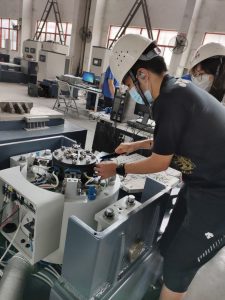
(July.2.2020, Suzhou) Together with three CDL students, we visited two local factories producing vibrators. As the vibration system (8000 N force, sufficient to drive an adult of 80kg up to 10 times the gravitational acceleration) we are aiming for is a “small” system for them (not for us, of course), it is lucky for us to be able to go there and do some simple tests. It turns out that the vibration lab needs to be reconfigured to fit for the system, and vibration system, a few months’ work ahead. In addition, further design on the force transmission system is needed to ensure purely vertical vibrations against gravity.

(Left: Air ventilation needed to cool down the coil. Right: DKU students mounting the IMU sensor for the test)

Transitions of CDL group meetings

In January, we sit in a team room to discuss progresses, with or without computers. We have never anticipated that:

Two weeks after the above meeting, we have to sit in front of LCD screens for the (bi-)weekly meeting throughout the pandemic.

Jun.1, we (some of us, thus hybrid meeting) are finally allowed to return to campus. We are also lucky to have  Profs. Hui Yang and Yunsong Hua from USSC visiting us.

(From left to right: Han Yue, Huyue Yan, Yunsong Hua, Kai Huang, Hui Yang, Jinchen Zhao, Chen Lv, Hui Zhou)

Think positively: Pandemic teaches us how to use technologies available to communicate better.

11 months, 12 cbm from Germany to China

Shipment of some used lab equipment finally arrived on May.13.2019, 11 months after the week (Jun.4-10.2020) of packing.  It requires tremendous efforts in each step, particularly for the PI, who had absolutely no previous experience in exporting and importing. However, if I get the chance to choose again, I will still say: Yes, let’s make it happen.

Many thanks to the shipping companies + extremely hard working staff at DKU  behind.  In case you are facing a similar challenge, please find qualified moving companies first (For the shipment, all partners in the shipment have certificate from EuroMover).

SRS students working on granular drag

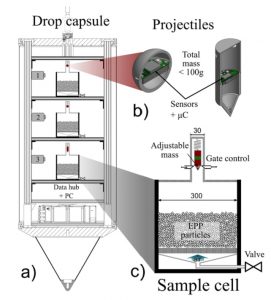
Funded by the dean’s office for undergraduate studies, Oscar Lv and Jinchen Zhao received an internal SRS (Summer Research Scholar) grant to work on an algorithm that reconstructs the trajectory of an IMU sensor embedded projectile penetrating through granular materials under micro-gravity, a DLR funded experimental campaign conducted at Bremen drop tower in 2019. See below for a sketch of the setup.