
An interdisciplinary team of professors, graduate researchers and practitioners, undergraduates, and research associates at Duke University collected the first round of data that serves as the primary focus of this project: stories of hope. This team was assembled as part of the Duke University Bass Connections program, which supports undergraduate and graduate students working alongside faculty to solve big, unanswered questions about societal problems. Dr. Patty Van Cappellen served as Team Leader alongside Dr. Erin Johnston for this project, entitled: “What is Hope? Bridging the Gap between Experience and Research.”
Background and Aims: Why is it important to understand hope in everyday life?
Hope is crucial to promoting resilience, motivation, and well-being–all of which have become increasingly important in recent years as people across the globe have had to navigate unprecedented challenges and crises. Hope is also an important religious competency, as it is integral to having faith and navigating existential questions.
Despite this evidence of hope’s importance to these facets of everyday life, the scientific study of hope is surprisingly limited. Existing attempts to define and characterize hope range from too narrow (Snyder, 1994: hope as goal pursuit) to too broad (Scioli et al., 2011: multidimensional definition confounded by multiple other constructs). Therefore, a renewed effort to understand hope and engage more deeply with its lived experiences and existential roots is necessary.
By studying hope through the lens of everyday people’s lives and religious practices, we can not only provide a renewed and grounded understanding of hope to the field of psychology, but also potentially contribute meaningfully to the creation of a more hopeful society. Thus, those involved in the Bass Connections course sought to bring the voices of those who hope, often through extraordinarily difficult circumstances, back into the science of hope. You can read more below in the next section, titled “Methods” to learn more about how the team went about doing this.
The resulting repository of people’s hope stories will be analyzed to identify key characteristics of the hope experience and the findings translated into resources that can be used by healthcare professionals and spiritual care providers. These resources will better equip these “practitioners of hope” to understand the role that hope plays in coping with trauma, illness, and other forms of adversity and develop interventions that promote hope and resilience.
Methods
This team engaged with the lived experience of hope as reported by practitioners and community members, including people of faith. Team members conducted semi-structured interviews to gather 76 personal stories of hope. This data repository contains rich qualitative data on experiences of hope from a diverse set of people representing different religious, cultural, and socioeconomic backgrounds. By identifying common themes and elements of these hope stories, the Bass Connections project team was able to provide a broadened understanding of what the lived experience of hope looks like for everyday people.
The Interview
I want you to think about different times in your life when you’ve experienced hope. Pick one that feels important or meaningful to you and which you feel comfortable talking about. It might be a recent experience or one that occurred a long time ago. I’d like you to tell me about this experience, describing it in as much detail as you can.
All participants were prompted to identify an experience of hope that was important to them (see the prompt above). Then, team members had participants provide further details such as what hope felt like in their story, how possible their hoped-for outcome seemed to be, and in who or what they were placing their hope. The following are some of the questions that participants were asked as part of the interview:
“What were you hoping for? Why was this important to you?”
“What did it feel like, in your experience, to have hope?”
“At the time, how possible did you feel that outcome was? In other words, how confident were you that that would happen?”
“What did you place your hope in? In other words, were you looking to yourself, a different person, the economy, or a higher power/God to make the thing you hoped for come true?”
“What, if anything, did this experience of hope make you want to do? For example, some people may say their hope made them take specific actions, while others may say that hope made/allowed them to sit back and relax.”
Preliminary Findings
The team wrapped up the year by presenting research highlights at the 2025 Fortin Foundation Bass Connections Showcase!

Interested in what we found from these stories of hope? See a preliminary data visualization HERE for themes from the narratives! In each section, click for supporting example quotes.
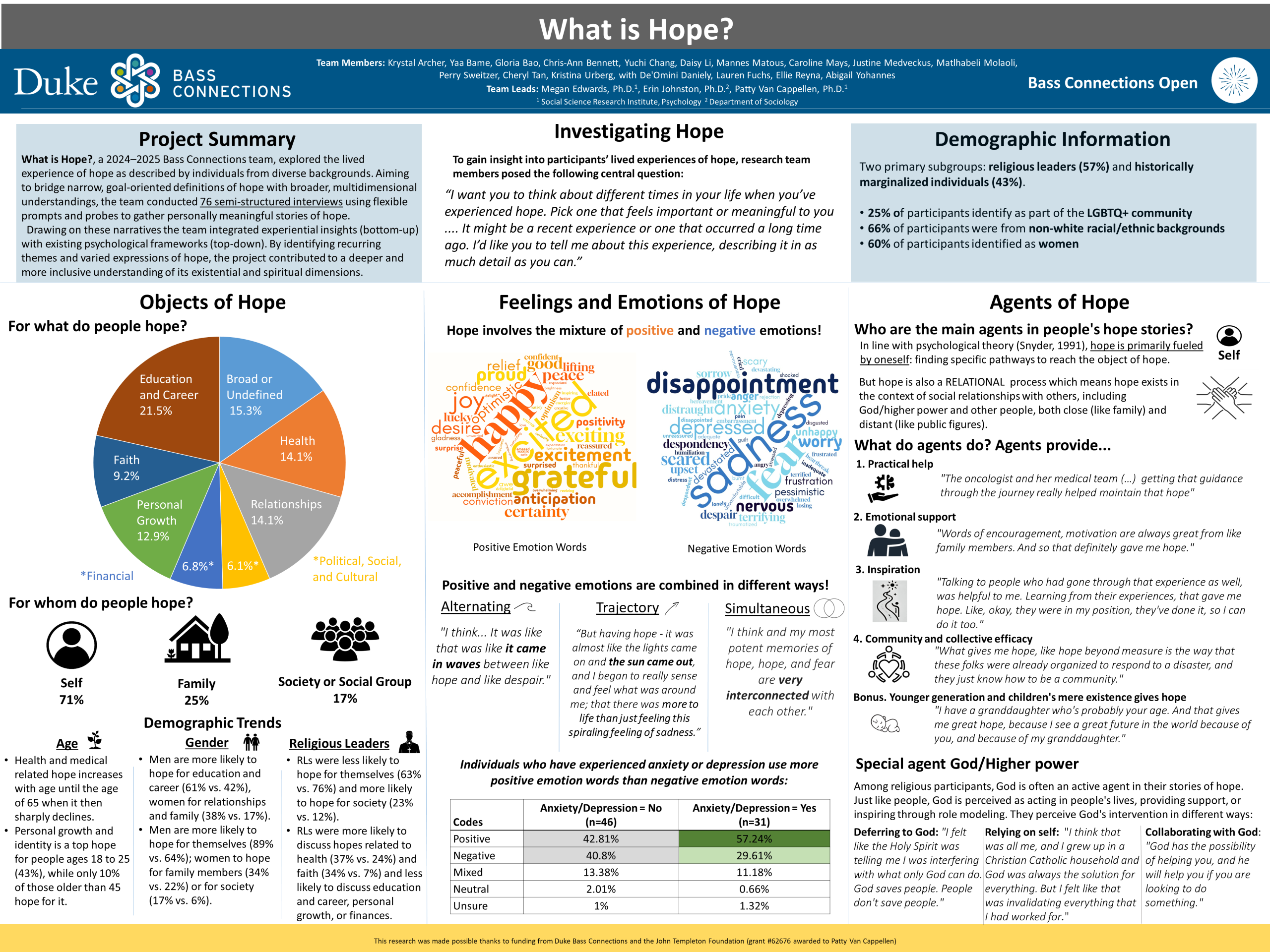
- Objects: For what do people hope? For whom do people hope?
- Feelings & Emotions: How, and what feelings and emotions are involved in hope?
- Agents: Who are the main agents in people’s stories of hope?
Also see the poster below for a broad overview of the team’s findings!
Acknowledgements
The What is Hope project team would like to thank the following Duke faculty contributing to Dr. Van Cappellen and Dr. Johnston’s Bass Connections class:
- Brett McCarty, Assistant Research Professor of Theological Ethics at Duke Divinity School; Associate Director of the Theology, Medicine, and Culture Initiative; Assistant Professor in Population Health Sciences at Duke School of Medicine
- Kate Whetten, Professor of Public Policy and Global Health and Co-Director of Duke’s Sexual and Gender Minority Wellness Program
- Anne Allison, Professor of Cultural Anthropology
