
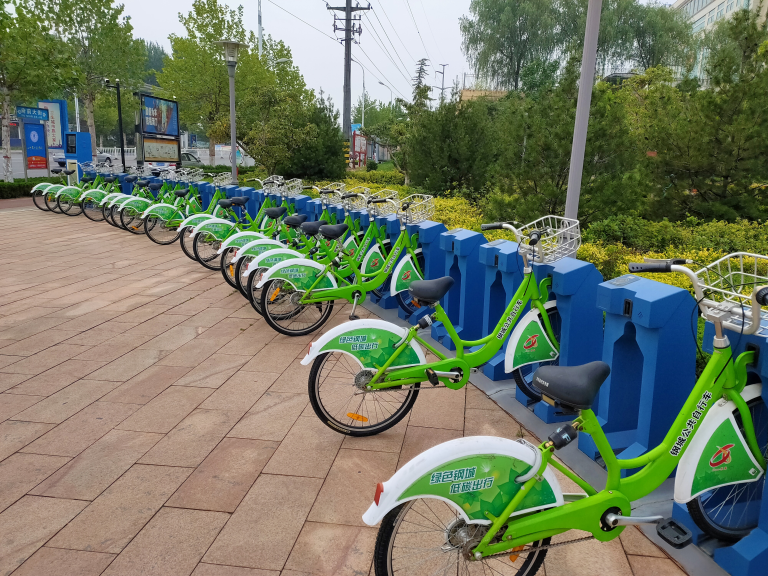
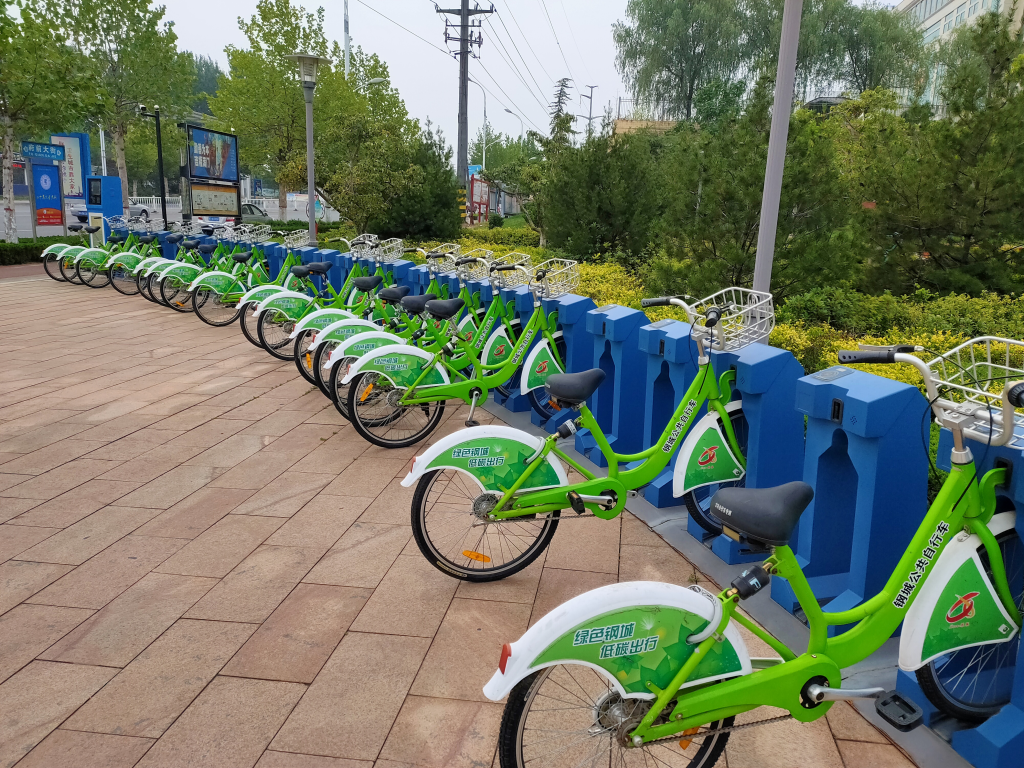
In Amsterdam, bicycles rule the roads; only 24% are cars. 30 years ago, China was also a kingdom of cycling. However, today, in Suzhou, every two people own a car on average. Citizens even prefer to call a taxi or Didi to the subway stations if they do not have a private car. To mitigate the impact of greenhouse gas (GHG) emissions in its city, Suzhou needs to expand green transport. Citizens should not only use public transport like the subways but also get used to micromobility like bikes and e-mopeds. Shifting from taxis to micromobility, citizens can solve their first-mile and last-mile problem to subway and bus stops. To smoothly move from point A to point B, we need convenient policies and practical operations supported by the government.
Taking Decarbonization to China’s Streets
In China, the government has promoted electric vehicles to reduce the high GHG emissions. Data shows us that the total GHG emissions of commercial vehicles in 2019 accounted for 9.1 % of the country’s total CO2 emissions (Zhang et al, 2024, 1). After replacing gas cars with EVs, China’s CO2 emissions are expected to plateau at these high levels until around 2028, then decline 1.7% yearly through 2035 (Climate Action Tracker, 2025). By reducing carbon dioxide and other greenhouse gases to the atmosphere, people are trying to ease the natural greenhouse effect, slowing down the rising temperature.
Besides EVs, shared e-mopeds and bikes are also encouraged by Chinese local governments(China Travel Blog, 2025). In my own experiences in Suzhou, people can borrow a sharing e-moped or bike in crowded places like malls and housing estates. Many parents even decide to use sharing e-mopeds to pick up and drop off the kids for their after-school classes instead of using cars. This approach helps a lot in reducing the emission of greenhouse gases since it really cuts the number of cars on the roads.
Uphill Challenge for Two-wheelers
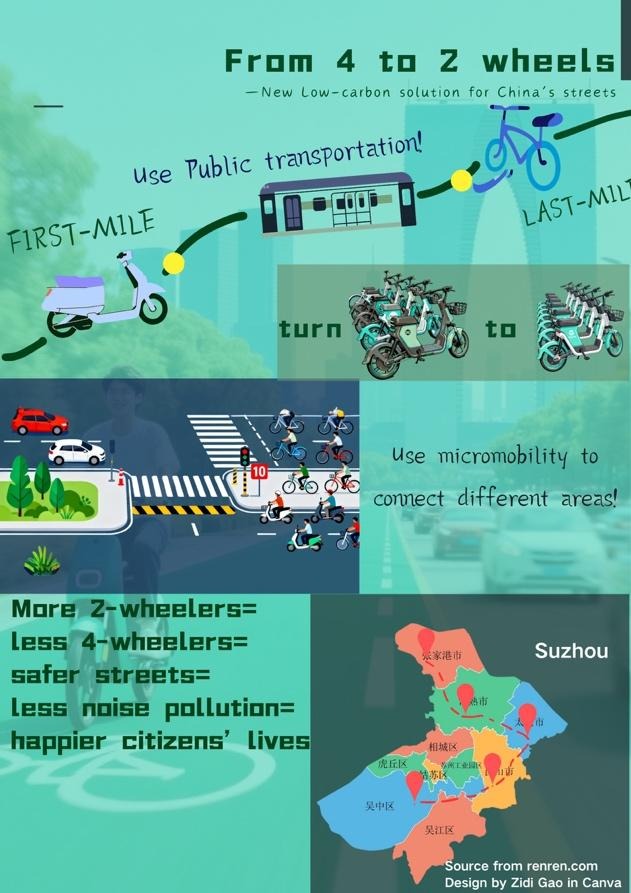
Although electric vehicles and some shared bikes may emit significant amounts of GHG, we still need to advocate the use of 2-wheelers to strengthen the low-carbon community. However, some hidden challenges obstruct the popularization of micromobility.
The dangers resulting from car drivers still happen in our daily lives. With too many cars on the streets, riders of bikes, e-bikes, and e-mopeds are prone to collide with cars. Without the safeguard of citizens, especially teenagers struggling to control such vehicles, the dream of having more people ride to their destinations will be much harder to realize.
Additionally, the explosion of shared micromobility brands in the market divides one city into different riding areas, where residents are not allowed to go beyond. This function bothered the users a lot. They may need to change a bike during their journey or even need to walk for miles to reach an e-bike.
Some layouts in the city are also not suit for micromobility. For example, riders may face an intersection that does not include a path for cycling while they are riding. Jennifer Turner, a DKU professor, shared with me that Kunshan, a part of Suzhou, has some great bike lanes, but they are mainly for recreation through forests and parks. These paths often don’t connect to bike lanes on main roads, making them a less viable commuter option.
Suzhou Could Accelerate Micromobility
Establishing a convenient cycling map over the city, alongside keeping riders safe, are two ways to decrease the use of taxis and Didi and increase the use of 2-wheel micromobility.
To increase the use of micromobility on the roads, we need to build a complete shared cycling system throughout the city. The government should connect the brands, eliminating the edges between the riding areas. Then, citizens will no longer use the different shared-bike mini programs and check whether they can arrive at their destination smoothly before starting their journey.
Besides, to keep the micromobility safe and convenient, it is necessary for the city’s layout designers to redo the lanes for bikes and e-mopeds in a proper way. In a speech at Duke Kunshan University, Chris Bruntlett, a manager at the Dutch Cycling Embassy, emphasized, “to provide for maximum diversity of users and journeys, Dutch planners look beyond individual lanes and think more holistically at the network level.” His statement emphasized that planning for micromobility should be part of the design of the traffic layout of a city. My hometown, Suzhou, is a tourist city with a historic district that is overcrowded with cars, tourist buses, bikes, and pedestrians. It is unsafe and inconvenient for residents. With the help of the Dutch model Bruntlett mentioned, I believe this area in Suzhou can create reasonable 2-wheelers and pedestrians’ paths and become car-free.
In conclusion, the Suzhou government must improve local policies and the infrastructure to encourage more people to choose micromobility over taxis.
This blog was written as part of the PUBPOL111 course Communicating Climate Solutions: Writing for Impact taught by Professor Jennifer Turner.

