
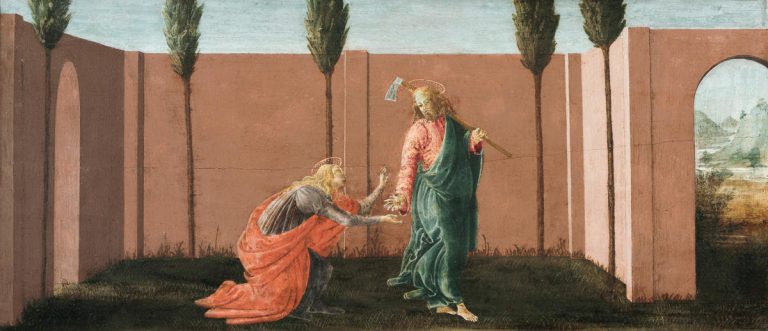
The Gospel of John describes Mary Magdalene as the first person to see Jesus Christ after his Resurrection. According to John, Magdalene afterwards said to Christ’s disciples, “I have seen the Lord”. Through modern scholarship, it has become apparent that her characterization has been subject to many changes from the time the bible was written. Scholars believe her character as interpreted by many Christians today is an amalgamation of unique biblical characters sharing the name Mary or other unfavorable traits ascribed to Magdalene.
I would argue, in addition, that Renaissance portrayals of Magdalene reflect, rather than her identity as written in the bible, a character synthesized over centuries by the Church, even if the artists may not have been aware of this, and will explore this through Magdalene’s appearances in Italian High Renaissance art.
Magdalene’s character not only appears at the Crucifixion and the Resurrection, as written in the bible. In Rome 591 CE, Pope Gregory I proclaimed that Magdalene held the same identity as several other characters in the bible, appearing in the Gospel of Luke, as the prostitute sinner who washes and dries Christ’s feet with her hair, in John as ‘Mary of Bethany’, and in the Gospel of Mark as one of Christ’s exorcized subjects. Although these distinctions are not supported by textual evidence from the bible, they persisted among many Western and European Christian communities. Magdalene’s identity is muddled even further by the discovery of the Gnostic Gospel of Mary Magdalene in 1896 Egypt, where Magdalene holds a leadership role as the “apostle of the apostles” because of her uniquely close relationship with Christ.
Italian artists became enamored with Magdalene. The oldest known example of Magdalene at the foot of the cross comes from Siena, Italy in approximately 1270 CE. A painting attributed to Diotisalvi di Speme places Magdalene at the foot of the cross–the only witness to be so close to Christ. The artist also drapes Magdalene’s garments with gold. Even the Virgin Mary is not honored like this by the artist – this becomes significant as we begin to see an increased interest in Magdalene among Italian artists.
Giotto
Giotto’s depictions of Magdalene often reflect the image of a loyal follower to Christ. His Crucifixion in the Sovereign Chapel (c. 1304-05) is another early example of a Crucifixion scene with Magdalene at Christ’s feet. Giotto makes an imperative distinction between Magdalene and other witnesses to the Crucifixion pictured to the (mirrored) left of Christ: she, along with the other apostles, has a golden halo adorning her head, indicating her holiness.

Crucifixion in the Sovereign Chapel
Giotto
c. 1304-05 CE
Italy
Fresco
200 x 185 cm
Image credit: Arena Chapel, Padua
Both works by Giotto also hold a symbol more subtle to modern-day viewers: Magdalene’s hair is cascading freely down her body. In Crucifixion, this contrasts with the other female witnesses, whose hair is close to their head or veiled. This symbol became associated with Magdalene because of her identity’s fusion with the prostitute sinner who anointed Christ’s feet and dried them with her hair in Luke.
Giotto’s portrayals of Magdalene are interesting because of this dichotomy: Giotto simultaneously recognizes the holiness of Magdalene while also utilizing imagery which directly draws from the suggestion that Magdalene was a sinful prostitute. This demonstrates an early example of Italian Renaissance portrayals of Magdalene becoming more representative of an imagined character than her actual role as written in the bible.
Titian
Titian’s interpretation of Magdalene’s identity would have been heavily impacted by the state of the Church. The Protestant Reformation occurred in 1517. This split within the Church had an impact on the interpretation of Magdalene’s relationship with Christ. Martin Luther saw great significance in the fact that Magdalene was among the first individuals who Christ revealed himself to following his Resurrection.
The Reformation also impacted the narrative about Magdalene because of its clash with the Renaissance. Catholicism remained the branch of Christianity in which the Church and priests held a great amount of power over the people. Priests and popes such as Gregory I are documented to have changed details of Magdalene’s role, specifically relating to sexuality. This would have continued to happen after the Reformation as Italy remained Catholic. During the High Renaissance, exploration of human sexuality through the arts gradually came to fruition, shown in the stark increase in nude subject paintings in this era.

Saint Mary Magdalene in Penitence
Titian
c. 1533-35 CE
Oil on panel
84 x 69.2 cm
Image credit: Galleria Palatina
Depictions of Magdalene in the 1500s saw a more explicit emphasis on female sexuality. As seen in Titian’s Saint Mary Magdalene in Penitence (c. 1533-35), Magdalene is pictured draped only in her hair. The use of the phrase “in Penitence” in the piece’s title establishes Magdalene as the sinner she was transformed into over years of biblical re-interpretations. Although Renaissance artists explored the human nude as a scientific advancement, sexuality was still seen as sinful religiously and socially. Magdalene’s nudity in this piece is not just a study of the human body, but also sensual. The placement of Magdalene’s hair and hands accentuate her nudity rather than protect it, immediately recalling Botticelli’s The Birth of Venus. Titian’s nod to this 1480s painting of a sexual goddess demonstrates the erotic nature of his portrayal of Magdalene.
Noli me Tangere

Noli me Tangere
Titian
c. 1514 CE
Oil on canvas
110.5 x 91.9 cm
Bequeathed by Samuel Rogers, 1856
Image credit: The National Gallery, London
Titian also contributed to a collection of High Renaissance portrayals of the Noli me Tangere scene. In his Noli me Tangere (c. 1514), Magdalene’s place on the ground before Christ is reminiscent of earlier depictions of her kneeling before the cross. Titian also exposes Magdalene’s hair – a nod to the misidentified prostitute from Luke. The dynamic poses and eye contact in this painting indicate a sense of passion. Magdalene’s hand reaching towards Christ’s garments implies a level of closeness, perhaps intimacy, between the two.
Titian’s use of symbols in the depiction of Magdalene, like Giotto’s, presents a seemingly paradoxical identity. The Noli me Tangere scene directly acknowledges Magdalene as among the first to have seen Christ after his Resurrection, which should affirm, at the very least, her importance and respectability, if not her holiness. However, as a result of Church teachings and trends established by previous artists, the artists still made the decision to employ motifs which undermine the honor implied by her significance to Christ.
Penitent Magdalenes
Donatello’s wooden sculpture Penitent Magdalene (c. 1453-55) portrays a particularly unique interpretation of the Saint. This sculpture is strikingly naturalistic and detailed. It may have been commissioned by the Florence Baptistery, also known as the Baptistery of Saint John. This is significant as this baptistery is among the biggest and most expensive from the Renaissance in Italy. The baptistery held immense significance to Florence, as evidenced by the competition to design the doors of the east wing of the baptistery, involving great Italian artists Lorenzo Ghiberti and Filippo Brunelleschi.

Penitent Magdalene
Donatello
c. 1454 CE
Italy
Wood sculpture
Image credit: Museo dell’Opera del Duomo, Florence
Donatello’s Magdalene embodies the sinful persona ascribed to her by the Church. The dramatic sculpture represents Magdalene after spending years as an ascetic, fasting while repenting for her sins in solitude in the desert. This is a story about Magdalene popularized by Eastern Orthodox churches. Donatello uses her overgrown hair to cover her thin body, which appears sickly and pitiful, void of any traditional elements of beauty. This was likely inspired by a ‘biography’ of Magdalene written by a Dominican friar in the 14th century where she, following leaving prostitution, mutilates her body by clawing at her legs, ripping out her hair, and beating herself with her fists and stones.
While we can see by the surge in Magdalene as a subject that her identity was of great interest, it would be a misguided generalization to assume all artists had the same intentions in their portrayals. Hindsight may cause us to assume Italian Renaissance portrayals of Magdalene consciously reflected a character synthesized over centuries through discourse within the Church rather than her identity as was written in the bible.
Through further investigation it becomes clear that we can indeed discern such a trend through select works of art, but this does not imply that Italian Renaissance artists consciously or purposely engaged in this dramatization of Magdalene’s identity. Rather, this trend can be explained as the culmination of the result of quickly evolving Renaissance art styles and the dynamic nature of the Christian Church during the High Renaissance. It is worth examining this trend as it makes way for discussion about why Magdalene was the subject of such treatment, especially by male artists.
In her 1973 essay Visual Pleasure and Narrative Cinema, Laura Mulvey coined the term “male gaze” and opened Pandora’s box for feminist analysis of men’s portrayal of women in visual media. In essence, she argued that men’s creative portrayal of women is simultaneously voyeuristic and decisively extradiegetic. That is, a female character in visual art seldom achieves a purpose beyond scopophilic visual aesthetics or distraction from the true plot pushed forward by the male protagonist. In all, we can say that perhaps Italian artists’ fascination with Magdalene as a subject for their work was greater inspired by her identity’s malleable nature than her role as a biblical figure and Apostle.

