
Barbara Barg took over Out There magazine at Northeastern in 1973 along with Rose Lesniak. The two remained close in the following years and moved out to New York where Barg Power Mad Press. Power Mad Press focused on publishing books with spines in order to get chapbooks into stores.
On “energizing a community and community activities”
BB: One thing about Ted is he was really good at energizing a community and community activities, like hosting readings, putting out small press magazines, getting together and doing collaborations, hanging out—you know, living the life of a poet. So even though the collating parties didn’t happen, there were so many other ways to be a community. One of the major things that changed the community in New York was economics, you know? When I went there, and even well into the ‘90s, you could get a waitressing job, or [get work at one of] the financial houses, and a lot of firms had tons of word processing work. You know, like computer-related things. I did help desk and computer training, and I had a job with this company that helped firms transfer from DOS to Windows, and trained the people, and stuff like that. There was tons of that kind of work that you could get. And you could really support yourself easily and get a fairly reasonable rent in the East Village or places like that. So everybody was able to live and live in the same area.
On “writing with smaller presses”
SA: Do you like writing with smaller presses?
BB: Yeah. I really think that strengthening regional stuff is more interesting to me now than positing everything in one or two scenes, like in New York and San Francisco. There was this group called the Committee for International Poetry that was Simon Petit, Ginsberg, Bob Rosenthal, and some others, and [they] hired me to be the host of this radio show. They had different groups of poets from different countries—a night of Indian readings, a nigh of Haitian poets, and this and that. They would tape them, and I would transcribe the tapes. Usually, they’d read in their native language and somebody would read the English. So I would transcribe the tapes and put together these little radio shows.
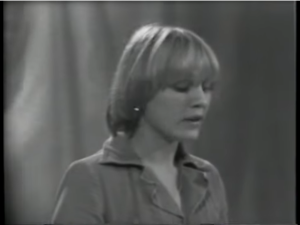
Rose Lesniak became one of the co-editors alongside Barbara Barg of Out There in 1973, taking over for Neil Hackman who was graduating. Lesniak solicited donations and further funding to keep the magazine running, while Barg put the magazine together. Out There continued after Lesniak and Barg moved out to New York, and Lesniak created Out There Productions as a performance and poetry video project.
On “the geographic range” of Out There magazine
RL: Ted was just our advisor, but he was very proud of us and told other poets to send work to us. He loved Bob Dylan, he loved poetry…Allan Bates, a theater professor, was kind of in control of Ted. He would tell Ted how to get around, and how to get money, and what to do, and how to do things. And then they pushed us out of the university. They said,” These are people using marijuana, they’re smoking, they’re drinking…” So they gave us a spot at 3307 W. Bryn Mawr Ave., the theater and poetry area away from the university. Alan and Ted were the two teachers assigned to that center. All Ted wanted was to impart his knowledge of poetry and have a good time. And he did—his classes were huge. People love him. You could get an A in his class if you brought him the right drugs.
On the issue of “women/dinner roles/douche bags/lipstick & clean work”
SA: Speaking of women poets, there’s that amazing issue of Out There, Issue 11, the one with the dedication to “women/dinner roles/douche bags/lipstick & clean work”…
RL: That was the one we did in New York, when we went to New York. When we got there, we were a force! Barbara, myself, Eileen Myles… We went to poetry readings and heckled the men, who were talking like, “Oh, your breasts are so nice when such them…” and stuff like that. These guys! And the Iowa School too, they weren’t really talking about what was going on in the world! They were just out there dreaming in their sexist wonderhood. Our guys, the Beat poets, liked us because we were women who came into the scene who challenged them. They thought that was cute. And we were fun and fierce, and serious about our poetry. We were a community of different individuals bonded together by poetry and the fun of it. We respected each other despite our diverse writing styles.
