A group of presenters from the Rosetta Reitz Archive Collective (2024-2025) presenting at the Care Ethics Research Consortium in Utrecht, 2025. L to R: Annie Koppes, Lou Brown, Tift Merritt, Craig Breaden, Trisha Santanam, Ethan Foote.
As we conclude our 2024–2025 journey with the Archives and Creative Process: Blues Women and Rosetta Records Bass Connections team, I find myself reflecting on a year marked by profound collaboration, discovery, and growth. Our collective delved into the rich archives of Rosetta Reitz, unearthing stories of blues women whose voices had long been marginalized. Through interdisciplinary research and creative engagement, we sought to honor their legacies and amplify their contributions to music and culture. Here is a glimpse at some of the phenomenal work I would like to highlight of our team members!
Archival Stewardship
Our project’s archival experts, Laura Micham and Craig Breaden, provided invaluable guidance. Micham, director of the Sallie Bingham Center, served as both a scholarly guide and a bridge between the archive, the donor, and our research team:
“It is especially exciting to be part of a team that has produced a wide range of excellent projects and programs that will continue to have an impact on their work as well as on future researchers and others,” Micham shared.
Breaden, who initially approached the project through his technical role managing audiovisual materials, found his practice transformed by the team’s conversations around feminist ethics:
“I turned my attention to Jailhouse Blues and what our conversations about radical empathy and care ethics meant in the context of songs performed by incarcerated Black women. I pursued the idea that recognizing a person’s name, their identity, empowers them, a concept that has gained a stronger hold in libraries and archives in the last decade as part of a movement towards “reparative description.” In this spirit I constructed Library of Congress name authority files for the women whose names were listed in the credits of Jailhouse Blues. In my twenty-year career as an archivist, I am particularly proud of this, and it has had a significant impact on how I view the contributions I can make in my everyday work.” – Craig Breaden, Audiovisual Archivist at Duke University
Undergraduate Research and the Power of Interpretation
Our team included a dynamic group of undergraduates whose creativity and intellectual curiosity helped animate the archive.
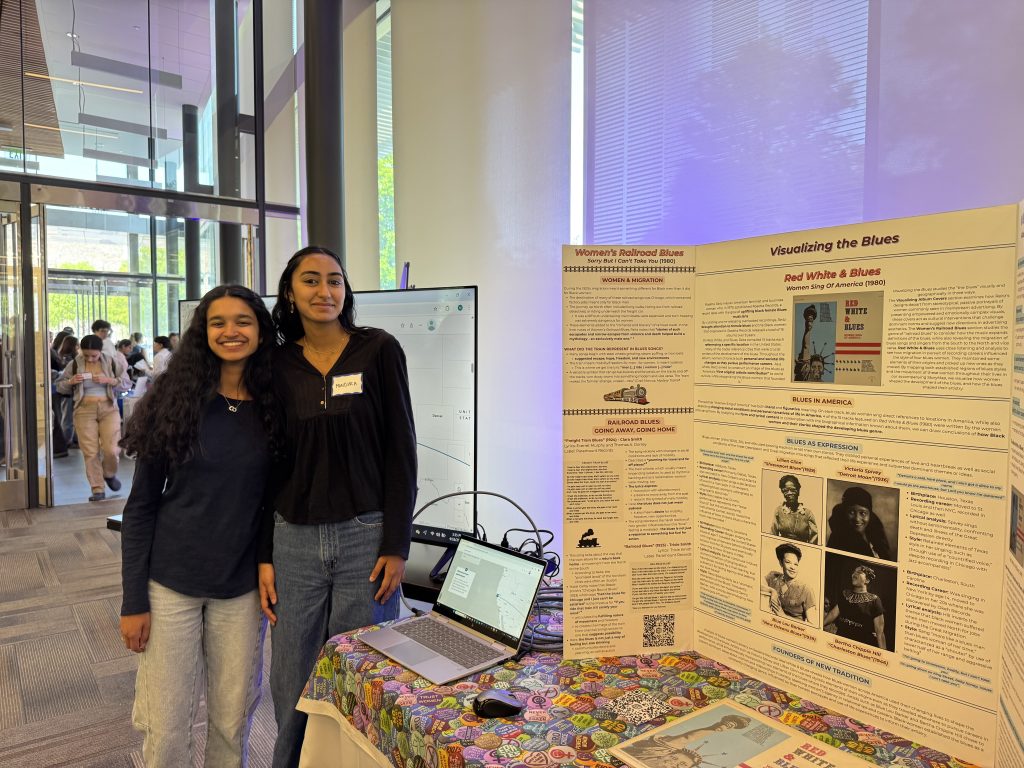
Mandira Bhat, a sophomore studying Mechanical Engineering, brought a STEM perspective to the humanities and created a rich, interactive map tracing the biographies and recording histories of the four women featured on Reitz’s Red, White, and Blues (Women Sing of America) album. Of her experience, she wrote:
“This project introduced the idea that there is no such ‘objective lens,’ and you need to take an active role in deciding what to bring attention to and how to speak about it.”
Mandira Bhat presenting at the Franklin Humanities Institute in Fall 2024. Here, she is discussing her work on social networks between jazz enthusiasts and photographers.
Trisha Santanam, a Trinity ’26 undergraduate and recipient of a Bass Connections Student Research Award, led a public listening session on Jailhouse Blues, highlighting the cultural and sonic significance of prison music sung by incarcerated women at Parchman Farm in the 1930s. At the Bass Connections Symposium, she co-presented work on Reitz’s Railroad Blues, analyzing themes of travel, displacement, and Black migration through a gendered lens.
Trisha Santanam and Mandira Bhat presenting at the Bass Connection Symposium 2025.
Isabelle Zhang, a senior at Duke Kunshan University majoring in Art History, contributed a visual-cultural analysis of album covers from the mid-twentieth century, examining how Rosetta Records intervened in dominant representations of racialized and gendered tropes in blues and jazz media. Her work shed light on how visual aesthetics, often overlooked, can enact feminist resistance.
Musical Dialogues and Creative Resonance
Our exploration of the Rosetta Reitz archive was shaped not only by textual and visual materials, but by a deep engagement with sound—particularly the voices, songs, and musical histories that Rosetta brought into circulation
Ethan Foote, a jazz musician and PhD candidate in composition at Duke, offered insights into the musical structures and improvisational languages of the recordings in Reitz’s collection. His analysis connected the blues to wider literary and cultural themes including feminine desire, Jewish identity, and the politics of sonic expression—deepening the group’s approach to listening and interpretation.
Tift Merritt, artist-in-residence and longtime collaborator with the Reitz Archive project, drew on her own experiences as a musician and mother:
“Spending time with Rosetta Reitz’s insistence on being independent and innovative in the music business as well as active in the political issues of her time gives me courage to insist on those same things from myself.”
– Tift Merritt, Practitioner-in-Residence at Duke
Tift also noted, “Being a human being—let alone a single mom pushing against the grain—is messy work, but none of us really understand how deeply our everyday kindnesses, our struggles, and our small steps forward affect the world.”
My own work (Annie Koppes) has been rooted in conversation with each of these brilliant team-members. As a musicologist, I helped facilitate listening sessions and offered historical framing around albums like Jailhouse Blues and Red, White, and Blues, among others. While I brought background in feminist sound studies and blues historiography, the team’s insights continually reshaped how I heard these recordings. Their questions and observations have directly informed a chapter of my dissertation on Reitz’s work on Blues Is a Woman, and reminded me that listening is not solitary—it’s a collective, interpretive act.
Marginalia, Memory, and Public Humanities
Lou Brown, who spearheaded the group’s organizational structure, brought unmatched dedication to both archival discovery and public engagement. From hosting events co-sponsored by the Franklin Humanities Institute and the Forum for Scholars and Publics, to conducting deep research on Rosetta’s marginalia—those handwritten notes, clippings, and scribbles often dismissed by traditional archival methods—Lou’s work exemplified feminist attention to the overlooked.
“This project provides the opportunity to engage in all the best parts of academic work,” Brown said. “Researching and learning side-by-side with colleagues across disciplines, experiencing the excitement of fresh insights as new team members come on board each year and as each of us has opportunities to go deeper in our individual research paths, and having the opportunity to share our work in public events and conferences. I’ve especially appreciated the chance to reach out to people outside the archive, following threads to see where Rosetta Reitz’s work can lead us in the 21st century.” – Lou Brown, Senior Research Scholar and Director of Programs at the Forum for Scholars and Public at the Franklin Humanities Institute at Duke University
Our project was also featured in a writeup by Jamal Michel titled Care, Ethics and Power in Bass Connections, which explored the team’s contributions to care-centered archival practice and presentation at the Care Ethics Research Consortium in Utrecht, Netherlands in January 2025.
As our year comes to a close, we are proud to have engaged the archive not only as a repository of the past but as a living space of political possibility, feminist intervention, and sonic imagination. From interactive maps to listening sessions, from marginalia to metadata, our collective efforts this year sought to honor and extend the radical spirit of Rosetta Reitz and the women whose voices she uplifted.
Looking ahead, we are thrilled to announce that Lou Brown and Tift Merritt will be continuing the work of the Rosetta Reitz Archive Collective in 2025–2026 through a new iteration of Bass Connections: Activism, Music and the Rosetta Reitz Archive. We are excited to see where their leadership and vision take the project next.
— Annie Koppes, on behalf of the 2024–2025 Rosetta Reitz Archive Collective