
Research
There is growing consensus that next-generation wireless networks (6G and beyond) will integrate radar-like sensing and artificial intelligence (AI) into existing communication infrastructures, enabling networks that can sense, infer, learn from and adapt to their surrounding environment. Legacy networks treat these functionalities as distinct optimization objectives; hence, optimize each functionality separately over distinct network resources. Unfortunately such an approach is sub-optimal, which prevents networks from operating optimally “anytime, anywhere”, e.g., under extreme mobility on bullet trains or in battlefields.
My research rethinks the foundational principles of networking to natively support sensing, AI and communication in shared network resources. My core innovation is to design network signal transmission and processing schemes in the delay-Doppler (DD) domain. This yields a basis of high-rate communication waveforms whose interaction with the environment is stationary – enabling efficient AI-based learning – and perfectly matched to the geometrical properties of the environment – enabling integrated sensing and communication. My research builds upon this core idea across three thrusts.
Fine-Grained Sensing at the Network-Scale
I transform channel impairments like multipath and under-utilized network resources like polarization into enablers for high-resolution, wide-coverage sensing in the DD domain. By enabling sensing at the network-scale, my work paves the way for new services (“sensing-as-a-service”) across verticals such as autonomous driving & defense.
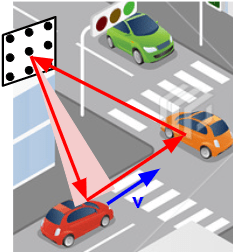
Traditional sensing algorithms assume transmitted signals scatter once at objects before being received. This, however, limits sensing coverage to directly illuminated objects. Building upon theoretical foundations in [1], in Hydra [2], I harness higher-order signal bounces (multipath) conventionally discarded in sensing systems to increase the sensing coverage of a single device. This enables sensing outside transmit beams and behind occlusions, such as around-corners and behind-devices, at no extra hardware cost. In [3-4], I utilize multipath to also estimate the motion vectors (speed and direction) of moving objects, which is conventionally not possible with a single device. My work has key applications in safety-critical infrastructure, enabling, for instance, vehicles to detect objects in blind spots and track tangentially moving traffic in real-time.
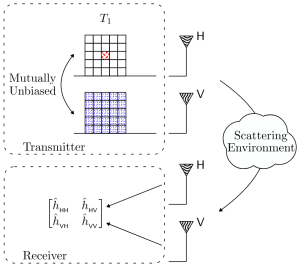
Sensing in urban areas requires detecting weak targets (e.g., drones) amid stronger background clutter from buildings, foliage, and other obstacles. Traditional solutions increase latency and hardware cost by fusing data from different devices across time to detect such targets. In my work, I utilize polarimetry – the ability to transmit and receive in orthogonal polarizations – to detect such weak targets. Nearly all wireless devices are equipped with polarized antennas, making polarimetric sensing feasible with arbitrary form factor devices at no extra hardware cost. In [5], I propose transmitting mutually unbiased DD waveforms within a single transmission frame to enable polarimetric sensing at FFT-scale complexities. My work paves the way for low cost, pervasive radar sensing with everyday wireless devices such as smartphones.
Key Publications
[1] Nishant Mehrotra and Ashutosh Sabharwal, “When Does Multipath Improve Imaging Resolution?,” IEEE Journal on Selected Areas in Information Theory, Special Issue on Information Theoretic Foundations of Future Communication Systems, 2022.
[2] Nishant Mehrotra, Divyanshu Pandey, Akarsh Prabhakara, Yawen Liu, Swarun Kumar and Ashutosh Sabharwal, “Hydra: Exploiting Multi-Bounce Scattering for Beyond-Field-of-View mmWave Radar,” ACM MobiCom, 2024.
[3] Nishant Mehrotra, Divyanshu Pandey, Upamanyu Madhow, Yasamin Mostofi and Ashutosh Sabharwal, “Instantaneous Velocity Vector Estimation using a Single MIMO Radar via Multi-Bounce Scattering,” IEEE/NIST CISA, 2024.
[4] Nishant Mehrotra, Divyanshu Pandey, Upamanyu Madhow, Yasamin Mostofi and Ashutosh Sabharwal, “Single-Frame MIMO Radar Velocity Vector Estimation via Multi-Bounce Scattering,” IEEE Transactions on Computational Imaging, Special Section on Computational Imaging using Synthetic Apertures, 2025.
[5] Nishant Mehrotra*, Sandesh Rao Mattu* and Robert Calderbank, “Instantaneous Polarimetry with Zak-OTFS,” IEEE Transactions on Radar Systems (Correspondence), 2025. (*co-primary authors)
High-Rate Communication in Extreme Mobility
Network users expect seamless connectivity – even in environments with extreme mobility, such as on bullet trains. Mobility causes legacy signaling schemes to fade, i.e., randomly fluctuate in signal amplitudes, negatively impacting network throughput and latency. In my work, I design DD domain transmission schemes that do not fade, thus support reliable connectivity even in extreme mobility. Practical realizability is a central feature of my work; I design energy efficient schemes that can be easily implemented on hardware.
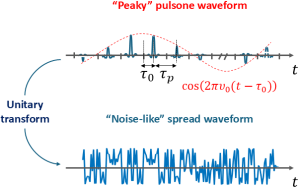
It is well-established that DD domain pulses (“pulsones”) form a basis of waveforms whose interaction with the environment is stationary (non-fading) and perfectly matched to the geometrical properties of the environment. These properties make pulsones ideal for high-rate communication and sensing in extreme mobility. However, the pulsone waveform has large variations in amplitude, making energy efficient hardware implementation challenging. In [6], I unitarily transform pulsones to noise-like “spread” waveforms with constant amplitude that can be efficiently transmitted by radio hardware. When sampled, these spread waveforms yield Zadoff-Chu sequences already part of wireless standards, making my implementation standard-compatible. My work further enables covert communication and radar sensing [7] free of interference and jamming in extreme mobility.
The idea of unitarily transforming (“spreading”) DD signals also simplifies receiver design. In [8], I detect spread DD symbols in the frequency domain, reducing computational complexity from cubic to linear. In [9], I superimpose mutually unbiased frames of spread DD symbols to transmit information at up to 1.5 x higher spectral efficiencies than conventional Nyquist signaling. By simplifying receiver design, my work enables energy efficient communication in extreme mobility, enabling, for instance, direct-to-satellite connectivity.
Key Publications
[6] Nishant Mehrotra*, Sandesh Rao Mattu* and Robert Calderbank, “Zak-OTFS with Spread Carrier Waveforms,” IEEE Wireless Communications Letters, 2025. (*co-primary authors)
[7] Nishant Mehrotra*, Sandesh Rao Mattu*, Saif Khan Mohammed, Ronny Hadani and Robert Calderbank, “Discrete Radar based on Modulo Arithmetic,” EURASIP Journal on Advances in Signal Processing, 2025. (*co-primary authors)
[8] Sandesh Rao Mattu*, Nishant Mehrotra*, Saif Khan Mohammed, Venkatesh Khammammetti and Robert Calderbank, “Low-Complexity Equalization of Zak-OTFS in the Frequency Domain,” npj Wireless Technology (Invited Paper), 2025. (*co-primary authors)
[9] Sandesh Rao Mattu*, Nishant Mehrotra* and Robert Calderbank, “Improving the Spectral Efficiency of Zak-OTFS via Mutually Unbiased Bases,” In Review, 2025. (*co-primary authors)
Shared-Resource Sensing & Communication
Integrating sensing with communication requires enabling both functionalities in shared network resources (time, bandwidth & power). Legacy network architectures fall short of this goal by optimizing each functionality separately on disjoint network resources. My work demonstrates how DD domain signaling enables integrated sensing and communication without dividing network resources between the two functionalities.
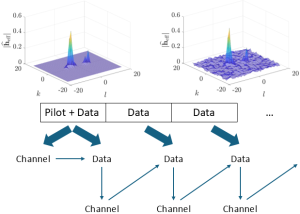
In [10], I make the observation that communication data, once decoded, can be reused for sensing. This simplifies transmission by removing the need to transmit dedicated sensing signals (“pilots”) alongside communication data in every frame. I extend the scheme to a distributed network of base stations, e.g., applicable to cell-free MIMO, in [11]. In [12], I verify the scheme in practice by demonstrating sensing using only DD domain data signals. By reusing over-the-air 5G/6G network transmissions to opportunistically sense the environment, my work can unlock new on-demand network services such as elderly fall detection in smart homes, threat surveillance in defense networks and traffic monitoring in transportation networks. My work also lays the foundation for designing Pareto-optimal multi-function networks that achieve optimal performance across sensing, communication and AI with minimal trade-offs.
Key Publications
[10] Nishant Mehrotra and Ashutosh Sabharwal, “On the Degrees of Freedom Region for Simultaneous Imaging & Uplink Communication,” IEEE Journal on Selected Areas in Communications, Special Issue on Integrated Sensing and Communication, 2022.
[11] Nishant Mehrotra, Ashutosh Sabharwal and César Uribe, “Consensus ADMM-Based Distributed Simultaneous Imaging & Communication,” IFAC NecSys, 2022.
[12] Sandesh Rao Mattu*, Nishant Mehrotra* and Robert Calderbank, “Differential Communication in Channels with Mobility and Delay Spread using Zak-OTFS,” IEEE Wireless Communications Letters, 2025. (*co-primary authors)
