In a 2010 book, Biology’s First Law, philosopher Robert Brandon and I argued that change in complexity and diversity in evolution are governed by what we call the Zero-Force Evolutionary Law (ZFEL). 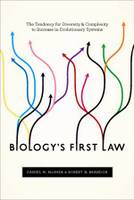 Our 2020 book, The Missing Two Thirds of Evolutionary Theory, offers a quantitative version of the law and discusses some of the objections that the 2010 book inspired.
The law says that in the absence of selection and constraint, complexity (in the sense of differentiation among parts) and diversity (in the sense of differentiation among species) will tend to increase. Further, even when forces and constraints are present, a tendency for complexity and diversity to increase is always present. Let’s begin with complexity (although the law for diversity precisely parallels it). The argument is that when selection is absent, the parts of an organism — say, the segments of a worm — should tend spontaneously to accumulate variation, and therefore to become more different from each other. At the cell level, the claim is that, absent selection and constraint, the degree of differentiation among cells in a multicellular organism should increase with the accumulation of heritable accidents (e.g., mutation), leading eventually to an increase in the number of cell types.
The principle applies beyond biology: the pickets of a picket fence will tend to become different from each other as each picket accumulates its own unique features, one picket losing a chip of paint, another acquiring a sticky pollen grain, a third getting knocked and dented by a passing animal, and so on.
There is considerable evidence for the ZFEL, for the existence of a spontaneous increasing tendency in evolution. We discuss some of it in the book. For an empirical test, see this paper with Leonore Fleming on complexity in Drosophila.
The law applies at all hierarchical levels (molecules, organelles, cells, etc.). It also applies above the level of the organism, to differences among individuals in populations, and to differences among species and among higher taxa. In other words, the ZFEL says that diversity also tends spontaneously to increase. The ZFEL is universal, applying to all evolutionary lineages, at all times, in all places, everywhere life occurs. And any complete evolutionary explanation for change in complexity or diversity will necessarily include the ZFEL as one component.
Importantly, the ZFEL points to a tendency, not a result. My leaning against the corner of my house creates a “tendency” for the house to fall down even if my leaning doesn’t cause any actual movement. Likewise, the ZFEL produces a tendency for complexity to rise, but complexity may or may not actually rise, depending on the strength of opposing forces and constraints. So the conventional wisdom of evolutionary biology is that complexity has risen over the history of life, that there has been a trend. That could be right, and if it is, the ZFEL must be part of that story. On the other hand, the existence of an overall trend is mostly undemonstrated (many will be surprised to learn). Increases have occurred but complexity has often decreased as well. And if it turns out that the two have been roughly in balance, that no net trend has occurred, that finding would not refute the ZFEL. Rather, it would suggest that powerful forces have acted to block the ZFEL tendency.
A consequence of the ZFEL is that we do not need natural selection to explain the large number of tissues and organs in complex organisms, nor to explain the internal complexity of those structures. The ZFEL says that the complexity of all structures is expected to increase spontaneously, in the absence of selection. That is not to say that the structures we ordinarily think of as complex — such as eyes and brains — arise spontaneously. Eyes and brains are not just complex, they are also functional. They *do* something for the organism. And selection is the only mechanism known that can produce functionality in evolution. But functionality aside, we can ask why these structures are complex, why they are so differentiated, consisting of many different part types? (Undoubtedly at least some complex structures could have been simpler, performing their functions with fewer part types.) And the answer could well be spontaneous differentiation, the ZFEL. Indeed, if there is a puzzle to be solve about complexity in evolution, it is not why some structures are complex but why *any* are simple. The puzzle is not how mammals have been able to achieve 250 cell types but rather — given that we have billions of cells, every one of which could in principle be unique type — why we don’t have many, many more than 250. In principle, every cell could be its own unique type. The answer is natural selection, acting to maintain uniformity, to maintain simplicity, wherever simplicity is needed. That is, natural selection acting *against* complexity!
If I had to fit the point of the ZFEL on a bumper sticker, it would say this: Complexity is easy. Simplicity is hard.
In a 2019 paper in Evolution, Robert Brandon, Steve Wang, and I used random‐walk models to quantify the zero-force expectation, producing equations that give the probabilities of diversity or complexity increasing as a function of time, and that give the expected magnitude of the increase. We produced two sets of equations, one for the case in which variation occurs in discrete steps, the other for the case in which variation is continuous. The equations provide a way to decompose actual trajectories of diversity or complexity into two components, the portion due to the ZFEL and a remainder due to selection and constraint. We demonstrate the procedure for applying the equations in a series of examples, using real and hypothetical data.
