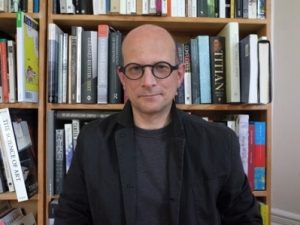
Associate Professor in Chinese Studies and Visual Culture at Durham University
Professor Schaefer works with images that hold still. His research and teaching center on Chinese visual and literary culture within a global context from the mid-19th century to the present, connecting photography and media studies, comparative literature, the geography of culture, philosophies of nature, and the environmental humanities.
His current research project, Photographic Ecologies: Nature, Culture, and Contemporary Photography in China, Japan, and the West, will be the first book-length academic study in English to address contemporary photography in China. It argues that photography is a crucial site for staging fundamental questions of the relations between culture and nature in the present moment of environmental crisis and mass displacement––and thus for learning to picture the Anthropocene.
His first book, Shadow Modernism: Photography, Writing, and Space in Shanghai, 1925-1937 (Duke University Press, 2017), explores the transformation of Chinese visual and literary culture by photography, and the centrality of that transformation to modernism in China. The book argues that in Shanghai––the center of China’s media culture during the 1920s and 1930s––images and ideas about images formed a contested ground of debate about culture, the past, and modern China’s place in the world.

Panel 4 | Global and Planetary Implications from China Studies
Fragments, Circulations, Sequences: Photobooks and the Perception of Geological Time
Abstract
A crucial resource for addressing the problem posed by the Anthropocene and its vastly disparate scales of geological history and of human life, is, Prasenjit Duara (2015) has argued, the multiplicity of local, indigenous, and alternative traditions in Asia that, “when re- energized by circulatory ideas and practices of our time,” offer different modes both for thinking nature and for linking “the personal to the social, natural, and the universal.” This question is even more urgent given the failure Amitav Ghosh (2016) decries of cultural forms––particularly narrative fiction––to imagine in the Anthropocene “forces of unimaginable magnitude that create unbearably intimate connections over vast gaps in time and space.”
This presentation proposes that the photobook has recently become in China, Japan, and the West an aesthetic form for picturing together human perception and geological time and force. In her photobooks Koan (2014 & 2017) and Paperbush (梦花, 2024), as well as in her video montage of image and sound, When Tethys Sea Retreats Westward, Leaving the Reverberation (当特提斯海向西退却,留下残响, 2022), Chen Xiaoyi explores interconnections among embodied human perception, landscape formations, and the legacies of mining by drawing together diverse cultural forms of fragmentation and connectivity: koans; poetry; texts by the poet, philosopher, and mining geologist Novalis; and indigenous, minority oral accounts of environmental and geological histories. And through its sequencing of deep black, monochromatic, nearly-abstract photographs the American Ron Jude’s 12 Hz (2020) explores relations between the deep time of geological and ecological forces and the limits of human perception.
A photobook consists, of course, not of a single still image, nor of a moving image, but of a dynamic sequence of still images that, as Keith Smith (2003) argues, “is so ephemeral that it exists only as fragments of now-time: the opened folio. It is only seen in full after the act of viewing.” Photographer Alec Soth shows how the non-narrative, non-linear sequencing of images (and the gaps between images) shapes the ways time is experienced in photobooks––a process parallel, I claim, to how geological histories are pictured through gathering, piecing together, and finding patterns in fragments of earth, or to ecologists’ work of picturing relationships of patterns and processes, cycles and circulations, fragmentation and connectivity, across multiple scales of space and time. How, then, does sequencing photographs become an aesthetic form for imagining and making thinkable together multiple scales of momentary perceptions, the materiality of media, alternative traditions of cultural memory, ecological cycles, and deep geological time, when human agencies have become a geological force?
