By Andy Wang
Github Link: Early-Modern-London
Introduction:
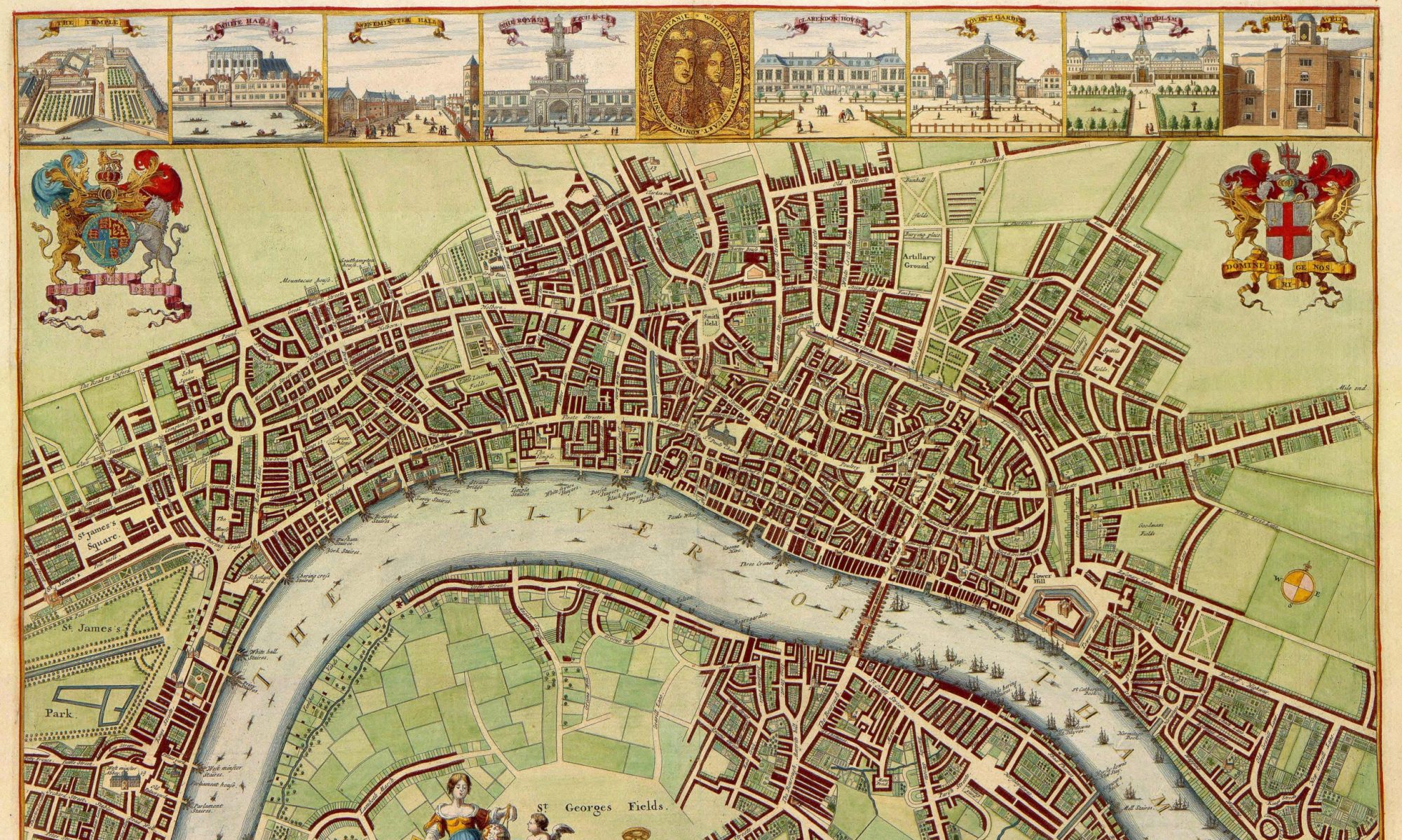
The 17th century London was a time of great change and growth for the city. It was the capital of England during the reign of King James I, and the center of power for the British Empire. London during this time saw significant expansion and development, as the city grew in size and population. The city also became a hub for trade, commerce, and culture, with thriving markets, theaters, and cultural institutions. The 17th century was also marked by important events such as the Great Fire of London in 1666, and the outbreak of bubonic plague, which had a significant impact on the city’s residents. Despite these challenges, London continued to be an important center of power and influence throughout the world. With the rapid expansion of land and population, London becomes the one of the financial center in the world, coming with the emergence of modern banking system. In particular, books, pamphlets, and playwrights, those on which the general public heavily relied for entertainment purposes, quickly become commercialized and easily accessible. In this site, we analyze the source of commercialization of literatures in early 17th century London using various techniques in statistics and data science.
Data Collection:
- 1. Source:
- Early English Books Online (EEBO) on the ProQuest PlatformProQuest. (n.d.). Early English Books Online. Retrieved from https://eebo.chadwyck.com/home
- The specific locations of 17th century London is retrieved from Agas Map: https://mapoflondon.uvic.ca/agas.htm
- 2. Process:
- 1.Data Retrieval: Retrieve all of the literatures from authors including John Marston, Thomas Dekker, Thomas Middleton, William Shakespeare, and Ben Johnson
- 2. Data Cleaning: Due to the chaotic nature of author name usage, we have map different nicknames and names to the same author, clean the data and look for the corresponding publisher and printer for each literature.
Data Analysis and Visualization:
K-means Clustering:


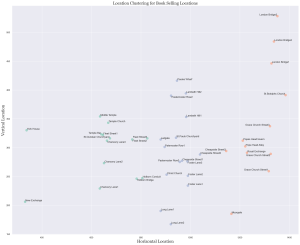
K-means clustering is a popular unsupervised machine learning algorithm used for clustering data points into groups or clusters based on their similarity. The goal of k-means clustering is to partition a given set of data points into k clusters, where k is a user-defined number of clusters. In this Early Modern London Map, the most suitable number of clusters is 5 from the elbow graph (not showing here), which divide the whole London into five business areas.
Cluster 0 [604, 302, St.Clement Danes]: East Westminster Cluster (Including west St.Dunstans)
Cluster 1 [949, 240, St. Martin’s le Grand]: Aldersgate Cluster
Cluster 2 [1350, 462]: London Bridge Cluster
Cluster 3 [922, 350, Paul’s Chain]: St.Paul’s Churchyard Cluster
Cluster 4 [1253, 297, Birchin Lain]: Royal Exchange Cluster
Hierarchical Clustering:

The dendrogram on the page shows the results of a hierarchical clustering analysis that was performed on the locations of businesses in early modern London. The dendrogram is a graphical representation of the hierarchy of clusters that were formed by the analysis.
The dendrogram shows the different levels of the hierarchical clustering analysis, with the initial individual locations represented at the bottom of the diagram. As we move up the diagram, locations are grouped together into clusters based on their similarities in terms of the types of businesses that were located there. The height of the branches in the dendrogram represents the distance between the different clusters, with shorter branches indicating that the clusters are more closely related.
The dendrogram can be used to understand the structure of the commercial landscape in early modern London. It shows that the businesses were clustered together in different neighborhoods based on the types of goods and services they offered
GeoCoding — Single Author
John Marston (1576-1634) was an English playwright, poet, and satirist who lived during the late 16th and early 17th centuries. He is known for his witty and often risqué plays, which were popular during his lifetime but fell out of favor in the centuries that followed.
Below is a graph for the distribution of places where sell John Marston’s work. Still, it exhibits a similar pattern as in the . Future Geocoding work addressing William Shakespeare might be an interesting topic.

Conclusion
Book selling in 17th century London was a rapidly growing industry, fueled by a growing demand for literature and an increase in literacy rates among the general population. The book trade was centered around the area of St. Paul’s Churchyard, which was home to many of the city’s most prominent booksellers.
During this time, the book trade was highly competitive, with booksellers vying for customers through a variety of marketing techniques. These included advertising in newspapers, distributing flyers and handbills, and creating eye-catching window displays to attract passersby.
Books were sold in a variety of formats, including individual pamphlets, bound volumes, and illustrated editions. Popular genres included history, poetry, and theology, although works of fiction also gained popularity during this time.
One notable aspect of the book trade in 17th century London was the proliferation of unlicensed and pirated editions of books. This was due in part to lax copyright laws, which allowed booksellers to reprint popular works without the author’s permission. This led to conflicts between authors and booksellers, with authors often struggling to receive fair compensation for their work.
Despite these challenges, the book trade continued to thrive throughout the 17th century, laying the foundation for the vibrant literary culture that would continue to flourish in London and throughout England in the centuries to come.
