Precision Health and Medicine Observation Laboratory
Internet of Things
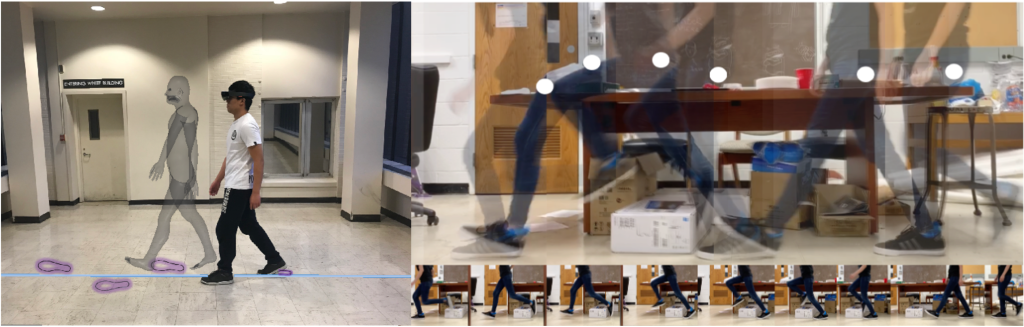
Smart Insole is a wearable safety tool designed to monitor dangerous walking surfaces before injuries occur. This system uses workers’ natural walking patterns to detect slip and trip risks automatically. By analyzing how gait changes on unsafe flooring, the device identifies hazardous areas with machine-learning intelligence and distinguishes unsafe surfaces with over 98% accuracy. This approach turns every worker into a real-time safety sensor, helping prevent falls and reduce costs related to workplace injuries.
Project Description
Smart Insole consists of a full-foot-area smart textile-based flexible pressure sensor array (including 96 individual pressure sensors), a 9-axis inertial motion unit (IMU), an ultra-low-power microcontroller, a Bluetooth module, a rechargeable Lithium battery, and the related conditioning circuits. All electronic components are ergonomically packaged in an insole. All streaming sensor data (including accelerometer, underfoot pressure sensors, and foot orientations) is streamed into a smartphone through low-power Bluetooth in real-time. The insole is lightweight (< 2 oz), thin (2 mm), and convenient to use. It does not need manual calibration and only requires minimal communication setup, such as pairing with a smartphone. The sensors are protected by a waterproof barrier and a layer that can wick moisture away. The sensor data are transmitted to the smartphone from the insole via Bluetooth and stored in the memory of the smartphone. A kinematic analysis can be performed to recognize the gait phases, general gait parameters, movement information, dynamic foot pressure distribution, and locomotion, such as walking impact, the center of pressure, acceleration, speed, and direction.
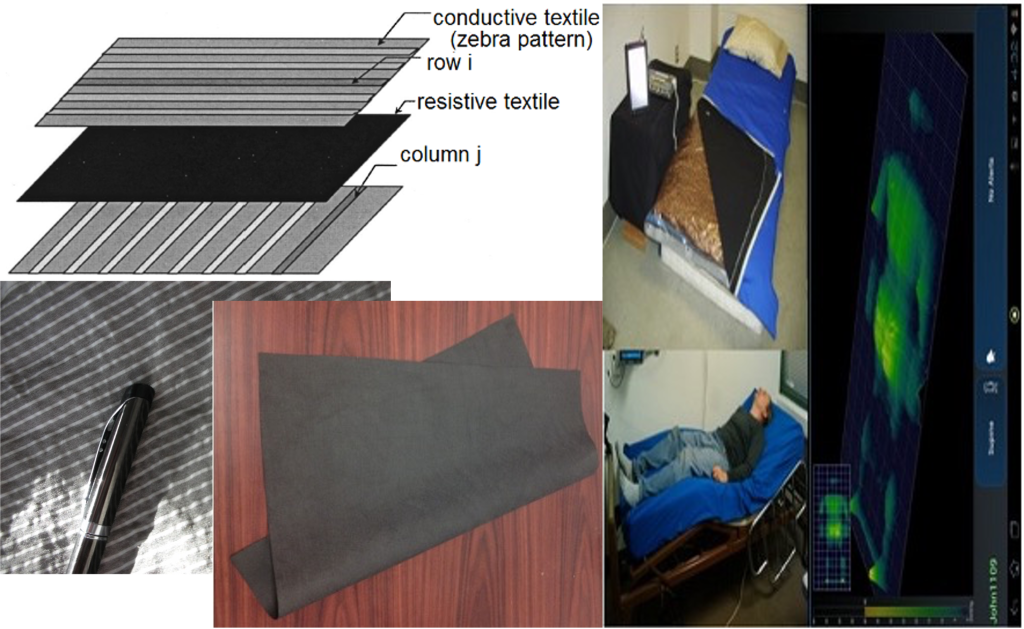
Bedsores, also called decubitus or pressure ulcers, are defined as injuries to the skin and underlying tissues that result from prolonged pressure on those areas. Pressure on the skin reduces blood flow to the region and causes the skin to necrotize. Bedsores most often develop on the skin that covers bony areas of bedridden patients, such as heels and buttocks. Bedsores can develop quickly and are often difficult to treat. Nevertheless, most bedsores are considered preventable if patients are moved periodically, such as every two hours, to alleviate pressure on bony prominences. This relies on the engagement and commitment of nursing services and places a large burden on the caregivers. We designed a bedsore monitoring system made of pure conductive fabric, similar to normal fabric, but that transduces contact force into texture deformation. The designed bedsheet-like prototype is a 2.5m ×1.25m system that contains 64 × 128 pressure sensors. 64 column conductive lines and 128 row conductive lines generate 8192 intersections. A sheet of e-Textile fabric which feels like a regular fabric coated with piezo-electric polymer in between the row and column layers. The array-structured fabric can be used for monitoring the accumulated pressure of the high-risk regions with appropriate fabric-human modeling and computation. We explored the possibility of logging bedsore development stages using pressure-duration relationships and evaluated whether visualizing quantified bedsore formation information can assist caregivers in predicting and preventing bedsore development in time. In addition, we discovered that micro-positioning, slightly moving certain body parts, can cause full-body pressure redistribution. This discovery may provide a new research path to explore more effective pressure alleviation methods in practice.
Publication
Ubiquitous Fall Hazard Identification With Smart Insole