

Keynote Speakers

 Kathleen Sikkema, Interim Dean, Columbia University Mailman School of Public HealthKathleen J. Sikkema, Ph.D., Interim Dean, Barbara and Bruce P. Dohrenwend Professor of Sociomedical Sciences and Director, Global and Population Mental Health at Columbia University Mailman School of Public Health, conducts community-based intervention research focused on HIV prevention and mental health treatment in the U.S. and in low- and middle-income countries. She is a clinical psychologist who specializes in health and community psychology and an honorary professor at the University of Cape Town. Dr. Sikkema has led pioneering scholarship in global mental health, specifically related to traumatic stress, coping and gender violence. Funded by NIH for thirty-five years, her research program focuses on community-level HIV prevention trials, mental health interventions to improve HIV care engagement, and university-community research collaboration. U.S.-based HIV prevention interventions and mental health interventions developed by Dr. Sikkema and her teams have been identified by CDC and SAMHSA as best evidence interventions. In South Africa, where Dr. Sikkema has worked for twenty-five years, her current intervention trial research focuses on integrating mental health treatment into HIV primary care to improve clinical outcomes for women who have experienced sexual trauma. This research addresses the syndemic nature of HIV and mental disorders, whereby social and economic contextual factors create and exacerbate the risk of disease progression. Dr. Sikkema previously served as the Gosnell Family Professor of Global Health and Psychology and Neuroscience at Duke University, where she was the founding director of the Global Mental Health Initiative at the Duke Global Health Institute and the Social and Behavioral Sciences Core in Duke’s Center for AIDS Research. Kathleen Sikkema, Interim Dean, Columbia University Mailman School of Public HealthKathleen J. Sikkema, Ph.D., Interim Dean, Barbara and Bruce P. Dohrenwend Professor of Sociomedical Sciences and Director, Global and Population Mental Health at Columbia University Mailman School of Public Health, conducts community-based intervention research focused on HIV prevention and mental health treatment in the U.S. and in low- and middle-income countries. She is a clinical psychologist who specializes in health and community psychology and an honorary professor at the University of Cape Town. Dr. Sikkema has led pioneering scholarship in global mental health, specifically related to traumatic stress, coping and gender violence. Funded by NIH for thirty-five years, her research program focuses on community-level HIV prevention trials, mental health interventions to improve HIV care engagement, and university-community research collaboration. U.S.-based HIV prevention interventions and mental health interventions developed by Dr. Sikkema and her teams have been identified by CDC and SAMHSA as best evidence interventions. In South Africa, where Dr. Sikkema has worked for twenty-five years, her current intervention trial research focuses on integrating mental health treatment into HIV primary care to improve clinical outcomes for women who have experienced sexual trauma. This research addresses the syndemic nature of HIV and mental disorders, whereby social and economic contextual factors create and exacerbate the risk of disease progression. Dr. Sikkema previously served as the Gosnell Family Professor of Global Health and Psychology and Neuroscience at Duke University, where she was the founding director of the Global Mental Health Initiative at the Duke Global Health Institute and the Social and Behavioral Sciences Core in Duke’s Center for AIDS Research.
|
 Florence Jaguga, Clinical Psychiatrist, Moi Teaching and Referral Hospital Florence Jaguga, Clinical Psychiatrist, Moi Teaching and Referral Hospital
Recording: https://youtu.be/rMiDcBe1PXY Dr. Florence Jaguga is a psychiatrist and Acting Director of Mental Health and Rehabilitative Services at the Moi Teaching and Referral Hospital (MTRH). She has extensive experience in mental health policy and governance having served within several national technical mental health committees and boards including the technical committee to develop the National Suicide Strategy, the Alcohol Technical Working Group, and the Medical Board for the National Police Service among others. She has participated in developing mental health policy internationally including the World Health Organization (WHO) Technical Packages for Human Rights and has served as a consultant on several World Health Organization projects notably the WHO QualityRights Initiative. She has over seven years of experience in managing hospital and community-based mental health projects. She has extensive experience in working with stakeholders to implement community-based mental programs including a school-based mental health project, a group-based substance use program, and a program to build capacity of primary healthcare workers to deliver mental healthcare. Dr. Jaguga is a champion of healthcare worker mental wellness and serves as Chair Employee Assistance Program at MTRH. She also sits in the Kenya Medical Association Physician Wellness Committee. Dr. Jaguga has expertise in research and has published numerous scientific articles on mental health and substance use.
|
 Emily Cherenack, Assistant Research Professor, Duke Center for Global Mental Health Emily Cherenack, Assistant Research Professor, Duke Center for Global Mental Health
Recording: https://youtu.be/rMiDcBe1PXY Emily M. Cherenack, PhD, is a clinical psychologist with a primary appointment as Assistant Professor in the Department of Psychiatry and Behavioral Sciences and a secondary appointment as Assistant Research Professor of Global Health in the Duke Global Health Institute. She is also an affiliate of the Duke Center for Global Mental Health. Dr. Cherenack’s mixed-methods research integrates self-report measures, qualitative approaches, and biomarkers to examine how individuals cope with unchangeable stressors and explore how adaptive coping can mitigate the negative effects of stress on immune functioning, reproductive health, and cardiovascular health. Dr. Cherenack is particularly interested in how acceptance-based coping, self-compassion, and exercise can be used to promote mental and physical health in domestic and global settings. Her prior global health research has included a focus on menstrual health among adolescent girls in Tanzania and coping with stress among Latino men living with HIV.
|



Climate and Global Mental Health Spotlight
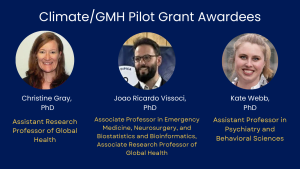
This conference session spotlighted awardees from the Center’s CMH-Climate Pilot Grants. Awardees briefly described the scope of their projects and spoke to the important intersection between climate change and mental health. Descriptions of the projects can be found below.
Recording: https://youtu.be/uhtj0DP71vY

Impacts of Climate Change on Mental Health of Young People in the Philippines: A Mixed-Methods Study of Epidemiology, Lived Experience, and Co-Designed Solutions
João Ricardo Vissoci, PhD (Presenter) & Renzo R. Guinto, MD DrPH
Project Description: Climate change poses an escalating threat to mental health globally, with youth facing disproportionate risks due to ongoing neurodevelopment, limited access to support, and emotional engagement with the climate crisis. This study aims to generate context-specific evidence on how climate change affects the mental health of Filipino youth, and to co-create community-driven solutions that can inform future interventions. Using a mixed-methods design, the project will involve a national online survey with youth aged 15-24 using validated tools; employ in-depth interviews with youth to explore lived experiences and culminate in a co-design workshop with youth, community partners, and mental health practitioners to develop culturally-appropriate, context-specific and youth-led scalable interventions.
PM2.5 Exposure Under Climate Change: Effects on Microbiome and Inflammatory Profiles in a South African Trauma-Exposed Cohort
Kate Webb, PhD (Presenter), Sian Hemmings, PhD & Caradee Wright, PhD
Project Description: This project will investigate how exposure to air pollution (PM2.5) contributes to post-traumatic stress disorder (PTSD). Leveraging a South African longitudinal cohort of individuals with PTSD (N=294) and trauma-exposed controls (N=311), we will test whether PM2.5 influences PTSD symptoms through alterations in the gut microbiome or systemic inflammation and whether these associations differ between groups. Findings will identify modifiable biological mechanisms to guide prevention and intervention strategies for trauma-exposed populations facing climate-related risks.
Regional Variations in Climate-Related Mental Health Outcomes in Sri Lanka: A Mixed Methods Approach
Christine Gray, PhD (Presenter) & Giselle Dass, PhD
