Radar for tracer particles
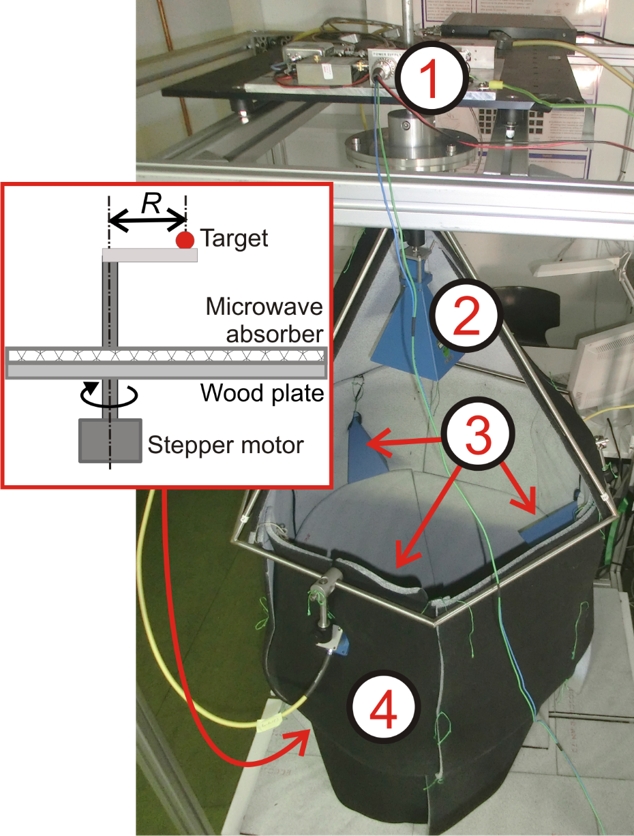
An X-Band radar system: (1) circuit, (2) transmission & (3) receving antennae, (4) microwave absorbers

Since the discovery of electromagnetic wave by Heinrich Hertz in 1887, the development of radio detection and ranging systems has changed our lives in many different ways: From weather forcasting to aircraft safety.    

In the sand lab, we have built and calibrated a small-scaled radar system to locate tracer particles (size down to ~5mm for the 10GHz system) in three dimensions and in real time. In comparison to computer tomography or other imaging techniques (see e.g. Imaging Particles), the excellent time resolution facilitates the investigation of granular dynamics.

The goal is to implement this technique to investigate granular drag for the enhancement of energy efficiency in industrial processes as well as assist in landing and exploring on celestial objects.


References

  • [Enhancement of spatial resolution] “Radar for projectile impact on granular media”, Felix Rech and Kai Huang, International Journal of Microwave and Wireless Technologies (2020) doi:10.1017/S1759078720000586arXiv:2004.10202 
  • [Radar tracking for monitoring projectile moving inside granular media] “The role of initial speed in projectile impacts into light granular media”, Kai Huang, Dariel Hernadez Delfin, Felix Rech, Valentin Dichtl, and Raul Cruz Hidalgo, Scientific Reports 10, 3207 (2020) doi:10.1038/s41598-020-59950-z
  • [Detailed introduction of the technique] “Radar for tracer particles”, Felix Ott, Stephan Herminghaus and Kai Huang Rev. Sci. Instrum. 88, 051801 (2017) doi:10.1063/1.4982942 arXiv:1603.08784
  • [Overview article] “Focus on Imaging Methods in Granular Physics”, Axelle Amon, Philipp Born, Karen Daniels, Joshua Dijksman, Kai Huang, David Parker, Matthias Schröter, Ralf Stannarius, and Andreas Wierschem Rev. Sci. Instrum. 88, 051701 2017) doi:10.1063/1.4983052 arXiv:1703.02928