Duke Engage in South Korea 2019

안녕하세요 서울!

Page 2 of 3

Week 7: The End of an Era

Our seventh week in South Korea was the second week at Wooridul School, a special-purpose academy for North Korean defectors and recent arrivals from countries such as China. Each of us were put in charge of our own classes and our own students. The lesson plans were completely up to individual opinion. 


I can’t speak much of the experiences of the other teachers — I did not teach with any of them, and didn’t have the chance to speak with their students on the level that they did. However, I do know that everyone has felt deeply for the school, staff, and the students we’ve been so lucky to meet and teach. 


I was put in charge of a student named Jae Myeong for the Reading Club period, a Chinese boy who had been in South Korea for the past year but had essentially no English or Korean experience, something I discovered when he stared blankly at me during introductions until I spoke Chinese. The other student that was supposed to join our sessions moved to another class, and I spend an hour every morning guiding him through various alphabet and phonetic-based books. In the span of two weeks, he not only learned the names of the letters, but also can understand the phonetics behind each letter, how to sound out words based on letter combinations, and how to comprehend basic sentences.


Jae Myeong’s motivation and budding confidence in English completely blew my mind. His progress was exponential, and I felt encouraged by the little differences from one day to the next. One day, he couldn’t pronounce the letter r, and the next day he was reading “whisper” out of the book. It was progress unmatched to any student I’ve taught in my life, and I sincerely wish I knew more Chinese to properly convey my wonder to him.


For my normal class, I taught a group of 5 students, aged 17-19, who had arrived from China only a few months prior. In the midst of learning Korean, they were thrown into an English-teaching classroom. Their English proficiencies were relatively similar, but varied enough that one student would finish an assignment in 10 minutes, while the other would need side-by-side explanations. 


They had all studied English in China — one girl, MiHye, had studied for 9 years — but didn’t have a listening or speaking ability on par with their reading ability. I tried to speak in several languages during the class (and sometimes used Papago when I was at a loss for words or couldn’t understand a word in Chinese), and I think this helped my students feel more comfortable around me. I was just as much a struggling student of their native language as they were mine. 


Compared to Jiguchon, I feel like it was harder to form connections with the students at Wooridul, primarily because of the age difference and preferred method of communication. The children at Jiguchon could simply hug us and play games with us, but the students at Wooridul wanted to converse and get to know us. With language barriers, it was definitely more difficult to converse about more complex topics outside of the classroom. 


My biggest regret about teaching at Wooridul is that I wasn’t able to form as deep connections as I wanted. My students wanted to spend each class learning as much English as possible, and I tried to accommodate this by filling each period with countless listening and grammar exercises, intertwined with brief conversations. While I feel like my students definitely got more comfortable with using English, I think I would have rather spent a little more time simply sitting with them and talking about wild topics.


One day, I shifted away from the general English lesson — a listening practice using a scene from the Incredibles — and started a conversation about superpowers and morals as a break. For the remainder of the class, we discussed why we all would want a certain power, the harmful possibilities, and the powers within our reach. For the first time, I saw one of the upper-level English students perk up and discuss his sudden want to be a zombie because “it’s hard for them to die,” and another boy who struggled to stay awake because of his late night working hours lit up to a discussion on time control and his love for the Avengers.


Time control would give them more chances. Time, for these students, is a luxury. They would leave my classes early for their part-time jobs, study at their jobs, and sleep for only three hours a night, just to survive in a country where they lived alone. 


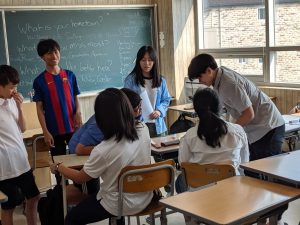
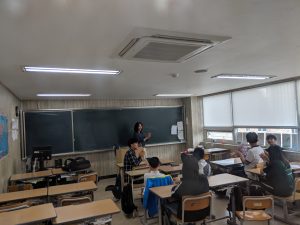
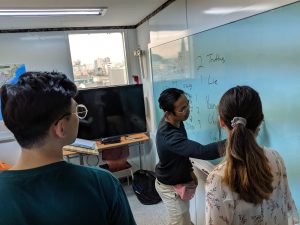
Nikki (me),  Martin, and Thomas teaching a class to the Korean-learning classes.

It was an honor to meet, teach, and get to know the students at Wooridul School, and I wish them all the success in the future. With their drive, they can conquer the world.

____________________________________________________________________________


We said goodbye to the Jiguchon middle schoolers Monday afternoon. We each received a piece of paper with our pictures and a bunch of signatures from our students. Many expressed their regret that they didn’t get to learn from and speak from everyone, but even so they were grateful for each and every one of us. The students formed a circle around us, and we rotated and said goodbye.

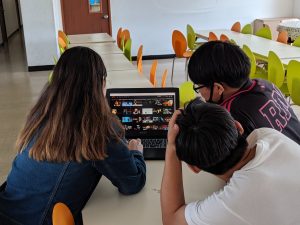
Showing my Jiguchon middle school students English movies.

Oh, middle school. Through teaching these students, I think we have all grown so much as people. To feel the experiential weight of our presence on these kids is a feeling incredibly hard to deal with. We will never really know what they have gone through, and we can’t even begin to comprehend the struggles they will encounter for the rest of their lives. But I hope they will have the courage to face whatever life throws at them, and even if their English level is the exact same as before we came, I hope our impact reaches much further. 

Closing ceremony for Jiguchon middle school

____________________________________________________________________________


Jiguchon and Wooridul students, I will miss you very much. 사랑하고 고맙다.


Nikki

안녕하세요 우리들학교~ (Hello Woorideul School~)

And thus, our first week at Woorideul School has come to a close.


Woorideul School is an establishment that provides Korean lessons and other subject education for North Korean youth from China and also straight from North Korea.   I can’t deny that I was incredibly anxious about teaching at the school. We had little information about the students other than their ethnicities and their very general language profiles.  We also had the daunting task of coming up with lesson plans on our own while also trying to decipher a very confusing schedule. Not to mention, the demographics and setting of the school is completely different from our previous school, Jiguchon.  The students are much older and have very different experiences than the young children and tweens we taught at Jiguchon. The burning question in my head the night before was: what could I possibly offer these students in nine days?


We arrived on the first day with a lot of anxiety but excitement.  The structure of our days are quite complicated but the general format is: first period is Reading Club, or a reading practice class, then depending on the day, one or two other classes with usually a different group of students.


I teach three students in total, all of whom who are in the lower English proficiency levels.  My first student for Reading Club is the sweetest woman who I will call K. I was incredibly nervous to meet her because all I knew before entering her class that I would be teaching one adult for an entire class period.  However, after we exchanged some very short introductions, I discovered that she was the same age as my sister and we became much more comfortable around one another.


K is absolutely lovely.  She is twenty-seven years old and is a very recent arrival from North Korea.  She works incredibly hard to learn even though she finds certain things difficult. This week I have been really emphasizing the alphabet and the phonics of English and she has been working with so much dedication that I can’t help but admire her and reflect on my own work ethic and passion.  However, the most incredible thing about her is her story. Without going into too many specifics, K has faced many hardships, including separation from her family and traveling from the northern part of North Korea through two countries to arrive in South Korea. Despite everything, she speaks and acts with a gentleness and an air of grace that transcends her circumstances a thousandfold.  By telling me her story, I feel like I have received the most precious gift that I could receive from her and I only hope that in the next four days at Woorideul I can reciprocate even ten percent of what she has given me.


My other two students I will call O and Y.  They’re a lively pair and despite having only known each other for a week, I am incredibly jealous of how comfortably the joke around and hang out with one another.  O and Y are also very similar to my sister’s age, twenty-six and twenty-five respectively, and I found myself to be quite comfortable with them. O also has an incredible story like K although much different in many ways.  He arrived in South Korea years ago but had worked in Russia for two years as part of a Christian volunteer organization. He’s spent the last nine years pretty much on his own but when I asked him if it was difficult, he answered no. His attitude towards his life after leaving North Korea was that he did what needed to do, and it seemed to me that he faced things on without hesitation and with a determination.  He approaches learning English in the same way. Despite often joking around and loving to make tangential conversation, he never deviates from the task and often makes notes and asks good questions in order to further his English education. Unfortunately, I have gotten to know O a lot better than Y because she was out our first day at Woorideul, but in the last few days, we have been able to bond over our shared love of fantasy and superhero movies and being playfully annoyed at the other male students in the class.  Both O and Y are preparing to enter into college, with Y making the rounds for interviews as of yesterday July 5th.


In essence, the students at Woorideul are an incredibly diverse group.  I personally haven’t been able to teach every single one of them as about half of the students are arrivals from China and, despite being ethnically or at least partially ethnically Korean, they mainly speak Chinese and have their fair share of stories and experiences I have yet to get to know.  Hopefully in this next week I will.


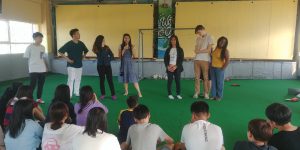
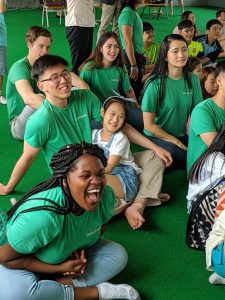
DESK meets the Woorideul students in morning assembly.

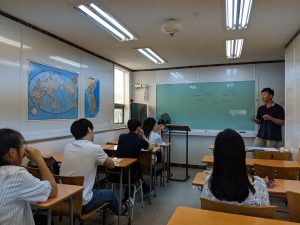
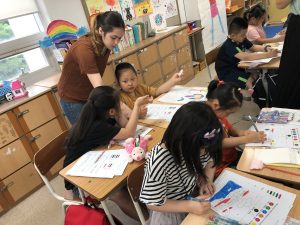
One of the DESK teachers, Thomas, teaches one of his classes.

First Week at Woorideul

After saying goodbye to the elementary students at Jiguchon last week, we said hello to our new students at Woorideul.  Woorideul is a school for students of North Korean background.  That is, they are either refugees from North Korea or are a child of a North Korean parent.  The latter was the case for most of the students I interacted with.   They were children of one North Korean and one Chinese parent.  For most, Chinese was their primary language and they had spent several years living in usually North East China.  Woorideul aims to help its students adjust to South Korean life and ultimately send them to college or help them find a decent job.  The students at Woorideul vary in age from late teens to early thirties.  Most of the Duke Engagers were accustomed to referring to our Jiguchon students as kids but now many of us had students in the class that were older than us!  Furthermore, some of the student were parents themselves!  The parents were hoping to get a better education and then a good job so they could take care of their children who were often times still in China.
When I got a sense of the purpose of the school and the students who attended I was initially apprehensive of teaching English there.  Sure getting to know people who actually escaped North Korea and maybe even helping them sounds great.  However, what good would teaching them English do?  Some of the students are not even too familiar with Korean yet so of course they should learn Korean first.  As for the others, when would they ever use English in their daily lives and how does learning English help assimilate to South Korea?  While I’m sure my fellow Duke Engagers and I have all reached our own conclusions to these questions, I feel very fortunate to have found the teaching I’ve done this first week to be meaningful.
All the Duke Engagers were assigned individually to different classes.  I was assigned the most advanced class which consisted of only two students.  These students were advanced enough that they had the large goal of attending a Korean University.  If they able to gain admittance, there are many opportunities for valuable scholarships for students of their background.  The admission exam tests science, Korean history and writing, mathematics, sociology, and English.  My two students had already finished their preparation for most subjects but weren’t yet ready for the English portion.  They planned on taking the test in November.  Therefore, if I were able to increase their English level at all in the two weeks that I spend with them I’d be making a difference!  Furthermore, my students were eager to learn and willing to put effort in.  The combination of great students and then finding out that the information I was teaching them valuable made my experience feel very fulfilling.  Thus I really enjoyed me first week at Woorideul and I feel very grateful to spend even a very limited amount of time there.

Goodbye, 지구촌!

Last Day with Jiguchon Elementary

By far, Friday has been the most emotional day of our trip. It was our last day at Jiguchon Elementary – time to say goodbye to all the friends we had made over the past four weeks. To celebrate the hard work we had all put in these past four weeks, there was a closing ceremony hosted by Peter and Sophia, with Thomas and Martha singing, our DukeEngage team dancing, and more (very talented performers, if I do say so myself). We watched videos: from cha cha sliding to hearing about the students’ favorite moments during class. We also took many pictures. And as a final testament of the bond we had created with our kids, many tears were shed.

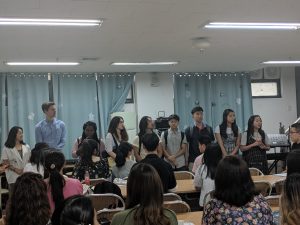
Teachers and Students at Closing Ceremony

I hope that our short time at Jiguchon will be impactful for them just as it has been for us. The third grade teacher said that the children keep talking about the DukeEngage teachers for a long time, and are always looking forward to the summer when the next group comes.

Being a teacher involves a lot of pressure, but the feeling of accomplishment and satisfaction when teaching is unparalleled. I feel grateful for the bright smiles and the unconditional positive energy these children showed up to school with every day. We all look up to how well these children are doing at school, despite the difficult circumstances they are facing back at home. The kids have managed to build friendships, look out for each other, participate in extracurricular activities, listen to their teachers. They are capable of much more.

This must have been one of the most heartwarming experiences in my life. I think we can all agree that our time at Jiguchon will become a highlight of our lives. I am looking forward to sharing my stories with friends and family back at home and school.

Learning Colors (Second Grade)

Second Grade Teachers and Students on the Last Day of School

Talking to Middle School about our Hometowns

On Tuesday after lunch, we had a conversation with the Middle School teacher about her aspirations for the students, and ways in which we could connect with them. The students’ reserved personalities, together with the language barrier and perhaps a lack of trust, make it really hard for them to talk to us and engage in the class. 

How could we get our students to be more interested and open to discussion? This week, Martin and I focused on a more personal topic: ‘hometowns’ (“Where is your hometown? What do you miss the most? What do you like better here?”)

What did the students know about us? Almost nothing. We thought that some more input from our part would encourage the students to share their own ideas.After talking to Pungwei about my school life in Argentina, he responded to me by sharing his own story about how he attended a public middle school for days and had to quit because he could not “fit” into the system. Our experiences at school can serve as inspiration to these students, and despite the obvious differences, there are always things we can all relate to.


Leandro


Goodbye, Jiguchon

Just two hours ago, our time at Jiguchon came to an end. We said our final goodbyes to the teachers and students, walking through each classroom one last time. Gave a few last minute hugs, walked down the stairs, and then closed the door to the school that for the past month that we called our school and home.

But I get ahead of myself. So much happened in the past two weeks that it would be a shame to only focus on the goodbyes of today.

Let’s start with week 3: 예비반

The multicultural class was a handful. It was helpful to have all eight of us in the same classroom because we got to have two teachers per table group of 3-4, so we had a lot of interaction with the individual kids. But at the same time, it was a pretty big challenge still. Unlike the other classes, where everyone speaks primarily Korean, the multicultural class’s Korean and English levels fluctuated drastically. Some kids (like Eunice), were really good at English, while others could barely understand anything we said. Almost all of the kids spoke Chinese, which was a relief (at least for me), since I could finally understand what most of the kids were saying. But at the same time, there were also kids who couldn’t speak Korean or Chinese. Manse only spoke Mongolian, and Forjune had better English than most, but was fluent in Thai. Crossing those two language barriers were a struggle, but everyone tried their best to use Google Translate to talk to them and make sure that they understood the instructions.


In many ways, the multicultural classroom reminded me of teaching the middle schoolers. We did our best to teach in a mix of English, Chinese, and Korean. But even so, Lisa and Hanly (the two oldest girls who had good Chinese and good Korean) would translate to the other younger kids instructions, or helping out the other kids when they didn’t understand. Even though the kids were a mix of ages and grades, it was incredibly heartwarming to see how much they cared about each other and wanted each other to do well. Yes, they made fun of each other. Yes, during some of the games they would be upset when their classmates messed up for their team (and of course, we talked to them about being more supportive). But at the end of the day, when I think back to the multicultural class, what I remember most is how close they all were. Despite language and age differences, they were friends. Hanly would hug Kitty (the youngest and smallest girl in our class) like she was her older sister. When Mijoo was crying over losing a game for her team, Cassie went up to draw together with her at the blackboard until she felt better.

Really, the kids had so much love.

In some ways, I felt more connected to the multicultural class. Maybe it’s because I could actually speak to more of them in a language I was more comfortable with, I don’t know. But the kids became so attached. Even after we left the multicultural class to teach the next grades, Mijoo and Cassie and Kitty would come without fail to visit us in the 2nd grade classroom. They’d pull me over to try to eat lunch with them, and cutely pout and whine if I sat anywhere else.

But what amazed me most about the multicultural class was how hopeful they were. Even though they were working on learning both Korean and English, they were still willing to learn. They still gave their all to us in the one week that we got to teach them. And I’m so thankful for that.

Two kids really stood out to me that I wanted to call attention to in this posting: Eunice and Forjune. Both of them are probably only 12 years old. But when we asked them what they wanted to do in the future, Eunice said that she wants to be a businesswoman and Forjune said that she wants to be a teacher in Thailand. Hearing that, I really was so amazed. Most of the other kids at Jiguchon have no clue what they want to be in the future. Even the middle schoolers, when I ask them what they want to do in the future, they have no clue. I really think that it’s a beautiful thing that Eunice wants to be a businesswoman and Forjune wants to be a teacher. I truly believe in them and their abilities, and I hope that they can achieve their dreams. We made sure to tell them that we thought they could do it. They shook their heads and laughed, but I hope they know that the eight of us will be cheering them on, no matter where we are.


Week 4: 2nd grade

I think we all expected 1st and 2nd grade to be the easiest to manage. At least I did. For some reason, I assumed that as we moved down to teach the younger grades, they would just become better-behaved. But of course, 2nd grade was probably the hardest grade we taught so far.

The classroom dynamic was probably the most difficult part, particularly with the girls. Though they were all only nine years old, they formed cliques. It was pretty rough. Two of the girls would exclude the other girls that they didn’t like. We tried our best to stop it, but it was hard when they wouldn’t want to hold hands with some of the other girls, or refuse to play with them. Even though we would explain to them how important it was to include everyone, they didn’t seem to understand.

The varying levels was also pretty hard. Seiya barely understood any English (or Korean I think? She had trouble understanding directions). The three boys (James, Hansel, and Peter) all had pretty good English. Or at the very least, they learned fairly quickly compared to the rest of the class. Whenever we played games, we had to split them up so that the teams would be more even. We ended up splitting up the class sometimes to teach vocabulary, which helped a lot. Before, the three boys would just shout out the answer and the rest of the class would just repeat what they said without actually learning. So splitting up helped a lot.

The second graders definitely learned the slowest out of all of the classes that we taught though. They picked up vocabulary slower, and remembered things a lot less. In the one week that we taught them, I don’t know how much they learned or how much they retained. I think we were able to reinforce a lot of the alphabet and introductions (I think all of the kids can now successfully say “My name is ____,” “I am nine years old” and things like that). But I wish that we could have more time with this class since they learned so much slower.

But despite all of the challenges, I feel like I got close to some of the 2nd graders. They were definitely the wildest and goofiest class, and I found the three boys were easiest to get close to. They liked to play games with me (a lot of them ending with me losing and getting flicked on the forehead as a result).

I’ll miss them.


Middle School

Every week, middle school gets better. Out of all of the kids in the school, I feel the most connected to the students in middle school, at least the ones that I work directly with. The classroom dynamics in the middle school continue to amaze me. I can’t even begin to convey how supportive they are of each other. Pavel (the Russian speaker) still struggles with Korean, yet the kids still try their best to support him and translate what they can. When Yahan doesn’t understand what Nikki or I am saying in English, Jongsu and Jooeun jump in and try to translate to Chinese or Korean. Even though they kind of ruin our intention to challenge his listening abilities, I still think it’s so sweet that they try their best to help him.

Aside from that, we tried something new this week. After talking to the middle school teacher, she wanted us to just talk to the kids about our experiences and our lives to try to inspire them. So we broke up into groups of the kids that we had connected the best with. I had Nayoung (the girl who wants to be a translator in the future), Boram (one of the girls that I teach for English), and Yeoeun (another girl that I help teach English to when I teach the English elective class). I opened the class time to just questions that they had. Boram had so many. She asked about almost everything, ranging from colleges in America to everyday American teenage life. I tried to answer her questions as best as I could. I asked them about their dreams and whether they wanted to go to college. They all said yes, though one of them said that they didn’t think that they could. I tried not to prod about why, because she didn’t want to talk about it. But thinking about that makes me really sad. I hope that they all have the opportunity to go to college if they can. Their teacher said that these students have some sort of a special tract that makes it slightly easier for them to get into college, so I hope that she can go if she wants to.

The girls also opened up to me about their stories. They talked to me about how they had all ended up from China to Korea, and how hard it was for them to adjust. Some of them traveled by train for days, following their parents. I was touched that they trusted me enough to tell me their stories. Each of these students have so much going on in their lives, and so much baggage that they’re carrying. I don’t know what I can do in the position I am in to help them in their situations. But at the very least, I’m glad that I had the chance to listen.


Goodbye, Jiguchon

Though we still have to come back to teach middle school for two more weeks, today marked the end of our time at Jiguchon with the elementary schoolers. We had the final closing ceremony today. Thomas rapped “See You Again” with our 5th grade Martha. Nikki, Erin, and I danced with some of the girls from all of the grades to “Everyday” that we practiced during many classroom breaks throughout our time here. And then all of us danced to something that Shey, Erin, and Nikki choreographed. The kids seemed to love it. And then we gave our closing remarks. Standing in front of all of the kids, I had so much to say. I wanted to tell them how thankful I was to all of them for our time here, how grateful I was for all of the love that they showed us, and how much happiness they had brought into our lives. I wanted to tell them that I was so proud of them, and that I knew that they could go great places. But, in the end, all I could choke out without crying was a few short sentences.

After that, the kids came up to take pictures with us and say their goodbyes. To say the least, it was an emotional time. The kids came up and started giving us hugs while crying. Seeing them cry, most of us just started breaking down crying with them. My 5th graders (Annie, Sophia, and Martha) sat on the ground crying. The girls in the multicultural class (Cassie, Kitty, Mijoo) swarmed me in a mob of tears and hugs. Miyeon sat on Thomas’s lap and sobbed. Nancy came up to me and said that she would miss me. I cried really hard. It’s hard to describe the emotions that were running through all of our heads at the time. All of the gratefulness, all of the happiness, all of the bittersweet feelings.

Finally, I just wanted to close off this post and my time at Jiguchon with a message to the kids who have made this experience for me.


To the kids at Jiguchon:

First of all, thank you. Thank you for allowing me to be your teacher during these four weeks. Thank you for giving me your time, and your attention, and your 100%. Thank you for all of the smiles, for all of the laughter, for all of the amazing memories that I’ll carry with me for the rest of my life. But most importantly, thank you for all of the love that you all showed me. You all were truly the best part of my day. In all of the stress and struggles that are going on in my life, thank you for showing me your love. As silly as this sounds, seeing all of you reminded me that there is good in the world. You showed me that even in the struggles that you all face in your daily lives, that you’re all able to still find happiness in the simplest of things. More than anything I gave you all, you all inspired me. To become a better teacher. To find different ways to communicate. To approach the world with the same optimism, happiness, and love that you all do.

Now for each of my classes.

To my 5th graders, thank you for welcoming me into this school with open arms. It was incredibly terrifying to suddenly become a teacher, on top of not being able to speak Korean. Thank you for all of your patience despite all of the mistakes that I made. Particularly to Annie, thank you for making me feel welcome in your class. Thank you for waving me over to sit with you all during lunch on the first day when I had no idea where to go, and for bringing me over to learn how to dance “Everyday” with you all.

To my 4th graders, thank you for all of the energy. You all tired us out so much, but it meant so much that you all directed that passion into the classroom activities that we did. Even during break times, you all would drag me and Nikki to start dancing with you all. And in the end, we were able to join you all to dance “Everyday” for the closing ceremony. To Nancy, thank you for including us in this and making sure that we learned the dance. I could see how much effort that you put into leading the kids to learning the dance, and I appreciated all of the time that you put in to creating this special opportunity for us.

To the 3rd graders who I never got to teach, thank you for letting me into your class. I would come into your classroom during break times to just breathe and rest from all of the energy that was happening in the 4th grade class. Eventually, you let me into your classroom and played with me too. Particularly to Miyeon, thank you for being like a little baby sister to us. To Mandy, though I always complained, I loved it when you dragged me everywhere to play the plane game with you. Though my arms would fall off as I carried you around and spun you everywhere, it made me happy to make you laugh and scream.

To the multicultural class, thank you for all of the love. For all of the love that you showed each other, and all of the love that you showed the eight of us. Though my Chinese wasn’t the best and I had to rely on Google translate sometimes, you all still were so patient with me, and so open. During breaks, you all would come up to me and grab onto my arms and whine to me about this or that. To Mijoo, thank you for the drawing you painted for me. I’ll treasure it forever. I hope that you will continue to keep smiling and drawing even when things get hard for you. To Forjune and Eunice, you two have great futures ahead of you as teachers and businesswomen. I truly believe in you.

To the 2nd graders, thank you for being a great class to end with. Though the material was a little challenging for you all, thank you for trying your best. For the last forty minutes, you all mobbed us with tickles and yells to take pictures. I wish that we could spend more time with you all since our time was cut short by the assembly, but I know that the teachers of Jiguchon will continue to make you all into great students.

And most importantly, to all of the teachers of Jiguchon. Thank you for letting us meet your students for a week, and for letting us teach your class. Thank you for all of the help that you gave us. But most of all, thank you for all of the time that you gave and continue to give to all of these kids. Every day, we saw how much these kids love and respect you all. Thank you for being our role models and theirs.

Jiguchon, I’ll miss you. Thank you for all of the love.

Until next time,

Emily
The Birds View

In the blink of an eye, it is already week four- our last week at Jiguchon International school. 

First grade, first grade, ohhh first grade. This week I taught first grade with Daniel and Erin. We walked into the classroom, greeted the homeroom teacher, and were greeted with the curious eyes, runny noses, nose picking fingers, and warm smiles of Jun-ee, Ji-hong, Uk-hweon, Kiki, Hyeon-seo, TaHa, and Ji-Ho. In return we each greeted and introduced ourselves in Korean and English. And then the ball was rolling- mostly with us running after it.  

On our first day together, our kids kept us on our toes with their endless energy, their short attention spans, and their tendency to touch us after rubbing or picking their noses (shoutout to Uk-hweon and Jun-ee) in each activity- from learning the alphabet, counting numbers one through ten, etc. At the end of the day, after hearing the bell that signals lunch time, the three of us looked at each other, with our drained faces thinking the same thing: rough. 

At that moment, we couldn’t understand why Ji-ho who is so smart constantly resisted our instructions, why Jun-ee constantly rubbed his wet hands on us or tried to hug us when we let our guard down while playing Simon Says, or why Hyeon-so spoke with sadness when we were talking about our families during break time. 

But as the week progressed and our time together shortened, we slowly began to understand the whys behind the whats as our homeroom teacher gave us background information on our kids. While one of our kids was seven years old, mentally he was five years old, which explained his baby-like behavior. One of our kids comes from a rather broken, mixed family- her father lives in a South Asian country while she lives with her two older sisters and her single mother who struggles to make ends meet. Another one of our kids, feels alienated from his classmates which makes him resist our instructions. All of these behaviors and circumstances felt oddly familiar to me, my own life and experiences- it made my heart race and I began to see Jiguchon and the kids I have taught from the birds view. 

As I reflect, the majority of my kids have at least one non-Korean parent. Majority of them are from low socio-economic households. Majority of them rarely see both of their parents on a regular basis. And, majority of them rewear the clothes that they wear on Monday, again on Tuesday. Jiguchon as a school does not have a surplus of funds or teachers. But, all of my students are smart, adventurous, beautiful, loved and valued by their homeroom teachers and our Duke Engage team.

And to our kids like Hyeon-seo, Yeong-eun “Chris,” Forjune, Eunice, CIA, Calvin:  

More than your capability to learn English quickly, your ability to come to school and cooperate with the craziness of our lesson plans despite familial and financial circumstances resonates with us. You all have heart. More than me teaching you all English, you guys have taught me so much about myself and the world we live in. More than being an integral part of our summers, you guys have become an unerasable part of our lives. Despite the differences- linguistically or phenotypically- whatever forces you into silence, drawing, writing etc, I want you to know that we see you and we hear your tears, laughter, and overall awesomeness. You guys are some of the best cha cha sliders I have ever met. And I am so grateful that I experienced you all.

Remember these two things:

1)It is okay to be different. 2) Life is going to test you, never fold. Stay 10 toes down. It’s not on you, it’s in you. And what’s in you, no one can take away.

Now for the last time lets “cha cha real smooth, turn it out,” and hug each other tight. 

지구촌학교에게 감사합니다!

Sawadikap, hello

To say the least, South Korea so far has been a rollercoaster -from the unwanted touches my braids feel, to the sea of eyes attracted to the skin I’m in, dietary restrictions and more- yes, rollercoaster, indeed. But atlas, a new day- a week- has come.

While walking to school, I turn up the volume of my headphones as the words of my favorite rapper, Tupac Shakur, boom into my ear: “You might be deep in this game, but you got the rules missing…”

It is week three at Jiguchon International School and we’re all excited for our new students. This week, we would be working with the non- fluent Korean speaking class- what exactly that entailed, I had no idea, but with two weeks in (kinda deep in this game of teaching), becoming more comfortable speaking Korean and a detailed lesson plan for that day, I thought I was set- that we were set.

After introducing ourselves in our respective languages, class began. I gravitated towards a table with two kids- Forjune and Eunice. Forjune and Eunice smiled warmly at me and greeted me again in Korean and I was so happy- “yes, they don’t look Korean (like me) but they speak the language (also like me). We can communicate.” My conversation with Eunice- while short, her English was amazing. But, within minutes of having a basic conversation with Jun- as we both are the two darkest in the class, asking where her parents are from- it became clear that she didn’t know a lot of Korean. “She doesn’t know much Korean, okay. She doesn’t speak Chinese, okay. She doesn’t know much English, okay. She speaks Thai, okay that’s cool. Wait, I don’t speak Thai. How do I communicate with her?” These thoughts later translated in my head- how do I communicate with my kids who do not know Korean or English?

These thoughts circled in my head throughout my first day interacting with her and teaching the class as a whole.

After struggling to effectively communicate all my questions and thoughts to her, it was finally break time. I noticed that Jun and Eunice kept quiet and stayed to themselves. While Jae-won and Joshua chased each other, Lisa played piano, Cassie and Hanly played Cat’s Cradle there sat Jun with her head down, a wave of calamity in the backdrop of the classroom chaos, reading a Thai book and Eunice observing the classroom.

Maybe they’re shy or maybe they feel uncomfortable not being able to confide in a friend in Thai/ Tagalog like how the Chinese speaking students can confide and laugh with each other. Either way I wanted to talk to them. Using Korean, I asked Jun how to say hello in Thai. Then her face lit up and for the next 5ish minutes she became the teacher and I the student. Sawadikap, hello: we sat side by side, laughing, and me repeating Sawadikap, then teacher, mom, and dad in Thai.

After that, I began drawing on a paper and they would look at my art and I,  sharing giggles and smiles. Then they started drawing, looking at each other’s drawings, enjoying each other’s company- a conversation without verbal language. Eventually, I had to whip out Google Translate but I enjoyed learning from Forjune and watching them interact.

Later that week, when breaking into small groups, we learned about their dreams. Eunice wants to become a businesswoman and wants to work very hard in school. Forjune wants to become a translator-from Thai to Korean to English and all the possible combinations there are.  

And that more than teaching them English for one week resonates with me.  The temporary goal, the task at hand is to teach them English, but as a team we want to teach and encourage them to use their other skills- to sing, to draw, to find joy in the company of their peers etc and foster the mentality of “yes I can.” And there doesn’t have to be a language for that. What we live and endure, what forces us into silence or writing, what we hold only as elusive memory sometimes is only a frustration of seeing others- their differences- physical, linguistic etc and feeling as if they don’t see us.

Language is not the only form of communication even though we tend to engage with one another in a manner that suggests it is the absolute way to communicate. Teaching has taught us to  keep ten toes down. Because regardless of how many weeks we have been at Jiguchon, we don’t know the rules to teaching- at least not all of them. As a team, we hope that if our kids can’t find comfort in seeing the diversity (ethnically and linguistically) of their teachers, we hope that they at least find comfort in enjoying each other’s company- whatever that may entail: growth matters most.

Just as we’re beginning to get the hang of this- just a tiny bit-  our last week at this school rolls in. Week four will be bittersweet for sure.


Heading into our third week at Jiguchon, our group should have been imbued with a long-awaited sense of relief and belonging. Instead, we were the most anxious we had been the entire trip. Although we had finally settled into a groove after teaching for two weeks, the daunting prospect of teaching recently immigrated students weighed heavily on our minds.

Ethically, we had to grapple with our role in the school. It was obvious to us that these children’s main focus should be learning Korean. What then was the point of us teaching them English? We feared that we would just burden them with unnecessary knowledge or distract them from their present schooling. Yet, over the course of the week, our concerns were abated as the children responded extremely well to the materials and games we provided.

Logistically, I was also scared that my inability to speak Korean or Chinese, the two dominant languages of the school, would be exacerbated. The multicultural class presented the unique challenge of being relatively new to the country, whereas the other classes were able to speak Korean. This was just one less avenue for our group to communicate with the kids and I could not rely on others to translate for me. This week has by far been my most creative in terms of physical movements, Google Translate, and random Sino/Korean terms I have picked up in the past few weeks.

I was able to connect with the kids with my very limited Chinese and a common goal of learning Korean. As they learned English terms, we really stressed the repetition of their Korean equivalent, killing two birds in one stone by reinforcing their Korean recollection as well as teaching English. This was easily accomplished when I found out the mainly Chinese speakers had been given Korean flashcards to help them learn occupations. We quickly adapted our occupation study set to match theirs and this really helped the kids work on their Korean as well as their English. This forced repetition also made it easier for me to learn Korean as well. It was important that I stressed to the children that I was also learning at every moment. Our relationship evolved from teacher and student to peers striving towards the same goals. Being on equal footing really motivated both myself and the children.

For the past two weeks, I had been able to bond with the children through energy and comedy, whether it be by playing with my hair, burneying through the cha cha slide, or introducing thumb wars to a very enthusiastic demographic (I carry hand sanitizer at all times now). Although it is deeply fulfilling to bring a smile onto the faces of all the children, I felt like I could not connect personally with the children as my classmates who shared common languages with them. Yet now that I was able to work with kids that were not only extremely proficient in English but also extremely motivated and engaged. Our small class already had dreams of becoming translators (Gordon and Forjune), doctors (Hanly), and even MD/MBAs (looking at my girl Eunice).

Another thing that worked extremely well was splitting into smaller groups based on proficiency. The English disparity was extremely obvious from the beginning as younger students like Ki Hyung and Mi Ju did not even know the alphabet while Eunice and Gordon were able to form complex sentences and carry conversations. Our advanced class was filled with the best English speakers in the school and they stumped me at every game I threw at them, from word scrambles, crosswords, and even Hangman.

Middle school

Although we only had two days with the middle schoolers as usual, it was quite an eventful week. We had to make the difficult decision of allowing our most proficient student, Yo un, graduate as Thomas noticed that she was comprehending and responding well in his optional English block. Although Yo Un was extremely important for motivating the others in our class as well as translating tough phrases into Chinese for the non-Korean speakers, her growth was undeniable and her “graduation” was bittersweet.

As for the curriculum, Leandro and I have taken to polling the students about their favorite movies and songs in order to hold their attention. This has worked extremely well in that regard; however it is difficult to account for the unpredictability of their requests. Explaining love and longing to middle schoolers have led to our best and funniest conversations yet.

Our last week at Jiguchon will be very bittersweet but I cannot wait for the end of the year celebration.

Lisa braiding my hair during one of our breaks

End of a successful week! (Kim Mi Ju is sad to see us go though)

Celebrating Huong’s Birthday and Learning about everyone else’s!

Taught the middle schoolers how to tie a tie in English!

Do you speak Korean? Go fish.

Some reflections from the first two weeks:

In many ways, my time in Korea so far has challenged me. Going into this summer, I was really excited to teach English to the kids at Jiguchon. I imagined the kids learning new vocab, having fun during our classes, and chatting with them during lunchtime. Yet, the first few days were incredibly frustrating. Because I’m not fluent in Korean, when Erin or Thomas would explain things to the kids in Korean, I felt like I had nothing I could add. During lunch, when Annie and Martha (two of our cutest 5th graders) and the other girls in our class would talk to each other in Korean, I felt unable to join their conversation. When I tried to talk to Nancy (one of our lovely 4th graders) in English and ask her what she was doing over the weekend, she just looked at me with a blank stare and a confused face. I felt isolated and useless, and worse of all, I felt like I had failed as their teacher.

But as time has passed, I’ve slowly began to realize that maybe these frustrations are what are allowing me to think about the kids and what some of them may be going through. Particularly in the middle school, there are so many kids who speak only Chinese. Their Korean isn’t advanced enough to understand what their homeroom teacher says when she gives instructions, and as a result, the kids who can speak both Chinese and Korean translate for them. The teacher says something, and there’s almost a ripple effect of whispers as the students translate to their Chinese friends what she’s saying. Seeing this during the first few days of middle school has really made me start to think about these kids beyond their education. How do these particular kids feel not being able to speak Korean? Not just restricted to during school, but in their day to day life. In some ways, feeling so isolated and confused all of the time helped me understand the kids.  I know that for me, it’s been really hard to not be able to talk to people or understand people. This influx of feelings from these past few days really makes me wonder whether these kids who can only speak Chinese or Vietnamese or Russian feel the same frustration and isolation that I sometimes felt. And while I will only have to get through the next few months in a country where I don’t speak the language, some of these kids will live here the rest of their lives. Thinking about this has made me realize that this Duke Engage trip is more than just teaching English. It’s also about helping the kids adjust socially, and helping them feel more comfortable in the classroom. Talking to the homeroom teacher, we realized that that was exactly what she wanted us to do. Rather than focusing on teaching the middle schoolers English, she expressed the hope that we would be able to connect with the kids and act as role models. She wants us to inspire them and nurture their hopes and dreams.

With all of that background info, here’s how week three went.

In terms of elementary school, the classroom dynamic was so much different. Last week, I taught 5th grade with Thomas and Shey. 5th grade was a small class—the kids were energetic, but not too rowdy. This week, I taught 4th grade with Erin, Martin, Daniel, and Nikki, and it was a lot (to say the least). It was only eleven kids, but I felt like their energy bounced off each other and amplified when they were all together. They always want to play games, and they’re so competitive. We used that to our advantage though. The kids pick up vocab really fast, so we played lots of games like Pictionary and bingo and charades. I think one challenge has been the fact that the kids are at such different levels. They’re all in the same grade, but some kids have trouble reading, while other kids like Wendy and Calvin seem to already know what we’re teaching. Seeing how different their English (and Korean) abilities were really made me wish that there were some better way that we could cater to their individual needs. Each kid really learns in such a unique way that it’s hard to find activities that engage all of them. The boys (like Hanshin and Junhyun) only really love playing games. Otherwise, they’re not really interested in other things (like drawing, or writing). The girls (like Wendy and Lili) have the patience to do more challenging activities like one of the writing games that Daniel came up with. It really made me wish that there were more classrooms, or some other way to split up the class more effectively. What we ended up having to do was split up into small groups to do activities so that there were more one-on-one teacher and student interactions. It worked out fine, but sometimes I wish that there was more that we could do somehow.

In terms of the middle school, it’s been a little better. Nikki and I (being the only two Chinese speakers in the group) have been teaching all of the kids who only speak Chinese. Last week was pretty rough. The kids weren’t really interested in what we were teaching (or learning English), and it’s been hard to get them excited. We didn’t really know what their homeroom teacher wanted us to do either, so that was a big problem. But after talking to her and hearing what she had said, we’ve tried to adapt our curriculum to try to connect with the kids. Particularly with the class that Nikki and I teach, it’s been difficult. The homeroom teacher herself told us that the hardest children to work with were the ones who spoke almost no Korean and no English. Because they don’t really understand what the teacher is saying most of the time, I think she feels like they’ve gotten used to not participating in class since they can’t understand. Hearing this, it became Nikki’s and my goal to simply get the kids to participate. I started teaching and speaking to the kids in Chinese so that they would feel more comfortable. Slowly, I think it’s worked. Yahan and Boram definitely seemed more comfortable after they realized that we were explaining things in Chinese. They’ve gradually been participating more in Chinese, and as the days go by, they’ve been using more English. For last week’s class, we taught them how to play Go Fish. It was the first time that I saw them so excited for any of our activities, which made me so happy to see. They got to practice their numbers (Yahan struggled a little, but we wrote the numbers on the board), and they also got to practice their English (it was really funny when Boram asked Jooeun “Do you have a ___?” three different times and he had all of the cards she needed).

In terms of how I’ve been doing this week compared to the beginning, it’s been getting better. Not being able to speak Korean has challenged me to find other ways to communicate with the kids. I’ve been picking up a lot more Korean (I can kind of speak now? Maybe?) and I’ve learned to just gesture and find different ways to explain things. I’ve started to teach lessons (instead of just floating around the room and helping individuals) and it makes me hopeful and excited. Every day gets a little better than the day before. I’m doing my best as their teacher, and that’s all that I can ask for.

It’s definitely a learning process. Not just for them, but also for us.

-Emily

Week 3: Leaving a Positive Footprint

Third grade!

This week, Sheyann, Thomas and I worked with the 3rd grade class, a group of five eleven-year-old kids. Angelina, Jack, Jordan, Mandy and Tony welcomed us with bright smiles, and they seemed as excited to meet us as we were ourselves. On the first day, we introduced ourselves to the kids and vice versa (“What is your name?”). I remember talking with our peers about this — we for sure knew that 3rd grade was bold, but as our time with these five kids continued, we realized how shy they initially were. Since then, they never stopped transmitting positive energy to us, and we tried our best to reciprocate by enthusiastically planning our lessons and having fun with the children.

We noticed that the attention span for some of these kids was perhaps shorter than we had expected. By the end of Monday, which was mostly speaking-based, we realized that the children were struggling to retain the material. We needed to engage the children in different ways too, encouraging reinforcement by switching the focus to reading and writing. For Tuesday, we prepared some worksheets. These were really helpful; they served as a break from the dynamic group activities. We gave the students space to focus on their own worksheets and test themselves. The small nature of the class allowed us to work with them one-on-one, adapting our instruction based on individual needs. On Thursday, we taught “activities” through recitation, dialogue, worksheets and games like charades. The kids were visibly more engaged when a variety of activities were prepared.

By the end of the week, our students were much more comfortable introducing themselves in English. Our goal was to familiarize them with some everyday English vocabulary, too. Most importantly, we developed relationships that will hopefully last long. We hope that our short-lasting presence in their class will give these children something to talk about in the future, that we leave a positive mark on their journey of learning.

Third grade students and teachers on the last day of the week

Middle School!

On Monday and Tuesday, Martin and I worked with a group of six middle schoolers in the afternoon. Due to the varying language backgrounds present within this group, communicating ideas to the students was a challenge. We have noticed that within middle school there are some who refuse to speak up or are simply too shy and their limited language reduces their confidence. As we took the initiative by showing more determination in communicating our ideas, the students themselves were more open to conversation and made an effort to respond. In order to facilitate this, the topic we chose for the first hour on Monday was “movies”. We watched a clip from the animated movie Up, which had no dialogue. The students told us their favorite movies and Martin, who knows a lot about film, introduced some interesting facts about them. For the second hour, we went upstairs and played soccer and dodgeball with a different group of students.

Most of the middle schoolers have been in Korea for a very short time. According to their teacher, many of them are not planning to pursue high school education, and intend to go straight into the workforce instead. While such decisions are to be expected given the situations their families are facing, my understanding is that their teacher’s desire is for us to set an example to the students as peers, by exposing them to our own experiences. Ideally, we would motivate the students to pursue their education further. Since we are working with the middle schoolers in Jiguchon after school, our main goal is not to introduce new material for them to learn and study. Through our small group discussions and activities, we do not only intend to build relationships between teachers and students, but also between the students themselves.

Teachers and middle schoolers singing “Happy Birthday” to 끄엉

By Leandro

« Older posts Newer posts »