안녕하세요 서울!

Author: Nikki Delmolino

I Love You 1400

8 weeks. 


 ~ Out of all of the words the Korean tutor taught me this summer, the one that I’ve never forgotten since I first learned it is “시원섭섭해” (siwonseobseobhae), or having mixed emotions. I guess the English translation would be something similar to bittersweet. As the end of our time in Korea has gotten closer, this is the word that most matches how I feel.~

Written the Sunday before we left Korea.

Now, after returning to the US, all I want to do is go back. Regardless of the stress, near mental breakdowns every late Sunday night as we wrapped up lesson planning, and the unabiding nervousness before I entered the classroom, all I have are good memories. 


In the pre-departure surveys we were given, I vaguely remember typing all my expectations. I expected to grow as a person. Vague, but check. I expected to learn a lot more about teaching. Check-ish: 8 weeks later and I learned how hard it is to teach and why there are actual degrees and licenses required (there’s a lot more to it than just having lesson plans and a load of activities). I don’t remember what else I typed, but I know I personally expected to struggle a lot. But that comes later.


Quick Wrap-Up of the Last Week

Monday and Tuesday were spent in Gwangju, a city in Southwestern Korea best known for its pro-democracy protest in 1980 after a military coup. 

DukeEngagers on one of the peaks of the hill near Unju Temple, a temple famous for its plentiful Buddha statues.

Soswaewon Garden

Taking a short break walking through the stream at Soswaewon

An anecdote from a 5.18 protester

5.18 National Cemetery Entrance

Reading epitaphs on 5.18 protester graves

On Thursday, we had a day trip to Ganghwa-do, an island with countless hilltop temples and a close view of the North Korean border.

Jeondeung Temple

On Friday, Shey, Leandro, and I went on the optional field trip to Seoul National University, where we explored the campus physically and historically and spent an hour walking through the university’s archives. 


Before entering the archives area, our tour guide explained the history of Gyujanggak and led us through important historical texts


Final Thoughts

LANGUAGE USE AND EDUCATION

When asked what my greatest worry for the program was, I replied “Language.” From past experience, I know that it’s entirely possible to form emotional connections without a shared language (games are magical). This summer has only further proved to me that even without being able to understand others verbally, there are hundreds of other ways to enjoy socialization and become more comfortable with people. However, the power of language cannot be overlooked, something that became incredibly apparent as we taught the Jiguchon middle schoolers. 


Although I had more experience with Korean and Chinese than others on the program, I still felt completely overwhelmed at times from not being able to understand, let alone communicate or translate. It felt that every other conversation was cut short by lack of understanding, and I felt like I made communication processes a lot longer sometimes (oh, sorry say that again…. What??? One more time… uhhh Emily/Erin helppp). At one point in the middle of the program, my frustrations reached the point where I didn’t want to open my mouth at all…something I saw reflected in the students. 


I discussed in an earlier blog post of mine that the lack of motivation in our classroom came from a lack of connection and not necessarily a lack of wanting to know. This was something I related to a lot over the course of the trip, and in turn helped me to connect better with my students over our shared struggle with language. Some students were much more open to me after I stumbled through instructions in Korean (an attempt is better than nothing), and Chinese students at Wooridul would instantly light up whenever I tried speaking to them in Chinese. While communicating non-verbally, or even through a shared second language helps create bonds and can allow for general comprehension, speaking in someone’s first language hits their heart.


I think that another great power of this program (besides mixed language background, diverse experiences, native English speakers teaching, etc. the whole shebang) is sheer numbers. We had the unique ability to split ourselves up as we saw fit and had the opportunity to speak with, play with, and simply spend time with individual students and get to know them on a deeper, more personal level. While regular teachers still can form individual connections with students, it’s much harder, and it’s so much more difficult to teach. There are no satellite teachers walking around the classroom to make sure kids pay attention, and if a couple kids finish an assignment too fast, or if others are struggling, there is only one person who can help at a time. As the summer progressed, we all learned the power of this one-on-one interaction, which, I think, is desperately needed in the education system (especially with younger students) as a whole.


IDENTITY

Even though I’ve been to Korea before, I never really comprehended how my appearance factored into people’s expectations of me until this summer. Living in a country with a homogeneous population and being very not Korean-looking really put identity into perspective.


When I came to Korea last year, looking foreign was met only with curiosity and confused conversations with people on public transportation. Since I was in Jeonju at the time — a city with much less of a foreign population, and therefore less standardized English usage, I was required to speak in Korean regardless of my appearance and felt much less outsidery. However, while in Seoul, I sometimes became painfully aware that I was a foreigner. Whether it be someone staring a little too long to be comfortable on the subway, a hurtful comment by a passing stranger, or a cashier who would call a coworker over so they wouldn’t have to speak English to me, I understood that their expectations for me were defined simply by my outward appearance. 


I wouldn’t say this was a problem for me (people were still very kind and helpful, and it was cool seeing people’s reactions whenever I surprised them by speaking in Korean), but it was something I grew to be aware of largely because of our students. Our students, most being ethnically mixed or non-Korean, largely identified as Korean. Regardless of what other languages they spoke, or what their ethnic backgrounds were, they felt like they were the same as any other Korean. But they will probably have to spend their lives constantly trying to convince people and prove that they are Korean. Identity is incredibly malleable and isn’t dictated by any one element of a person, but for these students (and us non-Koreans on the DukeEngage team), everything is assumed by just a look. Their capabilities, experiences, and thoughts are decided for them. 


I talk about these lessons in the context of our students because I feel like I was pushed to experience life more actively for their sakes. Relating to and learning about my students helped me to move past bouts of stress and hopelessness, and their optimism despite all obstacles was so encouraging for me, it’s impossible not to intertwine them with my personal growth on all levels.

THE END

I have so many more things to say — there’s no real way to encapsulate everything I’ve learned from this experience and from the people I’ve met, and I definitely could write a novel (or memoir, or something) — but time to finish.


Thank you to the Kim 선생님s for treating us like your own children. When we were sick, you bought us medicine and Vitamin C pouches, and regularly checked in to make sure we were okay. Every week, you bought us different fruits, snacks, and ice creams for break times and reflection meetings, all from the kindness of your hearts. When I wasn’t getting to eat as much (vegetarians in Korea, wooo!), you took me to restaurants I could eat at and bought me separate meals. Thank you for being concerned for our mental and physical wellbeing and giving us so much advice about teaching every time we hit a metaphorical wall in the classroom.


To the seven friends I spent 24/7 with: I think you all know how much I care for and appreciate you guys (I cried enough, ew). Our last night in Korea, we all sat by the Han River eating our sad bowls of ramen for our final meal and asked each other what word or phrase we would use to best describe the entire trip. While I don’t think we got a serious answer from anyone, all of the responses (“naiseu”, “rheeee”, “don’t smile because it’s over, smile because it happened”), and shared jokes are reminiscent of the hundreds of memories we’ve made together. Each of you have made me laugh (and made my day) a countless number of times, and your advice is A+. You guys have taught me so much about true friendship and trust (and helped me figure myself out a lot too hehe), and I feel like I’m a better person for knowing you all. Thank you. Thank you. Thank you. I will miss our crazy dynamic in Korea, but we’re going to still see each other at Duke (I’ll make sure of it!!!) so until next time. ~


Korea and my DukeEngage team: I love you 1400. **


** to quote one of the best lines from Avengers: End Game, the movie that all of our students loved so much. The line “I love you 3000” references the total number of minutes in the Marvel movies, to symbolize the end of the era. As this is another end, one that matters so much more to me than my childhood movie universe, I thought it was only fitting to end with the approximate number of hours we’ve spent together.

-Nikki

니키 
 

Week 7: The End of an Era

Our seventh week in South Korea was the second week at Wooridul School, a special-purpose academy for North Korean defectors and recent arrivals from countries such as China. Each of us were put in charge of our own classes and our own students. The lesson plans were completely up to individual opinion. 


I can’t speak much of the experiences of the other teachers — I did not teach with any of them, and didn’t have the chance to speak with their students on the level that they did. However, I do know that everyone has felt deeply for the school, staff, and the students we’ve been so lucky to meet and teach. 


I was put in charge of a student named Jae Myeong for the Reading Club period, a Chinese boy who had been in South Korea for the past year but had essentially no English or Korean experience, something I discovered when he stared blankly at me during introductions until I spoke Chinese. The other student that was supposed to join our sessions moved to another class, and I spend an hour every morning guiding him through various alphabet and phonetic-based books. In the span of two weeks, he not only learned the names of the letters, but also can understand the phonetics behind each letter, how to sound out words based on letter combinations, and how to comprehend basic sentences.


Jae Myeong’s motivation and budding confidence in English completely blew my mind. His progress was exponential, and I felt encouraged by the little differences from one day to the next. One day, he couldn’t pronounce the letter r, and the next day he was reading “whisper” out of the book. It was progress unmatched to any student I’ve taught in my life, and I sincerely wish I knew more Chinese to properly convey my wonder to him.


For my normal class, I taught a group of 5 students, aged 17-19, who had arrived from China only a few months prior. In the midst of learning Korean, they were thrown into an English-teaching classroom. Their English proficiencies were relatively similar, but varied enough that one student would finish an assignment in 10 minutes, while the other would need side-by-side explanations. 


They had all studied English in China — one girl, MiHye, had studied for 9 years — but didn’t have a listening or speaking ability on par with their reading ability. I tried to speak in several languages during the class (and sometimes used Papago when I was at a loss for words or couldn’t understand a word in Chinese), and I think this helped my students feel more comfortable around me. I was just as much a struggling student of their native language as they were mine. 


Compared to Jiguchon, I feel like it was harder to form connections with the students at Wooridul, primarily because of the age difference and preferred method of communication. The children at Jiguchon could simply hug us and play games with us, but the students at Wooridul wanted to converse and get to know us. With language barriers, it was definitely more difficult to converse about more complex topics outside of the classroom. 


My biggest regret about teaching at Wooridul is that I wasn’t able to form as deep connections as I wanted. My students wanted to spend each class learning as much English as possible, and I tried to accommodate this by filling each period with countless listening and grammar exercises, intertwined with brief conversations. While I feel like my students definitely got more comfortable with using English, I think I would have rather spent a little more time simply sitting with them and talking about wild topics.


One day, I shifted away from the general English lesson — a listening practice using a scene from the Incredibles — and started a conversation about superpowers and morals as a break. For the remainder of the class, we discussed why we all would want a certain power, the harmful possibilities, and the powers within our reach. For the first time, I saw one of the upper-level English students perk up and discuss his sudden want to be a zombie because “it’s hard for them to die,” and another boy who struggled to stay awake because of his late night working hours lit up to a discussion on time control and his love for the Avengers.


Time control would give them more chances. Time, for these students, is a luxury. They would leave my classes early for their part-time jobs, study at their jobs, and sleep for only three hours a night, just to survive in a country where they lived alone. 


Nikki (me),  Martin, and Thomas teaching a class to the Korean-learning classes.

It was an honor to meet, teach, and get to know the students at Wooridul School, and I wish them all the success in the future. With their drive, they can conquer the world.

____________________________________________________________________________


We said goodbye to the Jiguchon middle schoolers Monday afternoon. We each received a piece of paper with our pictures and a bunch of signatures from our students. Many expressed their regret that they didn’t get to learn from and speak from everyone, but even so they were grateful for each and every one of us. The students formed a circle around us, and we rotated and said goodbye.

Showing my Jiguchon middle school students English movies.

Oh, middle school. Through teaching these students, I think we have all grown so much as people. To feel the experiential weight of our presence on these kids is a feeling incredibly hard to deal with. We will never really know what they have gone through, and we can’t even begin to comprehend the struggles they will encounter for the rest of their lives. But I hope they will have the courage to face whatever life throws at them, and even if their English level is the exact same as before we came, I hope our impact reaches much further. 

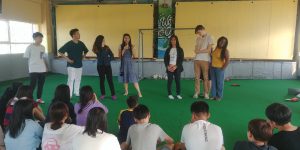
Closing ceremony for Jiguchon middle school

____________________________________________________________________________


Jiguchon and Wooridul students, I will miss you very much. 사랑하고 고맙다.


Nikki

Week 2: The Students Become the Teachers

Week 2

Thomas:

After settling in, we finally began our first week of teaching at Jiguchon International School.  Jiguchon literally means “global village,” and is intended to service children of foreign immigrants. Our day was divided into two parts: in the morning, we would teach elementary school students, and in the afternoon, our time would be spent on tutoring middle schoolers.


On the subway ride to the school, a flurry of thoughts ran through my mind. What if our lesson plan is too boring. What if our curriculum is too hard? Too easy? What if the kids hate us? But among all those thoughts the most prevalent was certainly, What if I can’t communicate with these kids? Among the three teachers that were assigned to teach the 5th grade class, I was deemed the most fluent in Korean and in charge of leading the class. Growing up, I had little need to learn Korean as both my parents spoke English, and as a result my Korean was, to say the least, very sloppy.


As one of our activities I had to tell the kids to pass around the ball. Everytime I said the Korean word for “ball” the kids would laugh and repeat what I said, “kong.” It took me a while to realize what was so funny about what I was saying, until one of the kids, Chris, tapped me on my shoulder and told me that the word for ball was “gong,” not “kong,” which I later learned meant “bean.” My face turned bright red as I realized my mistake, and I was overwhelmed with embarrassment. The kids, on the other hand, seemed delighted to know that their teacher was also learning with them.


From there our time with the 5th graders flew by. They seemed to respond well to all our games, our lessons, the vocabulary we decided to teach, everything. Regardless of our Korean speaking ability, the teachers in our class felt that they had an opportunity to lead the class, and it seemed that all of us were able to win the affection of our students. It was a perfect first impression of the school. I was ecstatic, thinking that I could expect this kind of behavior for the rest of the day.


Boy, was I wrong.


As I entered the middle school homeroom, the first thing I saw was papers fly across the room. After introducing ourselves in Korean and still seeing confused faces, we realized that a large majority of the class was not only unable to speak English but Korean as well. The first day with the middle school was our worst by far. No one felt that they learned anything, everyone seemed bored, and only half the class understood what was going on at any given time. It didn’t take long to figure out that there needed to be a separate class for students who only spoke Chinese. Even after we split up the kids by English level, the struggle continued. The best English students blew by two hours worth of planned activities in minutes, and the Chinese speaking students seemed completely uninterested in everything.


The next two days with the 5th graders went smoothly as expected. A cycle of learning, engaging in fun activities, and playing with the elementary schoolers made the morning fly by. With the middle schoolers, we were locked in a cycle of trial-and-error of figuring out how to teach them in an effective way. This will be our greatest challenge that we’ll be dealing with in the days to come.


Nikki:

The 6th Grade Experience

We fully expected things to be smooth sailing.


The first period passed too quickly, filled with teacher and student introductions. The kids had chosen new names for the week, most different from their Korean names (a little bit of a problem later on when they wouldn’t respond when we called on them), such as Watermelon, K, and Moana. Equipped with several dialogues and teaching only two of them, we decided we needed to be more efficient with time if we were to teach all of the material we had planned and still maintain the kids’ attention and interest.


For the rest of the day, we struggled to make vocab and dialogue lessons last longer than fifteen minutes, and most of the games we set for the third period, objectively, did not work for this class. While most didn’t know the body parts in English, they already knew the song Head, Shoulders, Knees, and Toes, so we sang through it twice and couldn’t force attention after. However, the lack of base knowledge translated into a shaky session of Hokey Pokey — with the kids essentially mirroring our exact moves without learning the body parts or directions — and Simon Says, with the same thing occurring.


Faced with a variety in English comprehension, motivation levels, and interest in our chosen activities, it was difficult to demand attention for long periods of time and the variance in our own Korean language abilities made it so only one person could teach at a time, leading to a confusing role division.


With team moral steadily decreasing, we instead focused our attention more on trying to understand the kids during breaks and figure out their hobbies and friend dynamics. Some of the girls were really into the Kpop groups BTS and EXO, some boys really into CS Go and League of Legends, and other students were visibly tied to their comic books, which they found difficult to put down during class time. Baba spent his time energetically wrestling classmates (and Martin) on the floor, while G couldn’t stop adding fractional expressions (for fun!) and Rafael devoted himself to a chemistry book.


As the week progressed and we got to know the kids on a deeper, more personal level, it became easier to gauge how they would respond to activities and how to deal with stragglers. We adjusted our curriculum to accommodate the new classroom dynamic, planning a music class and math class, and although there were still bumps along the way, we improved significantly in understanding the kids we were given to teach and how to connect with them.


From just this week I think I’ve understood a vital aspect of teaching — meeting kids where they’re at. Whether its using more words and games students are familiar with to boost their confidence, or catering a specific phrase learned to accommodate personal interest to increase applicability to oneself, I think it’s important to teach less from a teacher perspective and more from the student’s. Our mission is not only to teach English; it’s also to interact with and develop relationships with our students.


Once we took ourselves off of the teaching pedestal by either separating into small groups in class to be less lecture-based, or becoming the students ourselves (asking students to teach us about their interests, languages, or cultures), each period became much more enjoyable.


This week was short for elementary school teaching (only 3 days of teaching compared to the 5 day weeks we’ll have in the future) and definitely exhausting, but it was 100% rewarding. The kids’ English skills may not have improved significantly, but they bonded with us and felt comfortable enough with the learning environment we provided them with that they gave us thank you cards, asked for our social media information, and invited us to sit with them during lunch.

The Middle School Experience

Our time with the middle schoolers has been a continuous state of trial-and-error. This stems entirely from the fact that this is the first year that Duke Engage South Korea participants are teaching middle school. Instead of a full week and four class periods dedicated solely to teaching English by grade, we have two periods in the afternoon, two days a week, and a mixed grade class for the entirety of the program. The only information provided beforehand was a piece of paper detailing student names, country of origin, level of Korean and English proficiency, and level of motivation in class (simply denoted as 상, 중, 하; high, middle, low).


The first day, our goal was simply to know more about the students. We had them draw a picture of themselves and add a little information: name, age, and hobbies. Erin and Emily took the lead during the first class, since Erin is the most fluent at Korean, and Emily the only full Chinese speaker. The rest of us walked around the class, trying to make ourselves useful. Martin went straight to the Vietnamese students, Korean speakers worked with those who could speak Korean, and I stayed near the back, traveling between six Chinese speakers who were utterly confused as to what they were supposed to be doing. We quickly realized that too many students in the class didn’t understand Korean at all. After realizing there was such a wide discrepancy in not only English but also Korean proficiency, we came to the conclusion that we needed to split into smaller groups for the next day, grouped by English level ability.


Emily and I were set to teach the lowest level class and we felt completely overwhelmed. It seemed that the students had absolutely no interest or motivation to learn English, especially since most of them were already struggling to learn Korean and adjust to their new home. Every question was met with awkward silence and we felt like there was no way to connect with our students. Our only reprieve was a game we planned at the end where the students would move desks in a maze and lead a blindfolded friend through by shouting left, right, go, stop, and turn. They participated in this, at least, so we tried to find a way to take advantage of hands-on learning. This week with the middle schoolers left us desperate, wanting to understand and forge relationships but having no idea how. Although I could converse in Korean and Chinese and therefore communicate verbally, I left feeling like I might as well have been speaking in Russian and having no clue how to proceed.


~~~Afterword on the Middle Schoolers (Week 3 Thoughts; Read Week 3 Blogs First!)~~~

I don’t have power over the blog post next week and didn’t want to end my thoughts on the middle school class in such a pessimistic way, so I’m throwing in some thoughts after the second week of teaching has finished.


The amount of love these kids carry between them in silence is incredible. Before we taught again, I went to the middle school teacher with Erin and asked for advice on what to do. When I listed the students on my roster, her first comment was “this will be hard.” She affirmed what we already knew: the students had no motivation. But this came from a lack of understanding and connection and not necessarily a lack of wanting to know. The continuous conversations in the middle of class the previous week were not an indication of boredom, but instead were translations between students to help their fellow classmates understand. When asked what to do, she said to talk about the things they loved and to understand the 눈빛 (light in their eyes; way of conveying emotions).


So instead of teaching English as we could have, we spent our first hour teaching on Monday sitting in a circle and simply talking in the languages they were most comfortable with using. We learned their favorite songs, movies, characters from Avengers, people they liked, and random English or Konglish words they know like “hamburger.” To our great surprise, they responded. They were excited to type their songs into my phone so they could share with us, and one of the students in the band was more than willing to whip out his guitar to strum “Way Back Home.”


This was another reflection of how we were meant to interact with the students. We met them where they were at and stepped out of the teacher role and just became a fellow person. Although the atmosphere was still a little awkward, we became much more comfortable with each other, and for the first time I felt like the class was something we (the teachers) and they (the students) could handle.


After discovering the power of a deck of cards (Go! Fish is a lifesaver) to teach and make students willingly use English, we played a game with them and they finally (hopefully?) learned our names, which felt like the first step to creating real bonds in the future.


Outside the Classroom


On Friday we went on a cultural excursion to two major museums in Seoul: the War Memorial of Korea, which exhibits and memorializes the military history of Korea, and the National Museum of Korea. We spent hours exploring the halls of the War Memorial, walking past models of turtle ships that were used to defend against Japanese forces in the Joseon dynasty, and through tunnel-shaped sections that recreated the war environment of soldiers in battle and villagers in the midst of fleeing from invading forces. At the National Museum, we went through numerous floors exhibiting Korean artistic tradition and expression that included celadon (jade pottery that originated in Korea), stone tablets with proverb engravings, restored portraits of kings, and watercolor tapestries that had been created during times of Chinese influence and Japanese occupation.


Thoughts ~

  • Teaching middle schoolers is much different in practice than with elementary schoolers
  • Peanut butter is really expensive in South Korea
  • Kids are crazy energetic and love asking questions
  • Skipping breakfast and teaching all day is a recipe for disaster

–THOMAS AND NIKKI