Acting Environmentally

Environmental Art | Action | Activism

Page 15 of 19

The Power of Storytelling

Is the author an activist? Historically books have incited change in movements from civil rights to environmental and climate justice. If books inspire and instigate change, if books have the power to penetrate another’s mind, to speak to someone in a way that rallying at a podium could not, then books are activism, and the authors that write them – they’re activists. But writing takes time, while pressing environmental issues offer marginal, if any, time.

When Tim DeChristopher of Bidder 70 is told that the past generation has failed him, failed to protect his future from destructive disequilibrium of climate change, he does not despair or adopt “live like you’re dying” approach to the planet. He acts. While DeChristopher’s actions did not immediately stop the oil and gas industry, his story still inspires peaceful protests against the industries he attempts to thwart.

The story lights the movement. The story draws people in. Imagine if the documentary had not been made: I wouldn’t have known of Tim’s actions, learned the power of one person, or thought about the importance of actions matching sentiment. We learn from stories; storytelling is an innate and deeply ingrained form of passing down histories and knowledge. Knowledge is power, and even if knowledge is slow to be shared, there remains power in the slow movement, in the daily actions, the little actions, the slowly crafted stories and films that work their way into our hearts and minds. The heart and mind: Is that not what the environmentalist seeks to change?


I don’t know if this blog is the best place for amateur poetry, but I was feeling the need to creatively compress my thoughts about class so far.


The author is the activist.

Act first you say?

Ideas first, the writer says

writing makes sense of

the clouds in mind

the acts we fail to define.

Who is the true activist?


Write and you will learn

What the initial draft could never teach

See where the words start to turn

masses, you could reach


Write the story.

Visit the act

of the activist


Tell the story.

Speak. On your knees –

For the trees


Like Harriet Beecher Stowe

Like there’s a story we need to know

Like Carson on the silent spring,

Spring us to action


Let knowledge ring!


Too slow is the story you say?

I say, it may not be instant,

But constant


Writing, reading, inciting, dreaming.


The book, the film, the artwork – the acts

that keep on acting

So, pick up your pencils, your cameras, your paints

It’s time for some monkeywrenching.

Introduction

Name: Emma Stein

Hometown: Chicago, IL / South Haven, Michigan

Major: Program II

Three topics that intrigue me: Sustainable small scale farming, social justice (specifically racial equity),  environmental and marine activism

Interesting news I read lately: Cape Town’s threat of water taps going dry & lack of agriculture water use in the next few months.

Punishment Should Fit the Crime

Now having taken a closer look at two types of activism, monkeywrenching and civil disobedience, my personal notion and definition of what activism is and may look like is expanding. Off the bat the idea of civil disobedience, such as we saw in the documentary Bidder 701, stands out as a more personally appealing type of activism. The story of Bidder 70 follows Tim DeChristopher though a long legal battle as a result of bidding and winning leases in a BLM land auction without the intention to pay for the land. The documentary concluded with DeChristopher being sentenced to two years in prison.

What struck me the most about this documentary, and the outcome of this act of civil disobedience was the fact that he went to prison. Although I do not know as much as I would like to about America’s justice and prison system, to me, prison should be a last resort, and reserved for those who pose a threat to others. I see this documentary as a prime example of how America’s prison and justice system does not operate this way. Bidding in an auction, an act that neither harmed nor endangered anyone, should not result in a prison sentence. While I understand that technically DeChristopher’s actions were illegal, not all illegal acts need to be remedied with a stint in prison. According to the Population Reference Bureau, the United States has the world’s highest incarceration rate2. To me this suggests not that we have the most ‘bad’ people in our country, but that our system is too quick to send people to prison over some type of reform program or community service. To send someone who engaged in a harmless act of civil disobedience to prison is, in my opinion, a drastic and unnecessary punishment that does not fit the crime.

Prison should be a last resort and a way to protect people in society from harm, not for big corporations to make a point. Community service or some other way of repayment should be the go-to for such an act instead of jumping right to what should be the last resort. To me, it seemed as though sending DeChristopher to prison was aimed a making an example out of him. According to the Vera Institute of Justice, the average cost per-inmate in 2010 was $31,2863. Society is paying the cost of sending DeChrispher to prison for two years so that the government and large corporations can make a point. Bidder 70 told a story fraught with injustices against the American people, but the one that I see as the most unjust is jailing those who are not a danger to society at our expense.  


Citations:

1. Gage, G. & Gage, B. (Directors).  (2012). Bidder 70.  USA.

2. Tsai, T.,  & Scommenga, P. (2012, August). U.S. Has Highest Incarceration Rate.  Retrieved from: http://www.prb.org/Publications/Articles/2012/us-incarceration.aspx

3. Henrichson, C., & Delaney, R. (2012, January). The Price of Prison: What Incarceration Costs Taxpayers. Retrieved from: https://www.vera.org/publications/price-of-prisons-what-incarceration-costs-taxpayers

In Which I Am A Little Mean About Bidder 70 But Try To Be Nice At The End: A Blog Post By Margaret

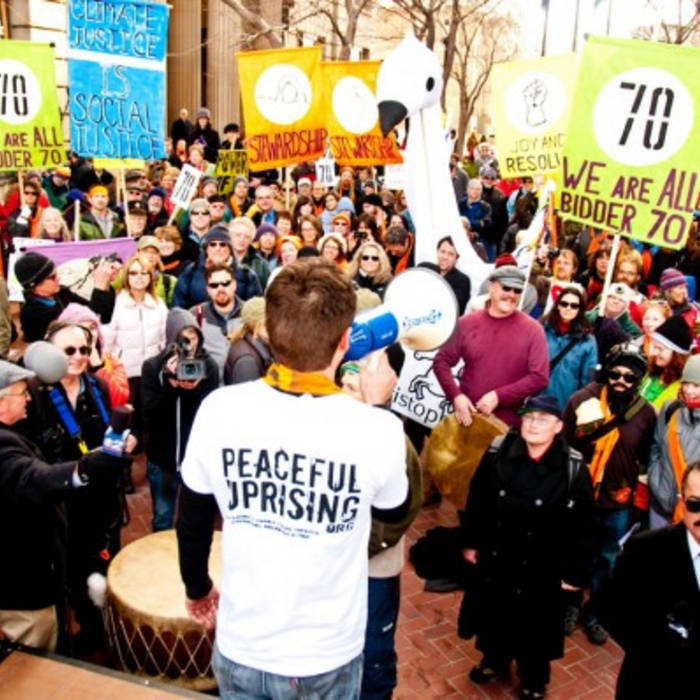
Something about Bidder 70 rubbed me the wrong way, and I’ve spent the last few days trying to figure out what it is. While I was watching the film, I was initially confused about why Tim DeChristopher’s actions were such a big deal. I wasn’t sure what he even did, or why it mattered, or how that was illegal at all after the auction was declared invalid. To me, it seemed like the only reason that it became such a big deal is the way that DeChristopher handled the aftermath. He was given an inch of attention and took a mile, and as he did so, it felt like he was missing the point. Maybe this was just how it seemed from the perspective of a documentary about him, but I was uncomfortable with the level of personal devotion to a single person rather than dedication to a cause or a set of principles. Yes, they staged environmental protests, but underlying all of those was the sense that DeChristopher was running the show according to his vision and his priorities rather than truly focusing on a community movement like he described. Even Peaceful Uprising’s murals, signs, posters, and protests used the image of “Bidder 70,” and while having a leader is certainly fine and good, turning DeChristopher into a martyr after a confusing and ultimately pretty useless “protest” seems like overkill.

But this strange focus on a single individual misses the mark on a larger scale, and it leaves both Peaceful Uprising and DeChristopher himself vulnerable to severe missteps as they try to build a community-based movement.

First, there was a rather obvious faux pas that made me cringe during the film, although I’m sure they meant no harm by it: their use of the raised fist symbol. Although it has taken on many forms and meanings throughout the years, it nearly always represents “unity or solidarity, generally with oppressed peoples.” Wikipedia further explains that in the United States, “the black fist, also known as the Black Power fist, is a logo generally associated with black nationalism and sometimes socialism. Its most widely known usage is by the Black Panther Party in the 1960s.” This is also what came to my mind first – among activists today, a raised fist is synonymous with black and/or working class (socialist) solidarity. So when I first saw this symbolism being used in Bidder 70, I started paying attention to the context of the movement that accompanied the gesture. What did I see? One black person in the entire film, and no discussion whatsoever of the effects of climate change on people of color and low income or otherwise disadvantaged populations. Granted, the population of Utah is over 90% white, but this is no excuse for an environmental movement to not make an effort to be inclusive, accessible, and thoughtful about for whom it is advocating. Seeing a group of white people giving the raised-fist salute before getting arrested at a protest and then basically patting themselves on the back for their heroism and courage was simply cringeworthy, and I’m saying that as a white person. I can’t say how I would feel about it if I was black, but either way, they should have thought more carefully before co-opting a powerful symbol within the black community for their own purposes.

However, failing to create a more diverse and intersectional movement is only one way out of many that Peaceful Uprising and Tim DeChristopher’s actions seem disappointing to environmental advocates today. I was actually shocked at how outdated many aspects of their movement appeared despite taking place less than a decade ago. Much of their rhetoric focused on scientific and technical aspects of climate change — fossil fuels, emissions, pollution, carbon dioxide and parts per million. Today, although these are undoubtedly still huge problems facing the world, many environmentalists have shifted away from these big picture, apocalyptic scenes that seem to big to change, and are instead starting to tell stories about the more personal impacts that climate change and humans can have on each other. Instead of talking about parts per million or oil spills, which seem insurmountable and distant to ordinary citizens, climate change is becoming a story of water, health, biodiversity, food, and small actions that can add up to have a big impact. Certainly, there are numerous problems that will likely only change if approached on regulatory, governmental, industrial, or corporate levels, but there are far more actions worth taking — and imperative to take — on the individual level, and the environmental movement will fall short of its goals if it is not personal enough or targeted at the appropriate solutions for its audience. It is all well and good to be realistic, but it is also necessary to be optimistic.

To be fair, I will give credit to Peaceful Uprising and Tim DeChristopher for the things that they got right. It is absolutely necessary to hold governments, corporations, and industries responsible for the damage they have done and are doing to the environment, and they have worked extremely hard to expose corruption and shed light on the environmental damage being done at the institutional level. It can also be tremendously difficult to mobilize popular support for climate action due to the long-term, global nature of the problem, but they have clearly galvanized a large group of people that support holding these powerful entities accountable and creating change within their community. Although a short amount of research on both Peaceful Uprising and DeChristopher failed to turn up any significant publicity for either party following his incarceration, I hope that they are still working to create change in their communities, and I hope that in the years since Bidder 70 was produced, they have found ways to be more inclusive, diverse, thoughtful, relevant, and hopeful in their activism.


Information about the raised fist: https://en.wikipedia.org/wiki/Raised_fist

Utah census data: https://www.census.gov/quickfacts/UT
Two Ways of Acting

We’ve been spending a lot of time in class discussing what it means to be an activist, and what is ‘good’ activism as opposed to ‘bad’ activism. By reading The Monkey Wrench Gang and watching Bidder 70, I feel as though we have gotten an in depth look at at least two separate ways that activism (as it would be defined by the people doing the acts) is informed and enacted. What surprised me about both of these examples is the apparent lack of planning that went into the initial acts. In The Monkey Wrench Gang no one member decided that they wanted to form a gang and go, as it would later come to be known as, monkeywrenching. It was a spontaneous decision made around a fire by a group of people who just happened to meet each other. In Bidder 70 he did not go into the auction with  plan, but, as he described it, had a moment of clarity in which he could not imagine taking any other action.

This really surprised me because I have always considered activism to be carefully thought out and planned acts. I imagine activism as marches that require intense organization and forethought. The fact that these two examples were each capable of spurring movements in reaction, point to there being something compelling about people taking action that, in the moment, simply feels right.

However, in spite of the similarities in initial action between the two examples, I also think that there is significant differences in the actions following the initial action. After he won dozens of bids in the auction, the audience gets to see and hear Tim DeChristopher processing the consequences of those actions, and coming up with real and valid reasons for why it was warranted. The audience doesn’t get a similar sense of thoughtfulness when reading The Monkey Wrench Gang. The rag tag group of misfits going out for a joyride together stays pretty constant throughout the novel. An aimless group with some sort of a sense of a greater purpose, but with real difficulties in articulating that greater purpose. It’s difficult to determine how these different approaches resonated with different audiences. Both DeChristopher and the gang inspired people into action, as we can see with the formation of EarthFirst! and Peaceful Uprising. But it’s difficult to get a sense for how effective either of those organizations have been simply by consuming the media created by them. I would be interested in discovering how these drastically different methods of inspirations affected their respective audiences in the long term.

Activism Ain’t Easy

Monkey wrenching is to activism as intramurals is to varsity. The former: unorganized, almost sloppy, often more rough. The latter: structured, hierarchical, far more serious. Dave Foreman inspired me to create this analogy with chapter 11 of his book, Confessions of an Eco-Warrior. He gives very strictnon-flexible guidelines on everything that monkey wrenching is and is not. Among other things, he describes it as non-organized, simple, and fun. After completing The Monkey Wrench Gang by Edward Abbey, I see exactly how these definitions fit in. Hayduke, Doc, Bonnie and Seldom seemed to wreck havoc on expensive equipment because it was fun for them, among other things.

However, I would never argue that monkey wrenching is 100% effective. Although a fictional tale, Abbey’s story concludes with no concrete changes being made to environmental policy. The gang destroyed bridges and bulldozers, but to what avail? The government became increasingly angry, not attempting to make any change, but rather devoting a lot of time and energy into catching these criminals. 

On the contrary, look at Bidder 70, an inspiring documentary about activist Tim DeChristopher.  DeChristopher attends an auction where he bids on (and wins) 12 separate land leases worth close to $2M. Obviously, he does not intend to pay for them, which results in a brutally long and painful legal case which ends with him serving two years in federal prison. In several instances, he describes the process as “annoying”, “lengthy”, and “cumbersome”. However, I believe that if he could go back in time and make the decision again, he would do the exact same thing.

DeChristopher demonstrates, to me, the difference between monkey wrenching and mass activism. To sum it up in one sentence: impactful activism ain’t always easy. In Abbey’s tale, the gang generally has an easy and fun time, despite toward the end where they get continually chased by authorities. In DeChristopher’s story, he bids not because he particularly enjoys bidding on land leases, but rather to make a political statement. He did what he did not for himself, but for the betterment of the human condition. The former is far easier than the latter – hence why the latter is more rare.

Activism that stems from one person sacrificing his/herself for the future of our environment and society (as in DeChristopher’s case) often succeeds more. As I talked about last week, people plant the seeds for large-scale movements by relating to people – and this is exactly why sacrifice works so well. People will always rally behind a hero(ine) (like DeChristopher) who puts his/herself in danger just to help others. His campaign succeeded in creating a large scale movement because people appreciated what he did and as a result, joined him in his cause.

I do not intend to disdain monkey wrenching; any action – small or large – toward the improvement of our environmental condition helps. However, activism ain’t easy – large-scale, impactful movements are never born from a gang just “having fun”. They are birthed by unselfish people that brave through difficult times knowing that better things lie ahead.

Civil Disobedience

I believe that Bidder 70 stood in stark contrast to The Monkey Wrench Gang, especially when it comes to the ongoing debate we have had in class about good versus bad activism. Although the intent is similar in both cases, as both groups fight for nature and the environment, the approach is completely different.

On one hand, the group in The Monkey Wrench Gang sabotage billboards and buildings belonging to the ‘evil’ corporates. As I have discussed earlier in a blog, I believe that this approach is too extreme. The group can quickly be labeled as the villains, which in turn discredits their beliefs and values.

However, Tim DeCristopher, the man behind Bidder 70, utilizes effective activism. It all starts with a relatively simple and peaceful protest, as Tim DeCristopher disrupts an auction selling land for drilling, by successfully bidding on some of the land himself without an intent to drill. As a result, his action includes severe implications, both positive and negative. On the negative, Tim DeCristopher quickly finds himself in the crosshairs of powerful corporates and the government, as he is prosecuted for civil disobedience. But on the positive, he gains national media attention. Tim DeChristopher is given a powerful voice in society, and takes full advantage. For instance, he founds Peaceful Uprising, expresses his concern for mountaintop removal in West Virginia, and supports a new democratic candidate in Utah.

Peaceful Uprising protest. Link: https://f4.bcbits.com/img/a1302879127_16.jpg

Bidder 70 therefore illustrates how powerful civil disobedience can be. The documentary itself even refers to Mahatma Gandhi and Dr. Martin Luther King on multiple occasions, possibly the two people behind the most successful movements involving non-violence. Drawing these comparisons sends an impactful message to the viewers. It gives us hope that we can have a voice in the issue of climate change. And we must utilize that, the same way Tim DeCristopher disrupted the auction posing as bidder 70.

Peaceful Uprising: Effective or Entertaining?

During the movie “Bidder 70,” environmental activist Tim DeChristopher disrupts an auction of land to prevent the selling of it to a large oil/gas company. Many people saw this act as an act of environmental activism as it was an “ethical and direct” decision to stop the exploitation of this country’s beautiful lands. Following this act, many fellow environmentalists banded together to form the “Peaceful Uprising” group which used theatre and art tactics to try and spread awareness and make change in the world. While I think this does a good job of spreading awareness, especially to the youth, it still begs the question: is this how we are going to make immediate change? According to fellow environmentalist Bill Mckibben’s article “Do the Math,” http://www.billmckibben.com we need to act and change now. Not tomorrow, not in ten years, but now. If our most promising way of enacting social and political change is through caricatures and ironic plays, will we really be able to put an end to the corrupt oil companies? Will we really be able to reach our goal (limit) of 350 ppm of CO2 in the atmosphere? If you ask me, no. The answer to our problems is money and getting people who have the right intentions and mindsets in the positions of power. While that’s easier said than done, I think it’s in everyone’s best interested to work towards getting into the top positions of these companies and changing them from the inside-out, rather than the outside-in. Theoretically it sounds good to keep protesting, but we need changes now and that will only come with power.

Activism: a chain reaction

After watching Bidder 7 and reading the Monkey Wrench Gang, my idea of what constitutes an activist has once again changed. To me, an activist is no longer one who fights for a cause, but rather one who inspires others to fight for a cause. It is this inspiration that separates an activist from a terrorist or criminal. While the cause is also important, an activist is equal to the cause but rather an activist is equal to the method by which he/she brings about the cause.

For example, I would argue that Tim (bidder 7) would not have been an activist if all he had done was monkey wrench the auction. Instead he became an activist after he rallied people to support his cause by creating Peaceful Uprising. His actions became a rallying cry for the organization and his actions and imprisonment although clearly criminal and unlawful became a rallying point for the members of the organization. He used the auction as a springboard to create this organization and subsequently become an activist.

Likewise, Hayduke became an activist and the rallying point behind the entire Monkey Wrench Gang. Although his ideas and actions were a bit unorthodox even for the members of the Gang, his ideas and motivation and even willingness to die for his cause clearly inspired the group and drove them to action. He continued to live in their hearts even after his “death” and inspired others to blow up the Glen Canyon bridge.

Therefore activism is not a one time event but rather a chain reaction that builds upon itself. No singular act in the series can be said to be activism but rather activism is the ability of each singular event to inspire others to continue after it and pursue the same cause.

« Older posts Newer posts »