LO6 Motivation

Learning requires motivation. Otherwise, we wouldn’t learn anything. By better understanding how people are motivated, we can find ways to improve our motivation to learn something. Improving our motivation can be as simple as adjusting our thoughts, plans, and attitudes, or it may involve discussing with peers or teachers to find reasons that resonate with us and can then be used as motivation.

This video is a very short overview of Self-Determination Theory. I recommend you watch it first to get the gist before you dive deeper: Self-Determination Theory Explained by Psychology Exposed

However, the video glosses over some crucial details, predominantly the self-determination continuum. Therefore, next, read the sections below from Self Determination Theory and How It Explains Motivation by positivepsychology.com. This resource is more geared towards teachers. However, it is still a helpful resource for you as a student because, in some ways, you are your own teacher.

  1. Introduction
  2. What is the Meaning of Self-Determination Theory? – The video here is optional, and skip the Self-Determination Theory Questionnaires section
  3. Self-Determination Theory and Goals
  4. How to Promote and Encourage Self-Determination Skills

If you want a video overview of self-determination theory that is between the above video and reading, you can optionally watch 3 Basic Needs That Drive Your Behavior [Self-Determination Theory] by Sprouts.

LO5 Cognitive Load

Understanding cognitive load theory will help us better understand the limits of our brains when it comes to learning tasks. By applying this theory, we will be more likely to recognize when a task is cognitively demanding, assess whether that demand is reasonable, and consider ways to restructure the task to enhance our learning, rather than having our cognitive limits reached, resulting in very little learning.

Read Sources of Cognitive Load by learningscientists.org

Read Factors Of Effective Note-Taking: Application Of Cognitive Load Theory by learningscientists.org

Notice how in the note-taking article, it is essential to consider context when deciding what kind of note-taking to do. The advice to “take notes by hand on paper” is not actually backed by all research studies. Instead, we should take into account the cognitive demands of the note-taking task and consider the course itself. Is the lecture very fast-paced, but also recorded? Perhaps it would be better to take minimal notes live and plan to revisit the content by watching the lecture recording, where you can pause as needed to create more comprehensive notes, which also then gives you spaced repetition of the content.

Finally, we can use the framework of intrinsic, extraneous, and germane cognitive load to also help us judge whether help is germane to a learning objective. If that help is part of the extraneous load, it is less likely to be germane compared to the intrinsic load. This identification can then lead us to find ways to reduce that extraneous load by modifying our environment, leveraging tools (including AI), and seeking assistance from others.

Final note: Germane load used to be considered its own category next to intrinsic and extraneous. However, more recent work has shifted germane load’s definition to be the ratio between intrinsic and extraneous. So be careful in what resources you use because more general media have not yet adopted this shift, and the training data of most AI has a lot more data with the old definition than the new one. Case in point, if I ask DukeGPT to define it, and it gives me the old germane load definition. When I direct ChatGPT to check the internet when defining and providing citations (internet search is not a DukeGPT feature yet), it also uses the old definition, but then adds recent developments and caveats that do mention the new definition. In this class, we use the new definition.

To make things clearer, this will be the last time we use the phrase “germane load” in the class. From now on, we refer to it as “germaneness” to make it clear that it is not a kind of load.

LO4 Self-Regulated Learning

Watch: Self-Regulated Learning Explained: How to Become Your Own Teacher by Powerful Learning

Then look through at least two of the following learning strategy resources:

  1. Learning STEM at Duke
  2. Five Study Strategies by Duke Academic Research Center (ARC)
  3. College Reading Tips by Duke Academic Research Center (ARC)
  4. How Do I Use Past Exams? by Duke Academic Research Center (ARC)
  5. Infographic on Retrieval Practice by The Learning Scientists
  6. Infographic on Spaced Practice by The Learning Scientists
  7. How To Take Notes In Class by The Learning Scientists

LO3 “Normal Learning” Day 2

Learning requires your brain. However, the brain does not fully develop until approximately age 25. Since a typical undergraduate student is 18-22 years old, it is crucial to understand what skills and brain development are currently occurring while the student is in college. A vital set of skills closely related to brain development is executive function skills. Executive function skills are the attention-regulation skills that help someone achieve a goal. There are many parts to this skill set, including maintaining focus on the goal, gathering relevant information, developing a plan to achieve the goal, adhering to the plan, resisting distractions, tolerating frustration, and considering the consequences of various decisions in relation to the goal.

While undergraduates possess adult-level capabilities in many areas, their executive function skills may be inconsistent, which is normal. Understanding these skills and that they are developing will help you recognize when learning challenges are part of normal brain development versus when you might benefit from adjusting your learning strategies or seeking additional support/guidance.

Required: Teens can have excellent executive function — just not all the time

LO3 “Normal Learning” Day 1

Forgetting Curve and Retrieval Practice

Think of a time you were trying to learn someone’s name. You meet them, hear their name, repeat it back to them to make sure you got it right, and then an hour later, it’s gone. You can’t remember it anymore, and now you have to figure out how you are going to learn their name again. Don’t worry, that’s normal. It’s called the forgetting curve.

Here is a graphic explaining the forgetting curve generally:File:Forgetting curve and work of Ebbinghaus.png

Attribution: Productive.Fish, CC0, via Wikimedia Commons

We start knowing something and then slowly forget it. Research found that what is remembered drops sharply and is barely remembered after a week or two. However, if the material is reviewed, the drop is slower. It’s impossible to know something forever without periodically reviewing it. Fortunately, there are many ways to do periodic review. One of the best is retrieval practice. What is important is that the information is reviewed every once in a while. In fact, it should be reviewed after some forgetting has occurred. Research has shown that the struggle to remember after some forgetting strengthens the long-term memory.

Learn more about retrieval practice, read: Cult of Pedagogy Retrieval Practice: The Most Powerful Learning Strategy You’re Not Using

Optional Supplement:

Growth Mindset

Read: What We Know About Growth Mindset from Scientific Research by Carissa Romero

LO2: Revised Bloom’s Taxonomy

Why learn about the revised Bloom’s taxonomy

Besides the Zone of Proximal Development, which frames whether someone has achieved a learning objective based on how much help they need, it is crucial to understand how to define and assess a learning objective. The revised Bloom’s Taxonomy is a way of doing this. Without a definition, we cannot determine that learning has happened. However, a definition alone is often insufficient, and Bloom’s taxonomy helps us define the ways to assess the achievement of a learning objective.

In the class Box folder, you will find a handout from Iowa State University on the Revised Bloom’s Taxonomy. This figure is a rich and dense resource often used by teachers to help them design their course materials, including homework and exams. We will use it to help us understand how to recognize when learning has happened.

LO1: Zone of Proximal Development (ZPD)

Zone of Proximal Development (ZPD) is an idea from Lev Vygotsky. It represents what a learner can do when given sufficient help. See below for a diagram explaining it.
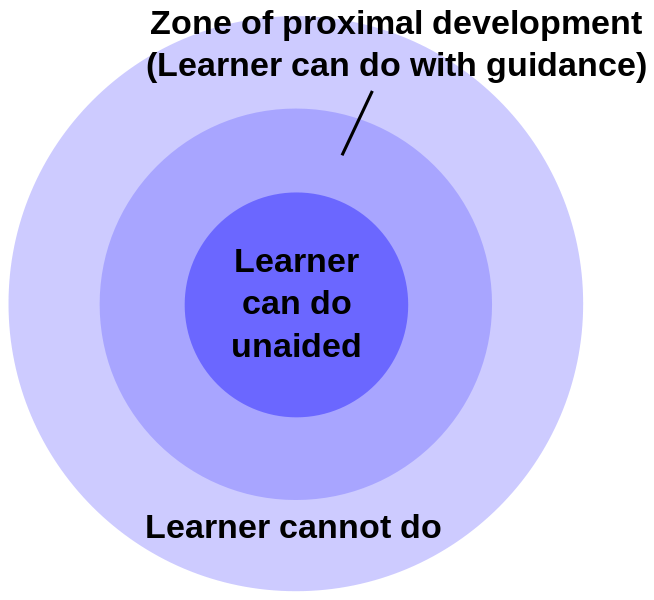
File:Zone of proximal development.svg

Source: https://en.wikipedia.org/wiki/Zone_of_proximal_development

In essence, there are three areas (or zones).

    1. What a learner can do without help.
    2. ZPD – What a learner can do with help.
    3. What a learner cannot do, regardless of how much help they receive.

Vygotsky originally developed this idea while studying children’s cognitive development and within the context of social interactions. However, we can still apply it to our own learning settings. The ZPD is where learners are provided scaffolds to help them succeed. Scaffolds are support “structures” that help a learner succeed. They come in many forms, such as a teacher pointing out pertinent information, asking critical questions, and nudging a learner in the right direction, or a homework that starts with simple questions using a single concept and then progresses to more complex questions that use multiple concepts. Over time, this scaffold is slowly removed or fades away, such that the learner can complete the task independently. Once they are independent, this moves the learning objective (i.e., the thing they are learning) from the ZPD into the “learner can do unaided” zone.

Differentiating whether Help is Scaffolding

When it comes to receiving help on a task that is intended to support achieving a learning objective, it’s important to consider whether that help is scaffolding the learning process. One way to do this is to assess how germane that help is to the learning objective. The way to assess help’s germaneness is by considering how much of that help/support needs to be faded away for the learning objective to be achieved. If that help were not available, would the learner have been in the zone of “learner cannot do”? Notice that the question centers around the learning objective, not the task that the person does to help them achieve that learning objective. Here is a concrete example:

    • Task: Draw a picture of your dream house.
    • Learning objective: Apply key techniques to create a drawing that accurately depicts perspective.
    • Help germane to the learning objective: Giving direct instructions on where to place a ruler to draw line guides or stating where vanishing points should be.
    • Help not germane to the learning objective: Offering ideas for potential dream house features, such as what colors to use.

The help’s germaneness to the learning objective is not necessarily black and white. For example, offering ideas that would make the drawing easier, such as giving feedback on reducing the number of windows so it’s easier to draw, could be germane to the learning objective. It would depend on the context and could require a judgment call between the learner and the teacher.

Whether the help is germane does not determine whether the help is “bad” or “good” for the learner’s learning. Once again, it will depend on context. The primary question is whether the help would prevent the learner from achieving the learning objective. Is the help scaffolding the learning such that it will/can be properly faded, and eventually the learner can work independently? For example, asking a tool to always place the line guides means the learner never practices making the judgment call of deciding where the lines go. While a teacher would be aware of how often the learner asks for such help and carefully fades it away, or has a direct conversation with the learner if they see overreliance on that help.