LO3 “Normal Learning” Day 1

Forgetting Curve and Retrieval Practice

Think of a time you were trying to learn someone’s name. You meet them, hear their name, repeat it back to them to make sure you got it right, and then an hour later, it’s gone. You can’t remember it anymore, and now you have to figure out how you are going to learn their name again. Don’t worry, that’s normal. It’s called the forgetting curve.

Here is a graphic explaining the forgetting curve generally:File:Forgetting curve and work of Ebbinghaus.png

Attribution: Productive.Fish, CC0, via Wikimedia Commons

We start knowing something and then slowly forget it. Research found that what is remembered drops sharply and is barely remembered after a week or two. However, if the material is reviewed, the drop is slower. It’s impossible to know something forever without periodically reviewing it. Fortunately, there are many ways to do periodic review. One of the best is retrieval practice. What is important is that the information is reviewed every once in a while. In fact, it should be reviewed after some forgetting has occurred. Research has shown that the struggle to remember after some forgetting strengthens the long-term memory.

Learn more about retrieval practice, read: Cult of Pedagogy Retrieval Practice: The Most Powerful Learning Strategy You’re Not Using

Optional Supplement:

Growth Mindset

Read: What We Know About Growth Mindset from Scientific Research by Carissa Romero

LO Checkpoint 9/11 (LO1 – LO2)

  • Learning Objectives available for this checkpoint: LO1 and LO2
  • When: Thursday 9/11, during regular class time
  • You may bring one piece of standard-sized paper as a helper sheet and can put things on the front and back.

Rubrics

Here are the rubrics that we will use to grade your answer to each learning objective.

LO1

  1. Exemplary
    1. Accurately identifies a LO in each zone of the ZPD framework.
    2. Explanation for the identification is clear and thorough, including a discussion of the learning objectives and how it is supported.
    3. Correctly uses relevant terminology.
  2. Satisfactory
    1. Accurately identifies a LO in two of the zones of the ZPD framework.
    2. Explanation for the identification is reasonable, but lacks some clarity, thoroughness, or discussion about how the learning is supported.
    3. Uses relevant terminology with some occasional omissions or imprecisions.
  3. Not Yet – Anything incomplete or that does not mean Satisfactory, such as:
    1. Only identifies a LO in one of the zones of the ZPD framework OR incorrectly identifies an instance that is inside/outside of ZPD.
    2. Explanation is vague, incomplete, or incorrect, such that it is not clear how well the author understands ZPD.
    3. Key terminology is misused.

LO2

  1. Exemplary
    1. Accurately identifies the specific knowledge dimension and cognitive process dimensions.
    2. Explanation for the identification is clear and thorough, including a discussion on why it is not at other potential levels.
    3. Correctly uses relevant terminology.
  2. Satisfactory
    1. Accurately identifies either the specific knowledge dimension or cognitive process dimensions. The other is only slightly inaccurate.
    2. Explanation for the identification is reasonable, but lacks some clarity or thoroughness.
    3. Uses relevant terminology with some occasional omissions or imprecisions.
  3. Not Yet – Anything incomplete or that does not mean Satisfactory, such as:
    1. Either slightly incorrectly identifies the specific knowledge dimension and cognitive process dimensions OR at least one identification is very inaccurate.
    2. Explanation is vague, incomplete, or incorrect, such that it is not clear how well the author understands the knowledge dimensions or cognitive process dimensions.
    3. Key terminology is misused.

Learning Log

Log Creation Due: 9/05

Late due: 9/06

The purpose of the learning log is to consistently reflect on your learning. You will submit to this log at least once a week, and you will use the data you generate in your Infographic final project. We recommend that you pick a particular kind of learning that you want to track. It could be a specific course, a specific thing within a course (e.g., writing exercises), a common task across multiple courses (e.g, homework), etc. The more care you take in picking what to track and the more consistently you fill out the form, the more informative your data will be.

Logistics and Grading

You can earn up to 2 engagement points per week as follows:

  • 1 point – For the first entry for the week.
  • 1 point – For the second entry for the week.
  • The third entry and beyond do not earn more points, but you are welcome to log more to support your learning.

Each week starts on a Monday and ends on a Sunday. The week your entry belongs to is based on the timestamp associated with that entry. This timestamp is automatically generated when you fill out your form.

Steps to create the learning log

  1. Open the Microsoft Form template [Update: since everyone has finished the creation of their own learning log form, this link is closed to prevent confusion.]
  2. Make sure you log in with your Duke NetID
  3. Click on the “Duplicate it” button
  4. Update the questions to better reflect your context, including the following:
    1. “Which course/thing were you learning for?”
    2. “What time did you do the learning?” – Feel free to change the options for this if you want
  5. Add 2+ questions to capture what you care about and any other information you think would be helpful for you to reflect on.
  6. Submit the share link to your form in this Microsoft Form. [Update: since everyone has finished the creation of their own learning log form, this link is closed to prevent confusion.] You cannot start earning engagement points without submitting the link.

Example Additional Questions

You do not need to limit yourself to just these questions. They are examples to help you think about what you would find interesting to capture.

  1. Did you ask for help? Yes/No
    1. From whom? [open textbox]
  2. How energized did you feel on a scale from 1 to 5?
  3. Where did you do the activity?
  4. Who did you do the activity with? Solo, 1 friend, study group, etc.
  5. How often did you take breaks?
  6. How motivated were you to do the activity? Very motivated, motivated, neither, unmotivated, very unmotivated
  7. What tools/apps did you use?
  8. How were you feeling as you did the activity? (Look up feelings wheels to get ideas of what to list)
  9. Did you use AI to help you with the activity? Yes/No
    1. If yes, how? [open textbox]

LO2: Revised Bloom’s Taxonomy

Why learn about the revised Bloom’s taxonomy

Besides the Zone of Proximal Development, which frames whether someone has achieved a learning objective based on how much help they need, it is crucial to understand how to define and assess a learning objective. The revised Bloom’s Taxonomy is a way of doing this. Without a definition, we cannot determine that learning has happened. However, a definition alone is often insufficient, and Bloom’s taxonomy helps us define the ways to assess the achievement of a learning objective.

In the class Box folder, you will find a handout from Iowa State University on the Revised Bloom’s Taxonomy. This figure is a rich and dense resource often used by teachers to help them design their course materials, including homework and exams. We will use it to help us understand how to recognize when learning has happened.

LO1: Zone of Proximal Development (ZPD)

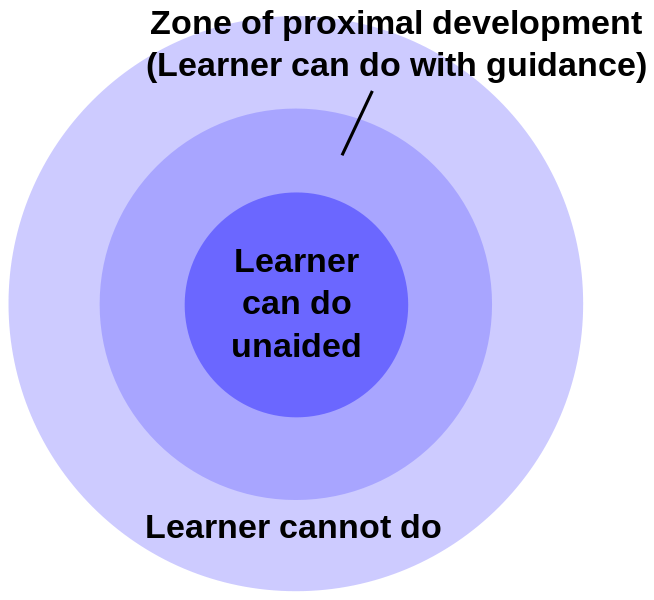
Zone of Proximal Development (ZPD) is an idea from Lev Vygotsky. It represents what a learner can do when given sufficient help. See below for a diagram explaining it.
File:Zone of proximal development.svg

Source: https://en.wikipedia.org/wiki/Zone_of_proximal_development

In essence, there are three areas (or zones).

    1. What a learner can do without help.
    2. ZPD – What a learner can do with help.
    3. What a learner cannot do, regardless of how much help they receive.

Vygotsky originally developed this idea while studying children’s cognitive development and within the context of social interactions. However, we can still apply it to our own learning settings. The ZPD is where learners are provided scaffolds to help them succeed. Scaffolds are support “structures” that help a learner succeed. They come in many forms, such as a teacher pointing out pertinent information, asking critical questions, and nudging a learner in the right direction, or a homework that starts with simple questions using a single concept and then progresses to more complex questions that use multiple concepts. Over time, this scaffold is slowly removed or fades away, such that the learner can complete the task independently. Once they are independent, this moves the learning objective (i.e., the thing they are learning) from the ZPD into the “learner can do unaided” zone.

Differentiating whether Help is Scaffolding

When it comes to receiving help on a task that is intended to support achieving a learning objective, it’s important to consider whether that help is scaffolding the learning process. One way to do this is to assess how germane that help is to the learning objective. The way to assess help’s germaneness is by considering how much of that help/support needs to be faded away for the learning objective to be achieved. If that help were not available, would the learner have been in the zone of “learner cannot do”? Notice that the question centers around the learning objective, not the task that the person does to help them achieve that learning objective. Here is a concrete example:

    • Task: Draw a picture of your dream house.
    • Learning objective: Apply key techniques to create a drawing that accurately depicts perspective.
    • Help germane to the learning objective: Giving direct instructions on where to place a ruler to draw line guides or stating where vanishing points should be.
    • Help not germane to the learning objective: Offering ideas for potential dream house features, such as what colors to use.

The help’s germaneness to the learning objective is not necessarily black and white. For example, offering ideas that would make the drawing easier, such as giving feedback on reducing the number of windows so it’s easier to draw, could be germane to the learning objective. It would depend on the context and could require a judgment call between the learner and the teacher.

Whether the help is germane does not determine whether the help is “bad” or “good” for the learner’s learning. Once again, it will depend on context. The primary question is whether the help would prevent the learner from achieving the learning objective. Is the help scaffolding the learning such that it will/can be properly faded, and eventually the learner can work independently? For example, asking a tool to always place the line guides means the learner never practices making the judgment call of deciding where the lines go. While a teacher would be aware of how often the learner asks for such help and carefully fades it away, or has a direct conversation with the learner if they see overreliance on that help.