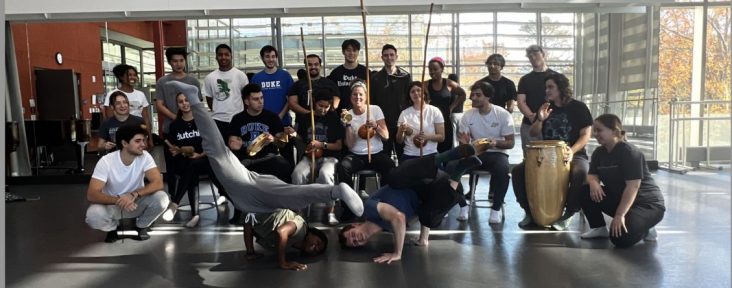
What is Capoeira?
Capoeira is an Afro-Brazilian art form that integrates self-defense, dance, acrobatics, ritual, and music. Created by enslaved Africans in Brazil several hundred years ago as a form of cultural and physical resistance, today the practice communicates a message of resilience and unity. Capoeira encompasses ancestral history through song and movement, which allows the game to be both grounded in the present and rooted in the past channeling energy from ancestral spirits and the individuals around them. Historically, the participants of the game were predominantly men, but throughout the late 20th and 21st centuries, women have increasingly entered the roda and become leaders in capoeira.
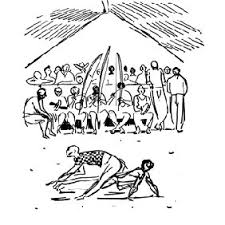
The roda is a circular structure that the game is played in, in which the musical orchestra sits at the top, where the games commence. Due to its circular structure, the roda is very inclusive and engages both the players inside and the ones standing on the circumference. The roda is made complete by an orchestra made up of different percussive instruments. Everyone in the roda is part of the capoeira experience because they are setting the rhythm and sound of the game, and they can involve themselves in active play at any time. Many capoeiristas say that capoeira is played both inside and outside of the roda, referring to how the game connects to everyday life and worldview.
Music
The musical instruments involved in capoeira are integral to the sounds and atmosphere of the game. The berimbau, along with agogô, atabaque (drum), and pandieros (tamberines) have a strong presence in a capoeira game. They create an all-encompassing sound, in which the most important instrument is the berimbau. The berimbau is a single-stringed musical bow that makes a strong percussive beat played. It signals the start of the game, as the two capoeiristas who are going to play must sit at the foot of the berimbau before entering the center of the roda. It sets the rhythm and tone of the game by leading the speed of the instruments and players. 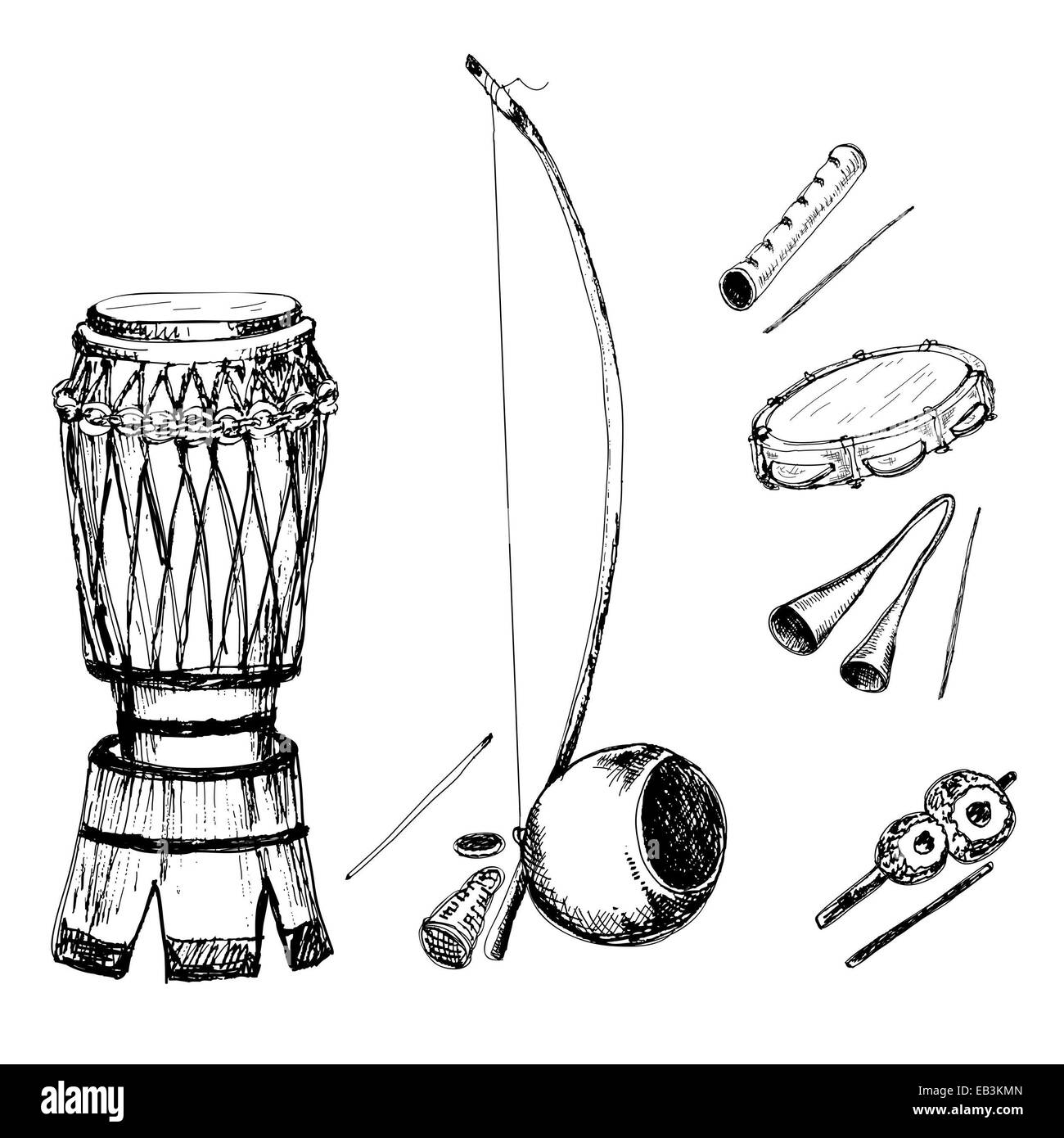
In addition to instruments, there are vocalists that sing songs specific to capoeira. Through call and response, the soloist sings out the chorus and the rest of the roda responds with the same chorus. As the company continues to sing the chorus, the soloist has the freedom to change the verses however they see fit. The relationship between the vocalists, the instrumentalists, and the players is one of the unique aspects of capoeira that makes it the diasporic game that it is. The players respond to the rhythms and sounds that the instrument players and vocalists make, allowing their bodies to flow freely with the beat, as it shapes the game.
History of Capoeira within the African Diaspora
As an African Diasporic dance, capoeira integrates many African aesthetics in its practice, such as call and response, polyrhythm, and the aesthetic of cool. The overlaid rhythms of capoeira “push individuals to imagine and reorganize their moving bodies dynamically as polycentric structures in space that, subsequently, enact polyrhythmic patterns of movement in time” (Rosa, 2012, p. 147). Ginga, a key movement in capoeira that players return to between movements, requires a relaxed, tension-free sense from the entire body (Rosa, 2012, p. 152). The tension-free aesthetic is juxtaposed with the derisive nature of capoeira. Capoeira, like many other diasporic dances, has deep roots in Africa and honors the ancestral years of oppression and slavery. The derisive nature encapsulates the trickery and wit of the players, as they try to tease their partner with kicks and swipes.
Capoeira Regional vs Capoeira Angola
There are two main types of capoeira: Capoeira Regional and capoeira Angola.
In the 1920s, Mestre Bimba began formally teaching capoeira. He developed “the aggressive potential latent in capoeira, incorporated throws and trips from batuque, and, after observing other styles of fighting created countermeasures derived from capoeira techniques.” This acrobatic, combative form of capoeira became known as today’s Capoeira Regional. This was one of the first attempts to standardize, teach, and proliferate capoeira to others outside of more “degenerate” forms (for example in street fighting or street entertainment). His academy was named the “Center of Regional Physical Culture” (it did not include capoeira because capoeira was a term correlated with thugs and the outcasts of society). (61 Downey)
“To Mestre Bimba’s image as a prizefighting champion, [Mestre] Pastinha plays a complementary role as artist and sage.”(68 Downey) Capoeira Angola was formalized by Mestre Pastinha. He was taught Capoeira Angola from his African neighbor, Tio Benedito. After teaching informally for decades, he started formally teaching capoeira in 1941. Later he opened the “Centro Esportivo de Capoeira Angola” which was the first registered center for teaching Capoeira Angola. This form of capoeira is said to be truer to the origins of capoeira all the way from Angola, Africa. This Afrocentric form of capoeira is typically more slow, low to the ground and conversational as opposed to as aggressive as the more combative Capoeira Regional. (68 Downey)
Capoeira Pop Culture
Capoeira may be rooted in rich history, however, it is integrated into modern pop culture as well. The globalization of capoeira has transcended the game across borders, and it is now widely practiced around the world. There is a lot of interest in capoeira because of the social fitness aspect as well as the protective, self-defense-type movements. Though sometimes not immediately noticeable, there are “unidentified fragments of capoeira” present in pop culture fitness fads, exercise products, films, and video games (Rosenthal, 2007).
Capoeira has been featured in multiple mainstream movies and television, especially when fighting scenes are involved. There are both Brazillian films that showcase capoeira as well as films from other parts of the world. In these films, capoeira is typically depicted as a martial art or combat skill.
- Black Panther: T’Challa uses capoeira moves during his fights in Black Panther
- Besouro: A fictional movie about fighting oppression with capoeira
- O Zelador: A movie about the culture of capoeira and how it’s a social force
- Madam Sata: A biopic about Madam Sata and his struggles with abuse due to his race and sexual orientation
Capoeira has been featured in multiple video games. In particular, there have been various fighting games that have modeled character fight styles after capoeira. Here is a compiled list of a few:
- Tekken Characters Eddy Gordo and Christie Monteiro
- Street Fighter III Character Elena
- Overwatch Character Lucio
- Fatal Fury Characters Richard Meyer and Bob Wilson
- Crossy Road

Lucio from Overwatch
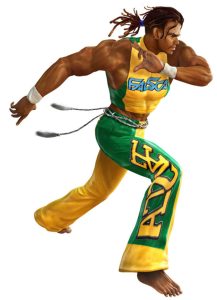
Eddy Gordo
Sources:
Joshua M. Rosenthal. (2007). Recent Scholarly and Popular Works on Capoeira [Review of Learning Capoeira: Lessons in Cunning from an Afro-Brazilian Art; Capoeira and Candomblé: Conformity and Resistance through Afro-Brazilian Experience; The Little Capoeira Book; Capoeira: The History of an Afro-Brazilian Martial Art; Capoeira: The Jogo De Angola from Luanda to Cyberspace, by G. Downey, F. Merrell, Nestor Capoeira, Alex Ladd, M. R. Assunção, & Gerard Taylor]. Latin American Research Review, 42(2), 262–272. http://www.jstor.org/stable/4499382
Rosa, C. (2012). Playing, fighting, and dancing: Unpacking the significance of ginga within the practice of Capoeira Angola. TDR/The Drama Review, 56(3), 141–166. https://doi.org/10.1162/dram_a_00193
