
By Thalia Halloran


The second city of our Spanish sojourn was Seville, where pastel castles leaned against one another for support and narrow brick streets were shared by pushy pedestrians and cars alike. On our first full day there we explored the Seville Cathedral, the largest cathedral and third largest church in the world, and the final resting place of (part of) Christopher Columbus.

When we entered the cathedral we proceeded to split up, taking audioguides and choosing our own path through the enormous site. Upon entry I found myself tearing up—any one of the columns holding up the massive building was larger around than my dorm room. No words could describe the enormity of this place, the splendor of the tiling, the stained-glass, the sculptures and paintings and metalwork all on display. Soon enough I stopped paying attention to the audioguide and allowed myself the chance to marvel instead. Everything was enormous, five or ten times the size of what I was used to, as though some giant commissioned this worship space.


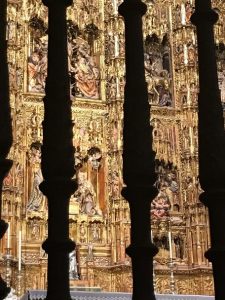
This building could easily fit eight of my childhood parish within it and still have room for a crowded Mass. There was no spot lacking detail—the ceilings were intricately carved or tiled, the pillars stretched into magnificent sloping arches, and priceless oil paintings hung throughout the whole space. Even the floors were lovely. Anything that could be edged in gold was. Any space with room for carving was carved. Some of the rooms were even rounded, in swirling, hypnotic ovals. Everywhere, enormous wealth and splendor were on display. I saw more silver and gold in the Cathedral than I have in the sum total of my life up until that point. I was overwhelmed and in awe. More than anything else I’d seen so far, the Cathedral showed me an idea which we’d touched on in class but only now gained real weight: this place had been here longer than I could imagine and would last longer than I could imagine, and hundreds of thousands of people had worked here, worshipped here, built this place into what it is with care for every detail.


I was particularly drawn to all the representations of the body of Jesus. As with all Catholic churches there were a number of crucifixes present, in mournful dark colors, celebratory golden ones, or bloody crimsons. The presence of a number of silver monstrances served to illustrate the remarkable reverence to the body of Christ in another form.



Behind the cathedral was a courtyard lined with orange trees and fountains, very reminiscent of the mosques we’d seen thus far and studied in our class. Here we could look up and see the Giralda, or bell tower, in full force. We’d learned that the Giralda had once been a minaret of a mosque on that site, but now it is full of bells that ring every hour. I was part of a group that missed the tours up to the Giralda by three minutes, but we returned the next day to climb the 35 ramps and 17 stairs and look down at the city around us. This marvelous town that seemed so lively and vibrant from street level was quiet and small from above, a collection of matchbox houses and papier-mache stores, all in shades of white.


On our way out we encountered an entire Dumpster full of bitter oranges that had fallen from the trees inside. The caretakers must have collected them all here to keep the courtyard grounds pristine. It was a strangely grounding moment, to see all these oranges here and remember that the space we’d just been in was created and maintained by humans who grew decorative fruit that were no good for eating. We were back in the city now, squarely in the present moment, and it was good.

