
The Acharya Lab focuses on uncovering the molecular and structural basis of how viruses enter host cells and how the immune system responds to these pathogens. Using advanced structural biology techniques—primarily cryo-electron microscopy (cryo-EM) and X-ray crystallography—we investigate viral surface proteins and their interactions with host receptors and antibodies at atomic resolution. This work directly informs the rational design of vaccines and antibody-based interventions.
Viral Entry Mechanisms
A central area of our research is elucidating how viruses, particularly HIV-1 and SARS-CoV-2, gain entry into host cells. By capturing the structural transitions of viral envelope proteins/spike proteins during the entry process, we aim to understand how these conformational changes facilitate membrane fusion and infection. Insights from these studies are critical for identifying targets that can be exploited to block viral transmission.
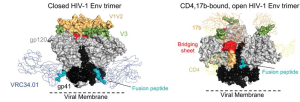
CD4-induced conformational changes in BG505 SOSIP Env by Bhishem Thakur Ph.D.
Antibody Responses
We also study the development and evolution of antibody responses, especially those capable of neutralizing a broad range of viral strains. By mapping the interactions between antibodies and viral antigens, and characterizing antibody lineages, we aim to understand the pathways that lead to potent and broadly neutralizing antibodies. This knowledge is key to designing immunogens that can guide the immune system to produce effective antibody responses through vaccination.

Cryo-EM structures of SARS-CoV-2 Spike ectodomain in complex with neutralizing and non-neutralizing antibodies by Kartik Manne, Ph.D. & Sophie M. C. Gobeil Ph.D.
Collaborative Science
Our lab operates at the intersection of structural biology, immunology, virology, and computational biology. Through close collaboration with other groups at the Duke Human Vaccine Institute and beyond, we translate fundamental molecular insights into practical strategies for preventing infectious diseases.
Ellie Zhang discussing the evolution of SARS-CoV-2 Omicron:
