
Today I want to talk about my trip to Suzhou. Obviously, it was a beautiful sight.
My classmate and I went to see two main things: 网师园 (Master of the Nets Garden) and 东方之门 (The Gate to the East/Gate of the Orient).
We both didn’t know what exactly to do, or where exactly to go – we just knew we wanted to see Suzhou. My goal was to take some photos and videos to document some of my journey to Suzhou as a place where students from DKU can go to enjoy themselves, engage with Chinese culture, and also get some work done. As a DKU student, what more could you want?
I want to shed some light on the Chinese culture aspect. Obviously, we all know what Suzhou is known for how in-tact its cultural relics are, as seen in its beautiful gardens and museums. One thing I did want to talk about, however, was my experience talking to locals in Suzhou.
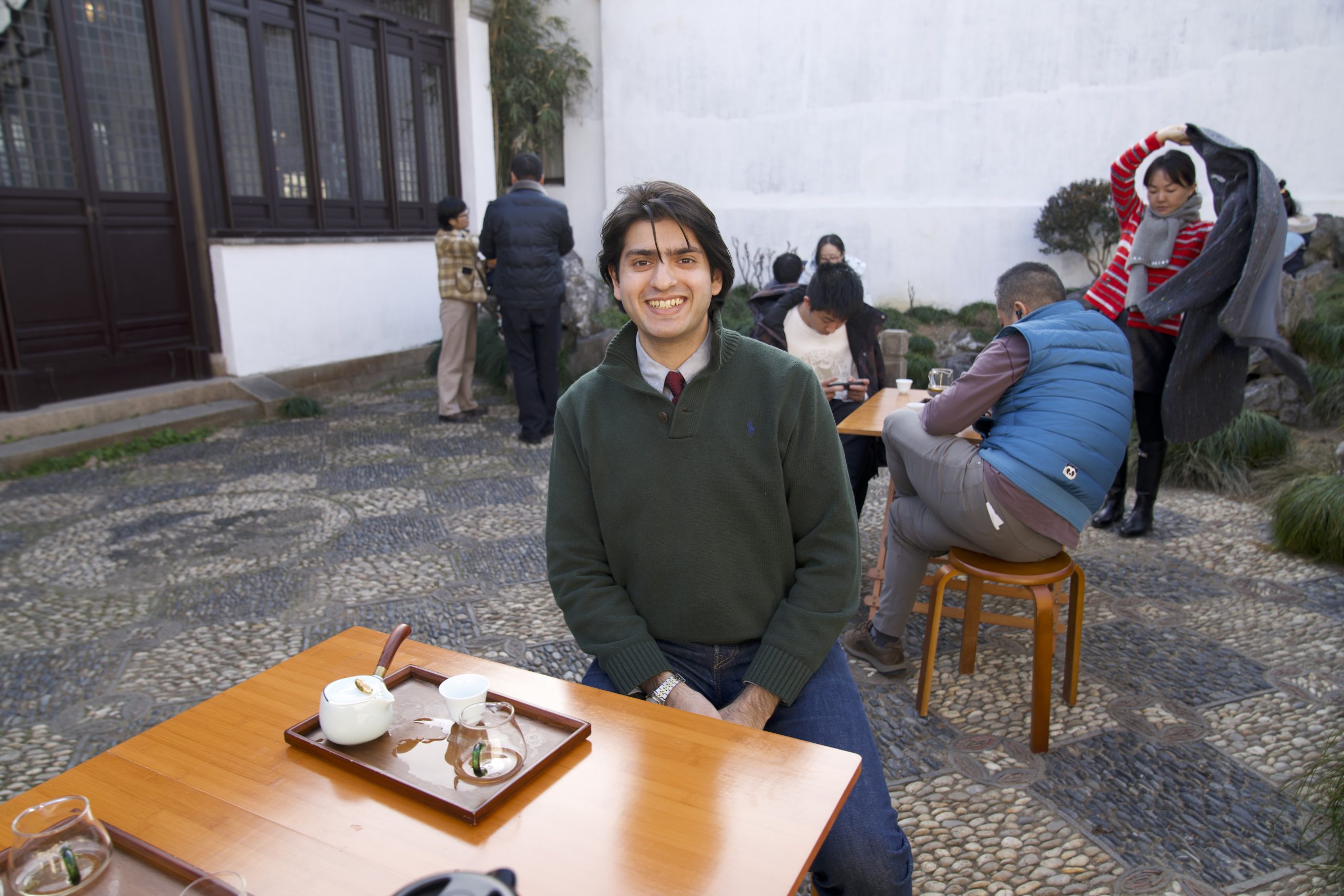
As we explored 网师园, we found a place to sit and enjoy tea.
The weather was perfect, enough to enjoy the outdoor seating. We were the only foreigners drinking tea so naturally, we got many stares. To be honest, I’m not sure exactly what to think of these stares, whether they are a good thing, a bad thing, or just a thing (it doesn’t have to be one or the other, it could also just be confusion). After all, if I saw foreigners enjoying tea in a really old garden in a smaller city having seen very few foreigners in my life, I’d probably stare too. I guess this is human nature, and we’re all similar in this way when looking at it from their perspective.
I don’t remember how this conversation started, but our table was placed directly next to another table occupied by a middle-aged Suzhou local and her mother. We sat down and they were talking about us in Chinese (all good things), and then we engaged in a conversation. The typical, simple, yet cordial conversation of “hello” and “where are you from,” “what brings you to Suzhou,” unraveled. Being able to answer each of these questions quite well (practice) in Chinese surprised them, and they became more pleased with us. Their smiles widened and they became visibly excited. The conversation then turned into her asking us even more questions about us, then talking about herself and why she was there. She explained that she’s from Suzhou and that she frequents this garden with her mother because it is beautiful and peaceful. She then explained to us how there are many gardens in Suzhou, and then how spoke a little about them. From there, she told us to explore more, eventually giving us an itinerary of what to look at and when. The conversation ended pleasantly, and we all resumed drinking tea, enjoying the garden, its sounds, and the taste of the warm tea.
I hope it becomes more clear from this interaction that, more often than not, we are welcomed. The fact that the local gave us an itinerary clearly shows that she wants us to see these sights and experience Suzhou. Obviously, I need to make it clear that this conversation was only possible because we know how to speak in Chinese. This brings me to my next point.
As foreigners, we get many stares because of curiosity. Put yourself in their shoes: they have seen very few foreigners, and they are naturally curious. Humans are naturally curious when we see something out of the ordinary, especially in a more homogenous society. One thing I can tell you, is that so much more often than not, the curiosity is positive. How do I know this? 1 year in China…
As they look at you, questions begin to form, and all it takes is for something to get you talking. Once you start talking to them, they become excited that you can speak Chinese and begin to ask you many more questions. They realize they can express their curiosity in their language, making the interaction more comfortable for them. They sometimes bombard you with questions out of their curiosity and excitement, but I think it’s cute. It reminds me that we are the same in that we are all curious and want to know more about what is different from us. It’s cute and it makes me happy that I made them happy. What makes me happier is that the general default attitude is positive curiosity. If you don’t know Chinese, it is okay as well. Just show effort — try to speak as much Chinese as possible, and it will bring their mood up so much more than you think.
Of course, humans are historically unkind to those different than them, but not in my experience in China. The inclination is towards being kind, friendly, hospitable, and just wanting to know what life is like for others. This is how we lead to the most productive intercultural communication. Start positive, meet in the middle (speak as much Chinese as possible and make both sides as happy as possible), and end positively – ignore the weird stuff.
