Craig’s List Study
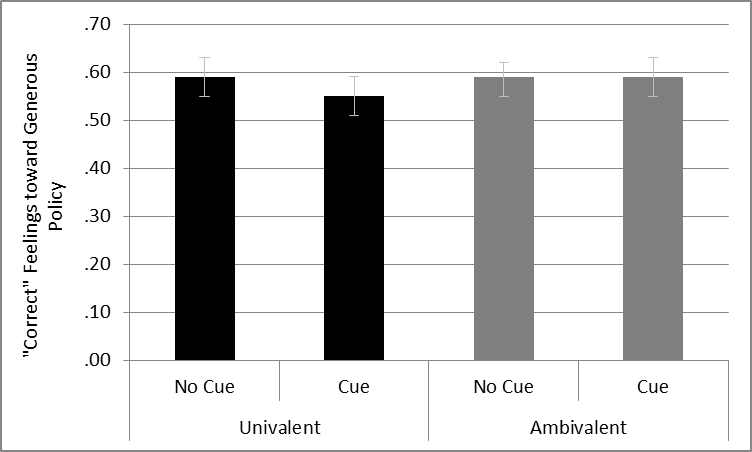
An alternative model specification to the one examined in the book utilizes the difference in feelings between the two policies. The results of this analysis are shown in the figure below. While in the correct direction, they are quite a bit weaker than those utilizing the dichotomous choice DV.
This y-axis in the figure represents relative support for the ideologically “correct” policy (i.e., consistent with partisanship; coded 0-1) as a function of the party cues treatment condition and manipulated partisan ambivalence. It shows that the presence of the counter-stereotypical partisan cue decreases relative support for the ideologically consistent policy, and that the gap between the no cue and cue conditions is smaller in the ambivalence condition. Nonetheless, there is no significant difference between the univalent-cue and ambivalent-cue conditions.
Long Island Study
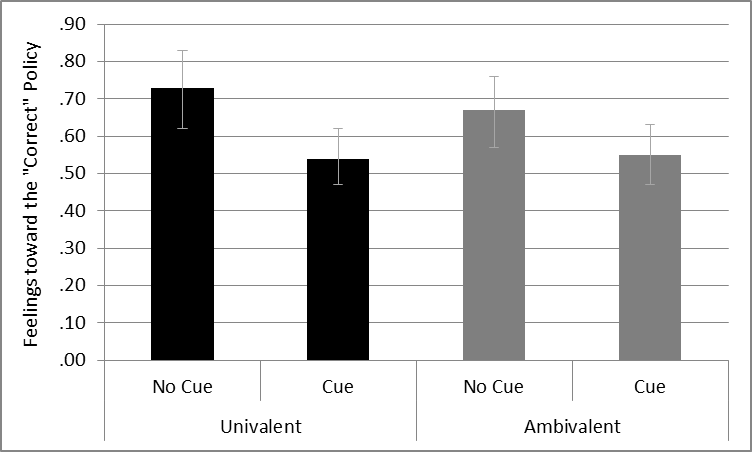
An alternative model specification to the one examined in the book utilizes the difference in feelings between the two policies. The results of this analysis are shown in the figure below. It reaches the same substantive conclusion as the analysis utilizing the dichotomous choice measure, but with stronger results, and no main effect of ambivalence (see Figure 4.2 in the book).
This y-axis in the figure represents relative support for the ideologically “correct” policy (i.e., consistent with partisanship; coded 0-1) as a function of the party cues treatment condition and measured partisan ambivalence. It shows that the presence of the counter-stereotypical partisan cue decreases relative support for the ideologically consistent policy, but only among univalent citizens. There were no significant differences among the other three conditions.

Knowledge Networks Study
An alternative model specification for Figure 4.3 uses only feelings toward the generous policy. In this sample, relatively few respondents (Democrat or Republican) preferred the generous to the stringent policy, and the correlation of both forced policy choices and feelings toward the stringent policy with partisanship were very low. The correlation of feelings toward the stringent policy with feelings toward the generous policy was also minimal. The analysis in the book utilizes the difference in feelings, but, given these patterns, feelings toward the generous policy alone may represent a better DV for examining the dynamic of interest. The results of this approach are shown below, and are indeed quite a bit stronger.
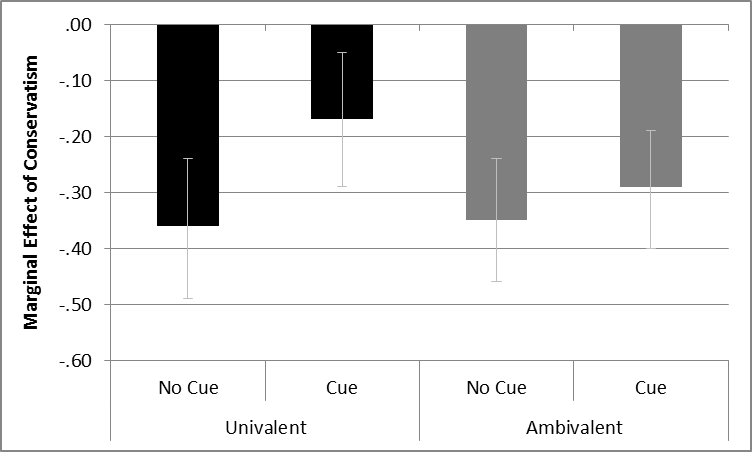
Notes: DV is coded on a 0-1 scale. The figure shows that conservatives oppose the generous welfare policy significantly more than liberals in all conditions, but the difference is substantially reduced in the counter-stereotypical party cues condition. This “blind partisanship” effect, however, does not occur when respondents were experimentally induced to feel partisan ambivalence prior to reading about the policies.
Finally, two additional specifications that parallel those of the first two studies above. The first uses “correct” relative feelings toward the two policies, and the second used “correct” feelings toward the generous policy only. The marginal effects are of a smaller magnitude, but are consistent in pattern with expectations.