Home » Hyponatremia (DDAVP Clamp)

Fellowship Program Leadership

Director-
Matthew A. Sparks, MD

Associate Director-
Harpreet Singh, MD

Associate Director-
Rasha Raslan, MD

Program Coordinator-
Ashley McPherson

Haskel Schiff Chief Fellow-
Samiddhi Weerasiri, MD

Click Links

RSS Renal Fellow Network

Follow Duke Kidney on Social Media

Hyponatremia (DDAVP Clamp)

DDAVP Clamp Purpose 

Download the Algorithm

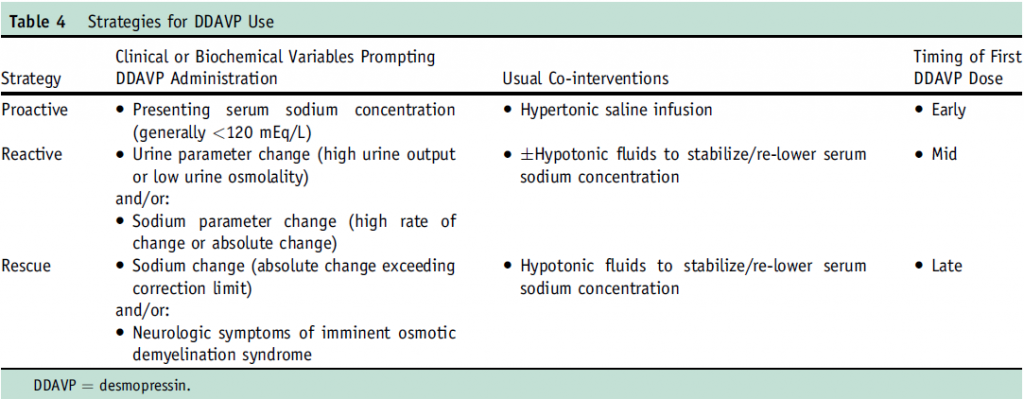
  • The goal of the DDAVP clamp is to use DDAVP together with 3% hypertonic saline as the initial correction strategy for high-risk hyponatremia. 
  • **This is different than rescue DDAVP which is given to reduce overcorrection without concomitant hypertonic saline 
  • “Clamping” refers to maintaining a high and fixed urine osmolality (UOsm >500 mOsm/kg), effectively taking the kidney’s variable free water excretion out of the correction equation. 
  • This allows serum sodium to rise predictably, driven primarily by the amount of sodium administered. 
  • The 3% hypertonic saline rate is adjusted based on frequent serum sodium measurements, with the expectation that UOsm remains consistently >500 mOsm/kg. 
Can Consider DDAVP Clamp 

  • Severe chronic hyponatremia with Sodium < 115 mEq/L 
  • Those with reversible cause that will abruptly turn off ADH
    -e.g. Thiazide-associated, hypovolemic hyponatremia, transient SIAD, alcohol use disorder/ beer potomania 
  • Patients who present with high UOsm and abruptly drops 
  • Severe hyponatremia from primary polydipsia 
  • High-risk of overcorrection and ODS: alcohol use disorder, malnutrition, advanced liver disease, hypokalemia 
Avoid DDAVP Clamp  

  • Acute (< 48h) hyponatremia 
  • Sodium >120 mEq/L 
  • Evidence of volume overload 
  • Severe SIAD, e.g. malignancy in which UOsm consistently >500 (they are already “clamped”) 
  • Not for use with 1.8% or 0.9% NaCl (ONLY USE 3%) 
  • Oliguria (AKI, ESKD) (they are already clamped) 


From MacMillan et al 2015

D5W infusion for patients with hyponatremia in patients on CRRT