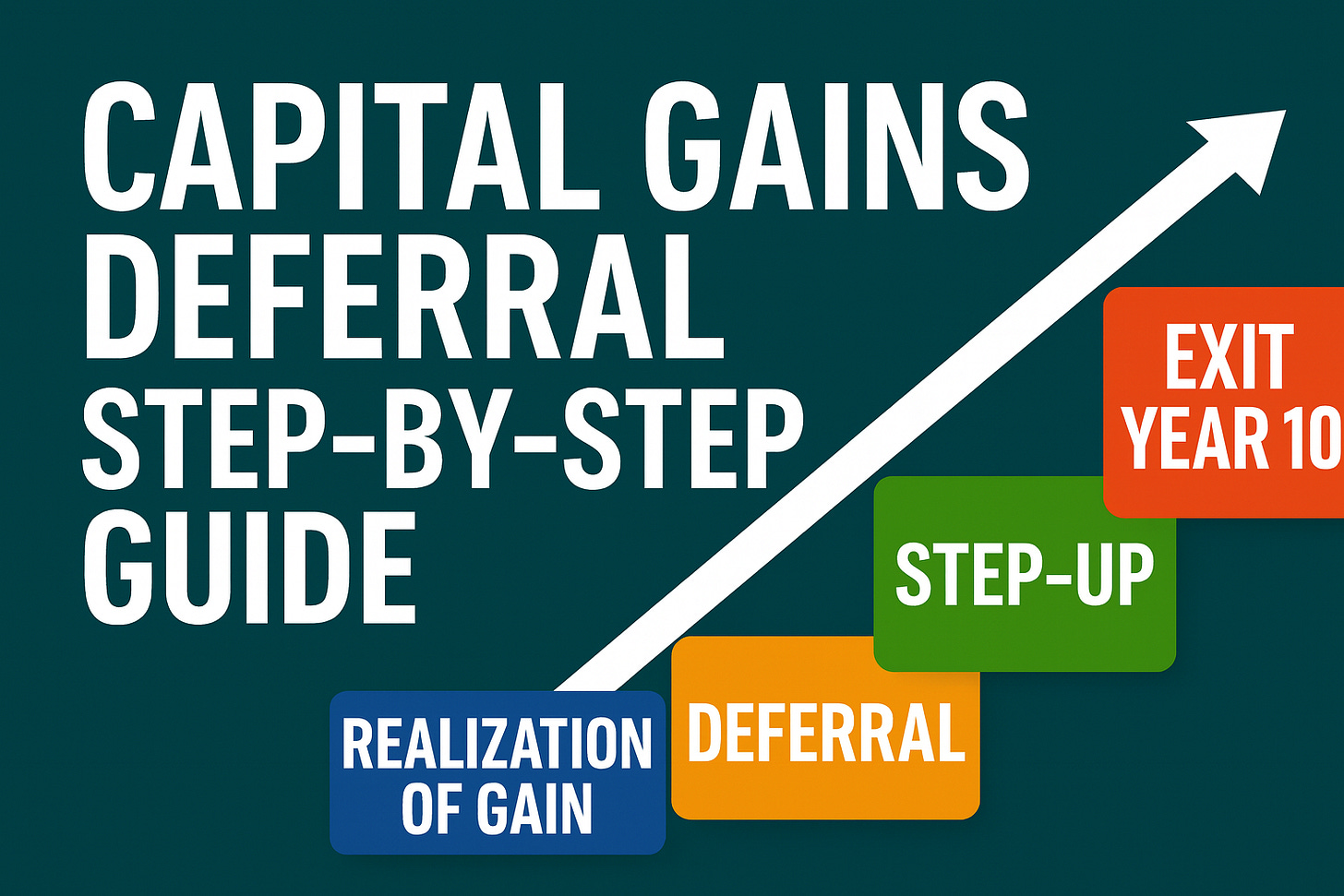
- A QOF lets you defer and potentially eliminate capital gains taxes by reinvesting your realized gains into Qualified Opportunity Funds within 180 days — deferring taxes until 2026 and making all appreciation tax-free after 10 years.
- It’s a powerful compounding and tax strategy — turning a one-time taxable event into long-term, mission-driven, and tax-advantaged growth through investments in designated Opportunity Zones.
If you’ve ever sold a big position, a building, or a business and felt that sting of capital gains tax coming for you — there’s a smarter move. Qualified Opportunity Funds (QOFs) let you defer, reduce, and even erase those taxes if you play the timeline right.
Born out of the 2017 Tax Cuts and Jobs Act, QOFs were designed to push capital into designated Opportunity Zones — areas that need investment — but the real upside is how it treats your gains. Here’s the playbook, step by step.

1. You’ve Got a Gain — Now What?
You sell something and trigger a capital gain — maybe it’s stock, crypto, a property, or even a company sale. Normally, Uncle Sam takes a bite that same year.
But under Section 1400Z-2, you can hit pause on that tax bill if you roll your gain (not total sale proceeds) into a Qualified Opportunity Fund within 180 days.
Example: You unload a rental property on June 1, 2025, locking in a $500K gain. Instead of cutting a check to the IRS this year, you reinvest that gain into a QOF — and the tax man waits.
“Deferring capital gains isn’t just about saving taxes — it’s about keeping your money in motion, compounding inside real projects that create jobs, build infrastructure, and generate real returns.”
— Robert Mowry, Senior Partner, Qualified Opportunity Fund
2. The 180-Day Shot Clock
You’ve got 180 days from the sale date to redeploy your gain into a QOF.
For individuals, the clock starts the day you sell. For pass-throughs (LLCs, partnerships, S-corps), you can choose to start the countdown either when the entity sells — or at year-end.
Miss the window, and that’s it — no deferral, no deal. Timing and paperwork are everything.
3. Deferral in Action
Once the money’s in, your tax bill goes on ice. You don’t owe that gain until the earlier of:
- When you sell or swap your QOF interest, or
- December 31, 2026.
So yes, the clock runs out eventually — but you’ve just bought yourself a few years of deferral and set yourself up for the real win: tax-free growth on the QOF itself.
“A good QOF structure turns a one-time tax hit into a long-term compounding machine. The trick is smart timing and backing the right projects.”
— Robert Mowry, Senior Partner, Qualified Opportunity Fund
4. The (Once) Sweetener — Step-Up in Basis
Early birds used to get an extra boost: a 10–15% basis step-up if they held the QOF long enough before 2026. That window’s basically gone now — though there’s chatter in D.C. about a reboot (the so-called “Opportunity Zone 2.0” bill).
Even without it, you’re still deferring gains through 2026 and potentially wiping out future appreciation if you hold the QOF long enough. Which brings us to the main event…
5. The Ten-Year Play — Tax-Free Exit
Hold your QOF stake for 10 years or more, and you can elect to step your basis up to fair market value when you sell. Translation: all the appreciation inside the QOF is completely tax-free.
Example:
You put in that $500K deferred gain in 2025. By 2035, it’s worth $1 million. You sell — and the extra $500K of appreciation? Tax-free. Zero. Gone.
The Big Picture
Here’s how the sequence works:
- Realize a gain.
- Reinvest it within 180 days.
- Defer the tax until 2026 or exit.
- Hold 10 years, sell tax-free.
QOFs turn a tax liability into a long-term, tax-advantaged growth engine — and if you’re smart about where you deploy the capital, you’re not just saving money, you’re compounding it.
For investors and advisors who think like capital allocators — not taxpayers — this is one of the cleanest plays still on the board.