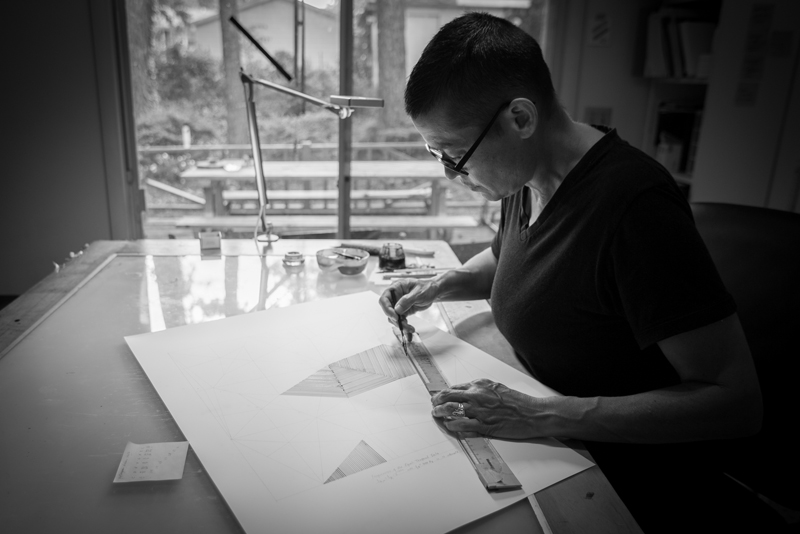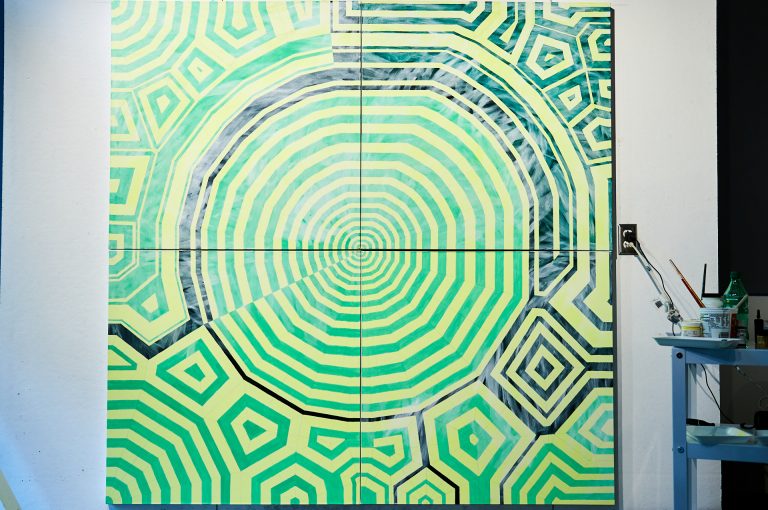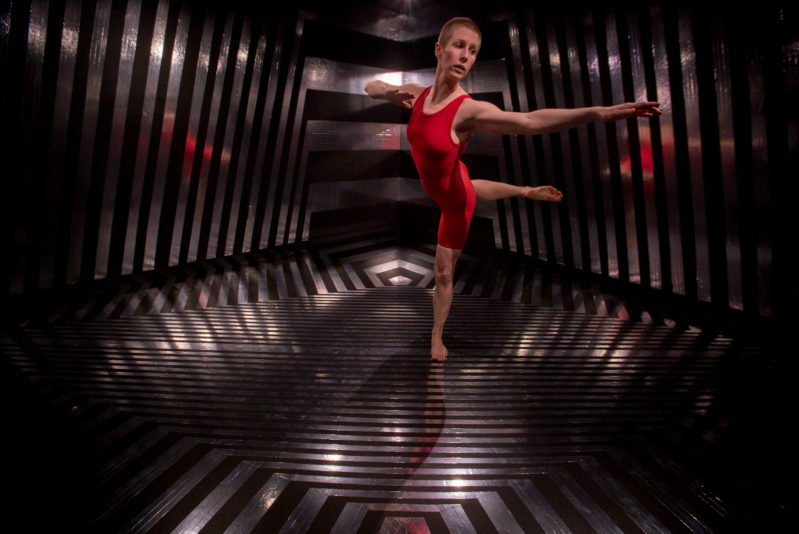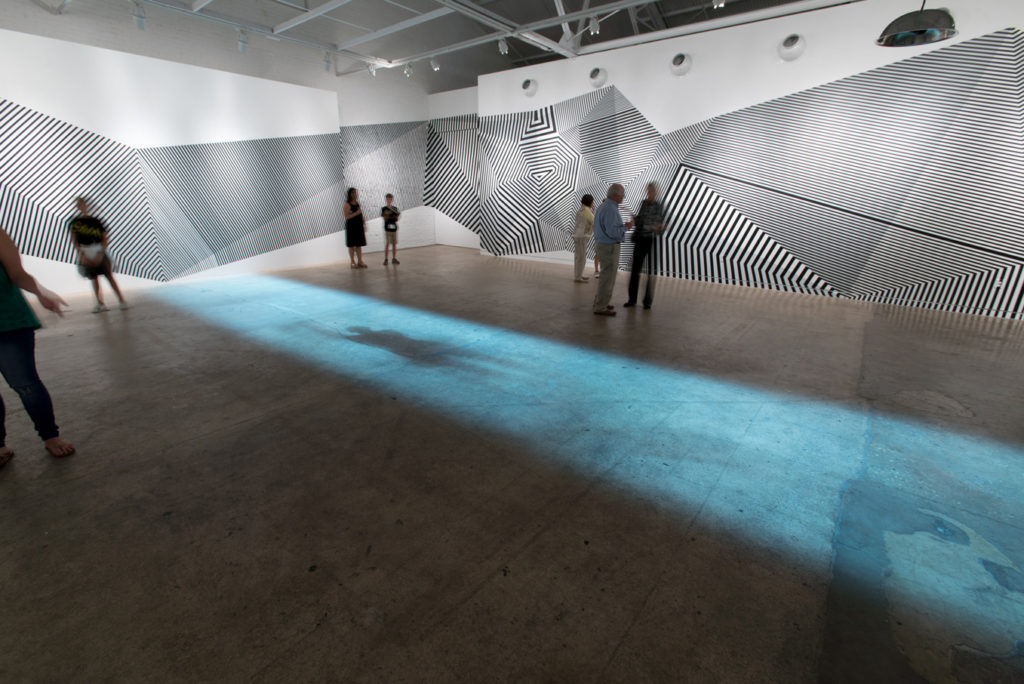
Third Mahato Viz Contest, Deadline Oct. 21

2011 People's Choice "Cold Atom Cloud," by Yinghi Zhang - Duke Graduate Student in Physics

Nearly 5 years after the tragic death of engineering graduate student Abhijit Mahato, the Duke community will once again honor his memory with a photography and visualization contest.

Deadline for entries is October 21, 2012. Rules are here: http://mahato.pratt.duke.edu/contest

This year’s awards ceremony and exhibit of entries will be Nov. 7 at 5 p.m. in Schiciano Auditorium. The keynote speaker at this year’s event will be Kellar Autumn, professor and chair of biology at Lewis & Clark College, who led a research team that discovered the trick gecko feet use to stick to any surface without an adhesive.

The first two contests produced a spectacular collection of beautiful images from scientific research to exotic locations to mundane objects like lightbulbs and jelly glasses viewed in startling new ways.


Learn More: http://mahato.pratt.duke.edu/

Taking a ‘DiVE’ into Neutrinos

Physicists can now analyze neutrino events, such as this one, in 3D. Courtesy: Berkeley Lab.

By Ashley Yeager

Using a virtual, 3D environment, scientists are getting their closest look yet at neutrinos’ interactions with matter.

Neutrinos are subatomic particles that “interact with matter only very rarely, maybe once in your body in your entire lifetime,” said Duke physicist Kate Scholberg during a Sept. 21 talk, which the Visualization Technology Group hosted.

Scholberg explained that to study neutrino interactions, scientists use large, underground detectors, which may only record one event per day. That might not seem significant. But, as Scholberg explained, scientists need to observe the events to determine how the universe developed with more matter than anti-matter, a phenomenon that allows life to exist.

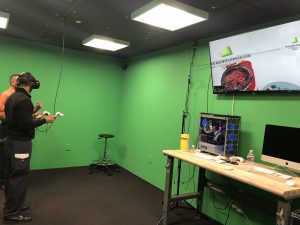
Typically, Scholberg and her colleagues analyze neutrino interactions from their Japan-based detector Super-K in a two-dimensional computer program. Recently, however, Scholberg “stepped” into the Duke immersive Virtual Environment, or DiVE, a six-sided, cave-like, virtual-reality theater programed with data from Super-K.

Inside, Scholberg got her first look at neutrinos interactions in 3D. She was able to see a representation of Super-K and thousands of its light detectors. She could also see data from a recent neutrino event and was able to walk around the detector simulation and visualize the neutrino interaction from all sides. The software had even traced out the “sonic boom” of light, which looks like a circle in two-dimensions and a cone or ring in three-dimensions, given off after a neutrino event.

“This is what I’ve imagined happens a million times after an interaction,” Scholberg said, showing a video of her experience in the DiVE. “It’s entirely different seeing it in 3D,” she said, adding that the drawing of the cone shape of a Cherenkov ring has never been done in a neutrino event display before.

Benjamin Izatt a student at the University of California, Berkeley was the mastermind who developed the 3D neutrino simulation, called Super-KAVE. He designed it to help Duke physicists explain their neutrino research to the public.

But, Scholberg said, the tool may also help her and her collaborators at Super-K better understand complex neutrino interactions and sort out where the particles’ rings and cones overlap. She added that in future simulations, “we may also be able to see particles and interact with the particles, which would be not only fun, but helpful.”

A second crack at the nature of glass

By Ashley Yeager

Glassblowers shape molten silica before the glass transitions from liquid to a more solid structure. Credit: handblownglass.com.

Patrick Charbonneau and his collaborators have taken another crack at understanding the nature of glass. Their latest simulations show that a key assumption of theoretical chemists and physicists to explain the molecular structure of glass is wrong.

Glass forms when liquids are slowly compressed or super-cooled, but don’t crystallize the way cooled water turns to ice. The liquidy pre-cursors to glass, like molten silica, do become hard like a solid, but the atoms in the material don’t organize themselves into a perfect crystal pattern.

The result is a substance that is as hard as a solid but has the molecular arrangement of a liquid — a phenomenon that scientists can’t quite explain, yet.

Previous theories assumed that at the transition point between a liquid and glass, the material’s atoms become caged by each other in a “simple” Gaussian shape. This same shape describes the distribution of people’s height in the U.S. and is known as a bell-shaped curve.

But new simulations, described online Aug. 13 in PNAS, suggest this assumption is wrong. The simulations model the interactions of glass particles in multiple dimensions and show the shape of the particle cage is much more complex than a Gaussian distribution.

The discovery is a “paradigm shift in the sense that so many people have been having the same, wrong, conception for so long, and they should now revisit that basic assumption,” says Charbonneau, a theoretical chemist at Duke. “The assumption was actually constraining how they thought about the problem.”

Even with a new shine on the way scientists think about glass, it is not clear how close or far the theorists are from writing an accurate description of what happens at the liquid-glass transition. But “the path to get there seems clearer than it has been in a long time,” Charbonneau says.

The next step in the research is to understand the relationship between glassy states of matter and those that are jammed, like pieces of cereal wedged in a grain hopper. Charbonneau and collaborators are already at work about how to study the connections between the two forms of matter.

Citation:
“Dimensional study of the caging order parameter at the glass transition.” 2012. Charbonneau, P., et al. PNAS Early Edition. DOI: 10.1073/pnas.1211825109

People, Embedded in a Network

Guest Post By Steve Hartsoe, Office of News & Communications

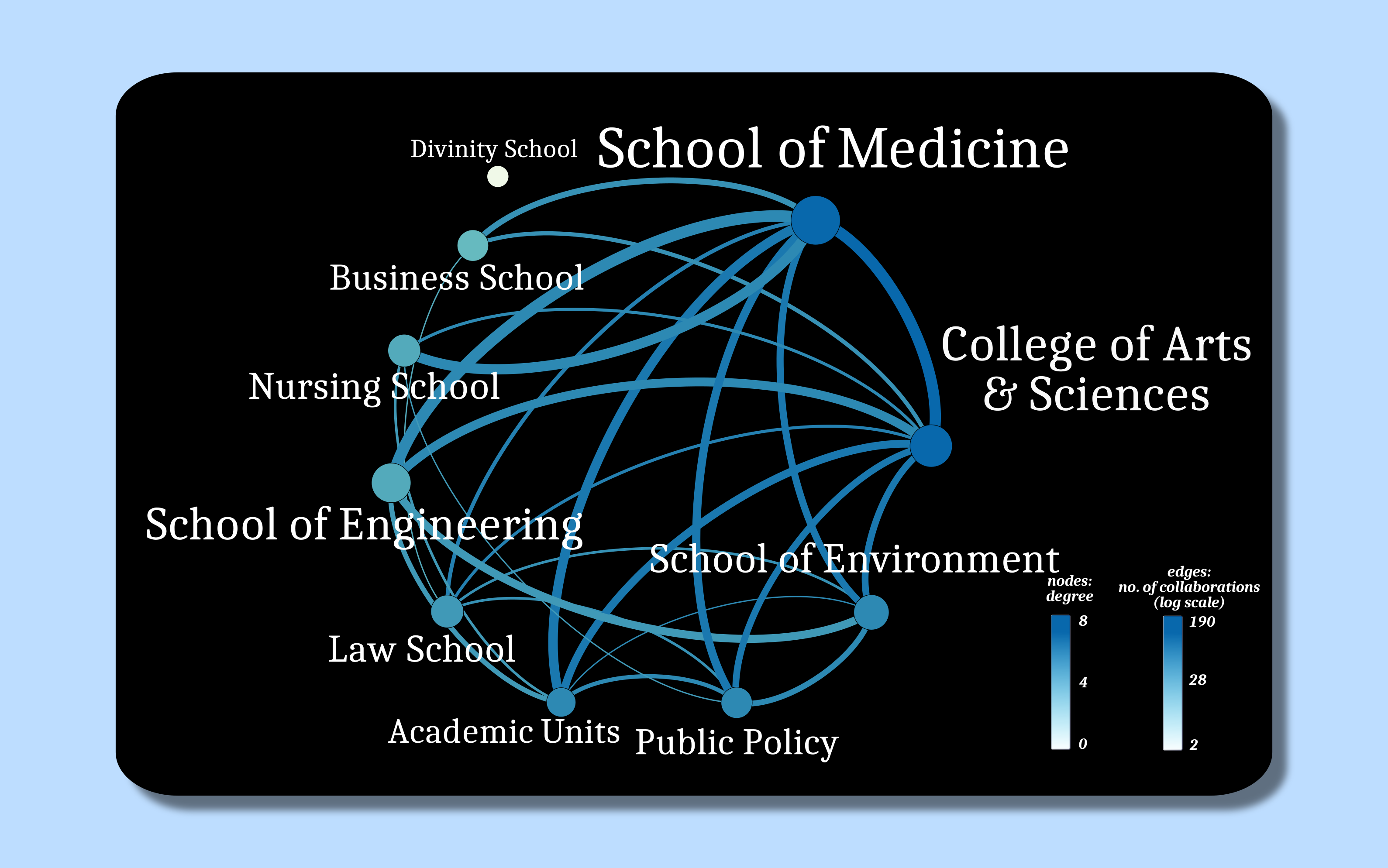
“While social network analysts 20 years ago struggled with networks of hundreds of nodes, we now routinely face networks of hundreds of thousands,” according to James Moody, a Duke sociology professor and director of the school’s Network Analysis Center.

James Moody analyzes networks.

Moody, who was studying social networks long before they became a movie title, says that the abundance of material now available has created new opportunities to test scientific models for cultural behavior. But that growth has also generated a need for new tools and investments in computational social science.

He was one of the featured speakers at an April 26 symposium in Chapel Hill called “Social Networks. Analysis: Opportunities and Realities.” The event also featured  speakers from Duke’s Social Science Research Institute, the University of North Carolina at Chapel Hill’s Odom Institute for Social Science Research, and the iLab at North Carolina A&T State University.

A common thread was how to adapt to the abundance of information now available via the Web, and how to make the best use of high-tech tools for analyzing social networks.

Moody urged the audience to stay focused and consider the merits of working with smaller samples. He also told participants to think of social networks as simply “people embedded in a context.”

An image from one of Moody's earlier studies on social networks.

“There’s a lot of data out there, but a lot of that data doesn’t answer the question you want to answer, right?” Moody said. “So I think there’s a data-question mismatch in some cases.”

Moody also stressed the importance of using the right tools for analyzing social networks. “Don’t trade a good idea for a bad instrument,” he said. “Global networking tools can easily apply to a network of 20 or 30 nodes.”

Speaking remotely via an audio feed, John Haaga, deputy director at the National Institute on Aging, urged researchers seeking federal funding to follow a basic tenet for hitters in baseball: Start smaller “and then swing for the fences.”

More than one attendee in the rapid-fire, three-hour discussion likened it to being on the receiving end of a fire hose of information.

Molecule traps treasure like a kid with M&Ms

By Ashley Yeager

A new guest molecule knocks out the captive one in a cavitand just before it snaps shut. Credit: Lubomir Sebo.

Kids know when they’re going to get a tasty treat like M&Ms. They hold out their hands, palm up, and the snap their fingers around the chocolaty treats like a venus fly trap around a fly.

About a decade ago, Julius Rebek of the Scripps Research Institute in La Jolla, Calif., and his collaborators created a molecule that could do the exact same thing, trapping other molecules in much the same way.

Rebek’s goals was to understand how molecules behave when confined to small spaces. To do this, the chemists created a molecule called a cavitand, which self-assembles through bonds of hydrogen atoms into hand-like structures.

During an April 11 chemistry seminar, Rebek described how the walls or “fingers” of a cavitand use strong hydrogen bonds to curl around and snare another molecule. As a result, prying the cavitand open is a lot like trying to take candy from the closed grip of a child. It can be done but it takes energy and a bit of coaxing.

Rebek said that the cavitands’ finger-based hydrogen bonds can rupture. In response, the molecule then acts like a kid who opens his hand to show his M&Ms to a sibling, tempting her to take some. The captive molecule in the cavitand is exposed, and another can come in and knock it out of place, like a sister throwing something into her brother’s hand to knock out M&Ms for herself. Both the hand and the cavitand clasp shut quickly, taking a new type of treasure into their clutches.

By designing cavitands and other self-assembling molecular traps, chemists have begun to explore the way acids bind when trapped, how to control nano-sized spaces and how to switch molecules in and out of these nanospaces. The discoveries, Rebek said, will help scientists understand the binding and movement of molecules and the nanospaces where life’s most fundamental chemical reactions occur.

Another hint of the Higgs, maybe

By Ashley Yeager

This cartoon shows a "line-up" of possible suspects for the Higgs boson. Click image for a larger view. Credit: Mark Kruse, Duke University.

Scientists may have spotted the Higgs boson again.

But, Duke physicist Mark Kruse says Fermilab has made its latest announcement prematurely.

Physicists have been searching for the Higgs for more than 40 years, hoping to find it and at last explain how mass in the universe is created.

Last year, the Fermilab team announced no significant hint of the particle when it had analyzed about 80 percent of the data from its two Higgs-hunting instruments, CDF and DZero.

Now, after adding the remaining 20 percent of the data, and some analytic improvements, the team is suggesting that Fermilab has seen the particle.

The signal, however, would be “almost fantastically high” if seen with other Higgs detection methods, Kruse says. He is on one of the committees reviewing the analyses from Fermilab’s CDF experiment and once led the instrument’s Higgs Discovery Group.

He also works at LHC, where teams made a similar announcement last December.

A “tremendous amount of work” has gone into the latest Fermilab results, Kruse says. But, the team could have waited for upcoming improvements in the CDF and DZero studies and also worked to better understand the discrepancy between the lab’s latest results and those from last year.

This might, of course, all be sorted out soon, he adds. But, “my feeling is that it was a little soon to make this announcement with the suggested claims we made, without the full results and proper understanding of the present analyses.”

This “rush to announce” mentality may also create a certain amount of distrust in the public eye, Kruse says.

Composing music with Xbox Kinect

By Ashley Yeager

Ken Stewart uses his motions and an XBox Kinect to narrate, musically, a dance by Thomas DeFrantz. Credit: Duke University Dance Program.

To watch Ken Stewart dance in front of his Xbox Kinect gives a whole new meaning to the “Dance Your Ph.D.” contest.

Stewart, a graduate student in the music department and a composer, is using the camera, along with specialized computer software, to narrate dance with sound. He demo’ed the program while walking an audience through his imnewhere, or I’m new here, composition of dance professor Tommy DeFrantz’s journey to Duke.

The Jan. 27 presentation was part of the Visualization Friday Forum and gave attendees a behind-the-scenes look at the research and mathematics behind Stewart’s new, “more expressive way” to write music.

With the Kinect, which has motion-detection technology for interacting with video games, Stewart can transform his gestures into sound, intimately controlling the loudness, pitch and rhythmic intensity of the score he creates. The system records 15 points on a controller’s body, including his head, neck, shoulders, knees and feet.

Using a library of sounds, the controller can then correlate and choreograph a composition, using the computer to calculate angles between his hands or distance between his body and the camera. These angles are converted to become the musical notes.

The work, Stewart says, gives him a way to use his ears and actions to “feel out” a song. He concedes that there are hiccups between how he moves and the sounds created, but, he says he thinks that the imprecision adds to the expressivity of the composing process.

Stewart said he and DeFrantz are still working on imnewhere. They plan to expand the piece to 15 minutes and will perform it again in Grand Rapids, Mich., Berkeley, Calif. and Belfast, UK.

Double-walled nanotubes shine, sometimes

By Ashley Yeager

Double-walled nanotubes

This montage shows modeled and imaged double-walled carbon nanotubes. Courtesy of: Morinobu Endo, Shinshu University.

Nanotubes are tiny, and they can give off light. Those properties make the carbon constructions promising for looking at cells inside our bodies and also making small electrons that can capture and manipulate light.

But recent research suggests that not all nanotubes shine as chemists thought, a discovery that ends a debate in the field about which type of tubes to use for applications relying on their ability to emitted light.

The debate pitted single-walled carbon nanotubes against double-walled ones. Some scientists thought only single-walled tubes could give off light and be used in light-related applications. But other scientists showed that double-walled nanotubes could also emit light and possibly replace their single-walled cousins.

Now, Sungwoo Yang, a former chemistry graduate student at Duke, and his colleagues in Jie Liu’s lab have shown that both single and double-walled carbon nanotubes shine when hit with lasers. But, in the double-walled tubes, only the inner wall emits light and only a small range of diameters of the inner tube could get their light to the outside world. The ones outside of this range gave off light, but it got doused on its way through the outer layer.

Bottom line: Some double-walled carbon nanotubes do emit light but most don’t, if you’re looking for the light outside of the tube. That discovery makes both camps in the nanotube debate correct, depending on the diameter of tube being considered.

CITATION: “Photoluminescence from Inner Walls in Double-Walled Carbon Nanotubes: Some Do, Some Do Not.” Sungwoo Yang, Ashley Parks, Stacey Saba, P. Lee Ferguson, and Jie Liu. Nano Lett., 2011, 11:10, 4405–4410
DOI: 10.1021/nl2025745